Dog food in India: what to buy, by age and size
What to feed a dog in India: the label line that proves a food is complete, what the shelf costs per kilo, and what changes with age and size.

Buy a complete food that matches your dog's life stage, from a brand you can get again next month, and feed measured meals. The rest is detail. Two things deserve your attention: the line on the label that proves the food is complete, and what you pay per kilo.
Key Takeaways
- Check the back of the pack for the line naming the life stage the food is complete for. That is the test.
- The same food costs much more per kilo in a small bag. Compare the per-kilo figure, not the price on the front.
- Home-cooked food is harder to get right than kibble, not easier. Ask a vet to balance the recipe.
*This article is general information, not veterinary advice. If your pet is unwell, please see a vet.*
Dry food, wet food or home-cooked?
Kibble is the practical default here. It keeps in the heat, it is cheap per calorie, and the complete ones are complete. Why vets lean towards dry food sets out the case, and baked food against extruded kibble covers how the stuff is actually made.
Wet food buys you water and appetite. It suits a dog that drinks little, an older dog with bad teeth, or a fussy eater, and it works best spooned over kibble rather than in place of it. The wet food shelf sits beside the dry food shelf, which is where most people should start.
Home-cooked is the option people assume is safest, and it is the one that goes wrong most. Dry food against homemade meals and the fuller comparison of all three lay out the trade. Two things that get added to the home bowl by habit are worth reading on first: milk and the cat's food.
What should the label say?
Turn the pack over. Somewhere in small type sits a sentence saying the food is complete and balanced for a named life stage: growth, adult maintenance, or all life stages. AAFCO, the American body whose wording most packs copy, calls that statement the most important part of a label and the key to matching a dog to a product. If the pack says "for intermittent or supplemental feeding only", it is not a complete meal: feed it as a topper or a treat.
The ingredient list is the part everybody reads and the part that tells you least. The veterinary association that writes the global nutrition guidelines says it gives no information about the quality of what went in. "Real chicken first" is a weaker signal than it looks, though why a named protein matters explains what it does tell you. For the rest, balanced nutrition for dogs and how to choose the healthiest food go further than this page can.
What changes as a dog grows up?
A puppy needs a growth food and an adult needs a maintenance one. The moment to switch is a weight, not a birthday: veterinary guidance puts it at roughly nine-tenths of expected adult weight, which a small dog reaches months before a Labrador does. Picking a puppy food and nutrition by life stage walk through the whole arc, and a steady feeding schedule covers how often.
Two measured meals at set times beats a bowl left out. That is the veterinary recommendation for keeping weight off an adult dog, and it is the one change in this guide that costs nothing.
Does size matter more than breed?
For food, yes. Size sets the kibble, the calories and the growth risk. Breed mostly sets the marketing. The real exception is the large breed puppy, whose growing bones need the most care. Which Royal Canin a large breed puppy needs works through the sizes.
One warning that goes against the usual advice: do not add calcium powder to a large breed puppy's food. Too much calcium is a known risk for growing large and giant breeds (it makes the bone problem osteochondrosis worse), and the vets who write the Merck Veterinary Manual say minerals should not be added without a reason. Ask your vet before adding any supplement. Where supplements genuinely fill a gap is a different question, as is a joint supplement for an older dog.
Which brands are worth the money?
None of them is the best, and a page that names one is guessing. What differs is the price per kilo and what each range is built for.
Pedigree and Drools are the everyday middle: sold everywhere, complete, cheap enough to keep buying for years. The budget shelf gathers the cheapest of those two lines in one place. Royal Canin sells by size and breed and carries the widest veterinary range; Farmina N&D is the grain-free and ancestral-grain end of the shelf. Which Farmina N&D suits your dog and the Henlo review are the detail on those two. If grain-free is the reason you started looking, read the benefits and the risks before you commit.
What will it cost a kilo?
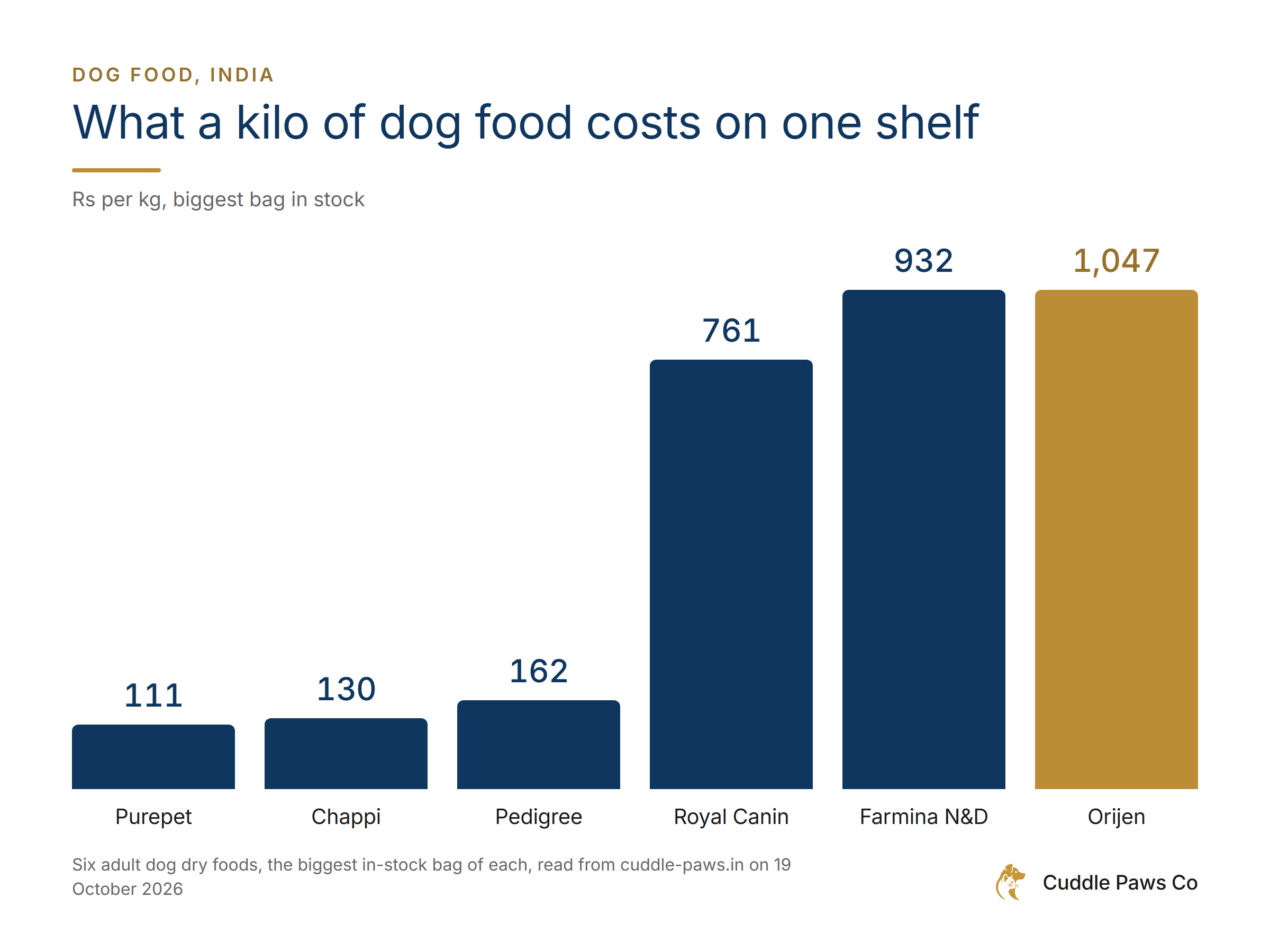
Compare per kilo, never per bag. On our own shelf the biggest bag of Purepet's adult chicken and vegetable food works out at Rs 111 a kilo, and Orijen Original at Rs 1,047. Nine times apart, both complete foods. The chart further down has the ladder in between.
The trap is bag size. That same Purepet is Rs 179 a kilo in a 1kg pack against Rs 111 in the 20kg. Orijen's 340g pouch is Rs 2,015 a kilo against Rs 1,047 for its 17kg bag. Every product page prints the per-kilo figure, so checking takes a second. Buy the biggest bag your dog will finish in about a month, then keep it sealed, because Hyderabad's humidity is what eats the saving. What dog food really costs in India does the monthly arithmetic, and dog food in Hyderabad is the local view.
How do I change my dog's food?
Slowly, over about a week, with more of the new food and less of the old each day. Switching food safely has the steps. A rushed change is the commonest reason a new bag gets blamed for loose stool.
Then give it a month before judging. What a food that is working looks like lists the signs worth watching: firm stool, steady energy, a coat that is not flaking. Energy levels and gut health go deeper on each.
When is a vet diet the right answer?
When a vet has diagnosed something. Kidney diets are made for dogs a vet has diagnosed with kidney disease, and your vet chooses which one (VCA Animal Hospitals). A weight-loss food cuts calories but still gives the other nutrients; a normal food fed in smaller amounts can leave a dog short. An allergy trial feeds only one new protein or a hydrolysed-protein food, for 8 to 12 weeks for skin signs (Merck Veterinary Manual). None of these is an upgrade on ordinary food. Buying one without a diagnosis means paying premium money for a food your dog does not need. The veterinary diet shelf holds diets a vet prescribes for a condition, and veterinary dog food in India explains the categories. If your dog is unwell, the vet comes before the bag.
The research behind this
| Food | Biggest bag in stock | Price | Rs per kg |
|---|---|---|---|
| Purepet Chicken & Vegetable Adult | 20kg | Rs 2,213 | 111 |
| Chappi Chicken & Rice Adult | 20kg | Rs 2,604 | 130 |
| Pedigree Chicken and Vegetables Adult | 20kg | Rs 3,231 | 162 |
| Royal Canin Medium Adult | 20kg (2x10kg) | Rs 15,224 | 761 |
| Farmina N&D Chicken & Pomegranate Adult Medium Maxi | 7.5kg (3x2.5kg) | Rs 6,993 | 932 |
| Orijen Original | 17kg | Rs 17,800 | 1,047 |
Six adult dog dry foods, the biggest in-stock bag of each, read from cuddle-paws.in on 19 October 2026, from the dry dog food collection. Each of those product pages prints its own per-kilo figure, so every row here can be checked in one click: Chappi, Pedigree, Royal Canin Medium Adult and Farmina N&D Chicken & Pomegranate. Two caveats. The Farmina row is its 7.5kg pack because the 15kg bag is sold out, and a smaller pack always reads dearer per kilo, so that bar flatters neither Farmina nor the comparison. And this is one shop's shelf on one day, not a national average; across all 633 in-stock dry food bags that carry a weight the span runs from Rs 109 to Rs 2,015 a kilo.
On what Indian dogs actually eat, the most useful recent work is a survey published in the Indian Journal of Animal Nutrition (Beigh, Akhter, Ganai, Ahmad and Farooq, vol. 42 no. 3, published January 2026), covering 91 adult pet dogs in Central Kashmir with 26 feed samples and 73 blood samples. It reports that "Mostly (~63%) the pet dogs were reared on homemade diets with about 90% receiving non-vegetarian type, and only ~5% were exclusively fed commercial dog feeds of different brands", that those homemade diets "had wide variation in composition and were generally imbalanced", and that "there was wider prevalence of calcium deficiency especially in pet dogs fed homemade diets". On the commercial samples it found that the "Percentage of available commercial dog feed samples having nutrient composition below than the recommended standards were 19%, 15%, 31%, 12% and 15% for protein, fat, fibre and calcium, total ash, and phosphorus, respectively." Read it as one region's picture rather than the country's, and note that the sentence listing those five figures names six nutrients, so the mapping of the last two is unclear in the paper as published. Its own recommendation is that owners "consult the animal nutritionist /veterinarian to make proper diet charts".
On the label, the AAFCO guide to reading labels states that "The nutritional adequacy statement is perhaps the most important part of a label. It is the key to matching a pet's nutritional needs with a product", and that ingredients "must be listed in descending order according to their weight". The WSAVA Global Nutrition Committee is the source for the point about ingredient lists: "Most pet owners consider the ingredient list to be the most important factor in choosing a pet food. However, the ingredient list gives no information on the quality of the ingredients."
The life stage and feeding advice comes from the Merck Veterinary Manual. Its page on nutritional requirements of small animals, last reviewed November 2023 and updated September 2024, states that "Nutritional problems occur most commonly when dogs and cats are fed unbalanced homemade diets", that "Dogs and cats require specific dietary nutrient concentrations based on their life stage", and on the calcium warning, that "Excessive supplementation (> 3% calcium) causes more severe clinical signs of osteochondrosis...in young, rapidly growing large-breed dogs". Its page on feeding practices in small animals, updated October 2024, is the source for the switch off puppy food, "After a dog has reached ~90% of its expected adult weight, a diet less nutrient dense than the growth diet is generally recommended", and for measured meals, "The best feeding regimen to use in most adult dogs to prevent obesity is portion-controlled feeding, eg, feeding two premeasured meals at regular times each day". On diets for a diagnosed problem, its page on nutrition in disease management, updated June 2025, describes therapeutic weight-loss diets as "formulated to be restricted in calories while providing other nutrients in appropriate amounts", and a food allergy trial diet as one "using a single novel protein source or a hydrolyzed protein diet".
One gap worth naming. Three of those five sources are American or international, and none describes Indian licensing or Indian labelling law. What they can tell you is what a dog needs and what a label is for, which does not change with the country. The Kashmir survey is the only Indian evidence here, and one region is not the whole market.
Frequently Asked Questions
How much does dog food cost in India?
Per kilo, complete dry food on our shelf runs from about Rs 109 to about Rs 2,015, and the big bags of the everyday brands sit near the bottom of that. What you pay a month depends far more on your dog's size than on the brand, since a large dog eats several times what a small one does.
Is a 20kg bag cheaper than smaller packs?
Almost always, and by more than people expect. The same Purepet adult food is Rs 111 a kilo in its 20kg bag and Rs 179 a kilo in a 1kg pack. The only reason to buy small is if your dog cannot finish a big bag within a month or so, because opened kibble goes stale and soft in this humidity.
Is grain-free dog food better for my dog?
Not by default. Grain-free suits a dog with a diagnosed problem with a particular grain, which is uncommon, and it costs more. A complete food with grain in it is a complete food. Our guide to the benefits and the risks goes through the evidence either way.
Can I feed my dog only home-cooked food?
Yes, if someone qualified balances the recipe. In one Indian survey, of pet dogs in Central Kashmir, most homemade diets were imbalanced and calcium deficiency showed up in the blood of dogs fed them. Ask a vet or an animal nutritionist for a written diet chart rather than following a recipe off the internet.
Is Pedigree bad for dogs?
No. It is a complete food, it is sold everywhere, and for most healthy adult dogs it does the job at a price their owner can keep paying. A food your dog eats and you can buy again next month beats a better food you give up on.
अक्सर पूछे जाने वाले सवाल
कुत्ते का खाना चुनते समय पैक पर क्या देखना चाहिए?
पैक को पलटकर पीछे देखें। छोटे अक्षरों में एक लाइन होती है जो बताती है कि यह खाना किस उम्र के लिए पूरा और संतुलित है - puppy यानी growth, adult maintenance, या all life stages। अगर पैक पर "for intermittent or supplemental feeding only" लिखा है, तो वह पूरा खाना नहीं है; उसे topper या treat की तरह दें। सामने लिखी बातें और तस्वीरें इससे कम मायने रखती हैं।
घर का बना खाना कुत्ते के लिए ठीक है या नहीं?
ठीक है, लेकिन सिर्फ तब जब कोई जानकार उसका चार्ट बनाए। कश्मीर में हुए एक सर्वे में ज़्यादातर घरेलू खाना असंतुलित पाया गया, और घर का खाना खाने वाले कुत्तों के खून में कैल्शियम की कमी ज़्यादा मिली। इंटरनेट की रेसिपी के बजाय वेट या animal nutritionist से लिखा हुआ डाइट चार्ट लें।
बड़ी बोरी लेना सस्ता पड़ता है क्या?
हां, और फर्क काफी बड़ा होता है। वही Purepet का खाना 20kg की बोरी में करीब Rs 111 प्रति किलो पड़ता है और 1kg के पैक में करीब Rs 179 प्रति किलो। हर प्रोडक्ट पेज पर प्रति किलो का रेट लिखा रहता है, इसलिए तुलना करना आसान है। छोटा पैक सिर्फ तब लें जब आपका कुत्ता महीने भर में बड़ी बोरी खत्म न कर पाए, क्योंकि खुली हुई किबल हैदराबाद की नमी में जल्दी खराब होती है।
Sources
- Welfare Evaluation of Pet Dogs Through Feeding Protocols Followed, Nutritional Composition of Available Feeds and Blood Metabolic Profile, Beigh, Akhter, Ganai, Ahmad and Farooq, Indian Journal of Animal Nutrition (ICAR), vol. 42 no. 3, published January 2026
- Reading Labels, Association of American Feed Control Officials (AAFCO)
- Nutrition Guidelines, World Small Animal Veterinary Association (WSAVA) Global Nutrition Committee
- Nutritional Requirements of Small Animals, Merck Veterinary Manual, reviewed November 2023, updated September 2024
- Feeding Practices in Small Animals, Merck Veterinary Manual, updated October 2024
- Nutrition in Disease Management in Small Animals, Merck Veterinary Manual, updated June 2025
- Nutrition for Dogs with Chronic Kidney Disease, VCA Animal Hospitals, updated 3 March 2025
- Dry Dog Food, Cuddle Paws Co, prices read 19 October 2026
*This article is general information, not veterinary advice. If your pet is unwell, please see a vet.*
Prices are current as of October 2026 and do change. The figure on each product page is the live one.