How to Stop Your Dog from Pulling on the Leash
Leash pulling turns every walk into a battle — and it does not have to. Here is what actually works.
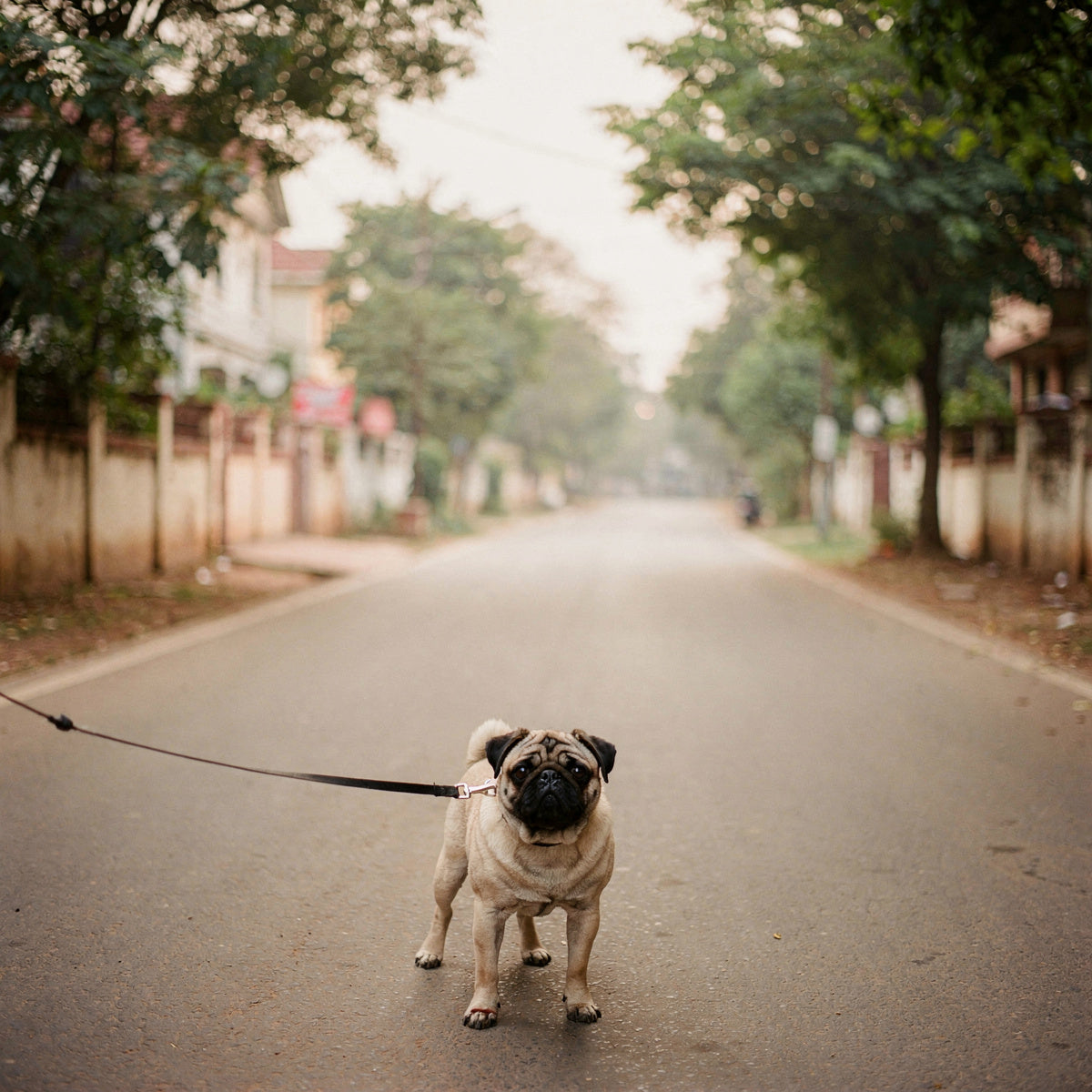
If your morning walk feels less like exercise and more like being towed behind a small truck, you are not alone. Leash pulling is one of the most common problems dog owners have, and it can be fixed with the right gear and a few weeks of consistent practice.
This article is general information, not veterinary advice. If your pet is unwell, please see a vet.
Why does my dog pull on the leash in the first place?
Before jumping into fixes, it helps to understand what is actually happening in your dog's head. Dogs do not pull to dominate you or be difficult. They pull because walking on a leash is genuinely unnatural for them, and no one ever taught them the alternative.
Think about it from their perspective. Their sense of smell is far stronger than ours. Every walk is an overwhelming stream of information — other dogs, food smells from the chaat stall down the road, a cat hiding under a car. Their body wants to go now. The leash says no. So they pull harder.
Excitement is the biggest driver. But there is also simple habit reinforcement at play. If pulling has historically gotten your dog to the park faster, or to that interesting bush sooner, your dog has learned that pulling works. Dogs repeat what works. So the first job is to make pulling not work anymore.
There is also a third scenario, common with rescue dogs and dogs who were walked on retractable leashes early on — they genuinely do not know that a loose leash is even an option. Nobody ever showed them.
Start here: get the right equipment before anything else
Gear is where many people go wrong. They struggle with leash pulling for months while using a thin nylon collar and a two-metre leash. The right gear does not train your dog for you, but the wrong gear will absolutely work against you.
For dogs who pull, a front-clip harness is usually the best starting point. The leash attaches at the chest rather than the back, so when your dog lunges forward, the harness naturally redirects them back toward you instead of letting them use their full body weight to drag forward. It is not magic, but it genuinely changes the physics of the situation in your favour. You can browse our range of harnesses if you want to see what fits your dog's size and build.
If your dog is particularly strong or reactive, a no-pull harness with both a front and back clip gives you even more control. Our no-pull harness collection was sold out when this was written, so check it before you count on one. The main harness collection had 42 harnesses for dogs and cats in stock that day, from about Rs 250 to about Rs 3,300.
On leash length — stick to 4 to 6 feet. Retractable leashes teach dogs that the leash tension changing means nothing, which is the exact opposite of what you want to communicate during training. Leave the retractable at home for now.
The single most effective technique: stop walking the moment the leash goes tight
This sounds almost too simple, but it is the foundation of loose-leash walking and it works. The rule is straightforward: a tight leash means you stop. A loose leash means you move forward. You are teaching your dog that the leash tension itself carries information.
The moment your dog pulls, stop walking completely. Do not jerk back, do not yell. Just become a statue. Wait. Your dog will eventually look back at you — often with an expression that suggests mild offence — and the moment they do and the leash goes slack, you start walking again. Repeat this every single time the leash tightens.
For the first few sessions, you might only make it ten metres before stopping. That is fine. The walk takes longer, yes. But you are building a completely new understanding of what the leash means. Within a week of consistent practice, most dogs start to figure out that pulling literally gets them nowhere.
Pair this with marking the loose-leash moments. When your dog is walking calmly beside you with a relaxed leash, say something like "yes" or "good" in a calm, warm tone and reward with a small treat or simply praise. You are reinforcing the right behaviour, not just punishing the wrong one.
Does my dog need obedience commands to walk nicely on leash?
Not strictly, but they help enormously. "Look at me" or "watch" is probably the most useful one for leash walking. If your dog can redirect their attention to your face on command, you have a tool to use before they lock onto a distraction and start pulling toward it.
Practice this at home first, with no distractions. Hold a treat near your face, say "look", reward when they make eye contact. Once they understand it indoors, take it outside. The goal is to use it proactively — you spot a dog approaching on the footpath, you ask for "look", you reward, you walk past calmly. You stayed ahead of the pull.
"Heel" or whatever word you choose for walking position is also worth teaching separately. But honestly, in Hyderabad's busy streets and apartment complexes, a dog who simply walks without a tight leash is already a huge win. You do not need to create a show dog.
Train in boring places first, then add difficulty
Here is something most people skip: they try to train leash manners in the most distracting environment possible, like the main road during evening rush hour in Gachibowli, and then wonder why their dog cannot focus. That is not fair on the dog.
Start practicing in your apartment corridor or stairwell. Then move to a quiet corner of your building's parking area. Then try a quieter street at an off-peak hour. Gradually increase the level of distraction as your dog gets consistent at each stage. This progression is not slow — it actually produces faster results than throwing a dog into chaos and hoping for the best.
If your building has a terrace or a quiet ground-floor walkway, those are genuinely ideal training spots for the first couple of weeks.
Common mistakes that set training back
The biggest one is inconsistency. If pulling works sometimes — say, when you are in a hurry and just let the dog drag you to the gate — you have just undone a week of training. Dogs are always learning. When the rule is sometimes enforced and sometimes ignored, they test it constantly.
The second mistake is accidentally rewarding the pull. If you tug back on the leash every time your dog pulls, you are giving them something to pull against. Some dogs find this stimulating rather than discouraging. Stop instead of tug-of-warring.
The third one is starting training sessions when the dog is already bouncing off the walls. A dog who has been inside all day and desperately needs to run is not in the right state to learn leash manners. Give them five minutes of fetch or a bit of rough play first to take the edge off, then start the training portion of the walk.
When should I get a trainer involved?
If your dog is reactive — meaning they lunge or bark aggressively at other dogs, people, or vehicles — that is a different challenge from regular pulling, and we would genuinely recommend working with a qualified behaviourist. Reactive behaviour has an anxiety or fear component that pure leash training does not address on its own.
Similarly, if your dog is large enough to actually injure you, or if you have been consistent with training for four to six weeks and seen no improvement at all, a professional can watch what is happening in real time and spot things that are hard to diagnose from a blog post.
You can also speak to our team in store or get in touch via our contact page.
What you actually gain when your dog walks well on leash
Beyond the obvious — no more sore shoulders, no more embarrassing scenes at the park — a dog who walks calmly on leash is a dog who gets walked more often. That matters. Dogs who get regular, calm walks are generally less anxious and less destructive at home. The training investment pays back in quality of life for both of you.
It also opens up more of the city to you. Restaurants with outdoor seating, visits to friends' homes, walks through busy markets — none of that is enjoyable with a dog who is constantly straining forward. Teaching leash manners is genuinely one of the highest-return things you can do as a dog owner.
If you are looking for the right gear to get started, explore our full range of leashes and harnesses at Cuddle Paws Co. Our team at our Hyderabad shop is always happy to help you find the right fit for your dog specifically — breed, size, and temperament all matter when choosing training equipment.
Prices are current as of October 2026 and do change. The figure on each product page is the live one.
Frequently asked questions
My dog only pulls when they see other dogs. Is this still a leash training issue?
Partially. What you are describing sounds like leash reactivity, which has a different root cause — usually over-arousal or mild fear — compared to everyday pulling. The loose-leash techniques still help, but you will also need to work on your dog's emotional response to other dogs specifically. A "look at me" command and careful distance management when passing other dogs is a good starting point. If the reaction is intense, a trainer helps.
Can I use a choke chain or slip collar to stop pulling?
We do not recommend them, especially for everyday training. They can injure a dog's neck, and they work by causing discomfort rather than teaching your dog anything. A front-clip harness gives you better control with none of the risk. There are very specific professional contexts where slip leads are used correctly, but for a regular pet owner trying to sort out leash manners, there are safer and more effective options.
My Labrador is three years old and has pulled since he was a puppy. Is it too late to retrain?
Not at all. An ingrained habit takes longer, often a few weeks of very consistent work, but older dogs can and do change behaviour. The key is that the rules have to be consistent every single walk, every single time. Patchy training with an adult dog with years of pulling habits is what usually does not work.
Should I use treats during leash training or is it bribery?
Treats are a training tool, not a bribe. A bribe is giving the treat to get the dog to stop doing something bad. A reward is giving the treat after the dog has done something right. Use small, high-value treats during active training sessions — a tiny piece of paneer or chicken works well for most dogs. Once the behaviour is solid, you phase the treats out gradually. You do not need to carry a treat pouch on every walk for the rest of your dog's life.
This article is general information, not veterinary advice. If your pet is unwell, please see a vet.