Which Farmina N&D should your dog eat?
Five lines on the shelf and one real decision. Which Farmina N&D your dog needs, and what each bag costs per kilo in Hyderabad.
Pick your Farmina bag by your dog's size and age, not by the words on the front. For a healthy dog the Ancestral Grain chicken bag and the grain-free Pumpkin one carry the same protein and fat for about the same money. Grain-free here is a choice, not an upgrade.
Key Takeaways
- Size band first, then life stage. Mini is the small-dog bag and Medium & Maxi covers everything bigger.
- The two adult chicken bags carry the same protein and fat on the label, so buy the cheaper pack.
- The Quinoa bags are for a diagnosed problem: skin, digestion or weight. They cost around half again more.
Which Farmina bag does my dog need?
Two things decide it, and neither is the biggest word on the front.
First the size band. Farmina splits its dog food into Mini for small dogs and Medium & Maxi for everything bigger. The feeding chart on the back of the bag is printed by weight, so check your dog against that rather than guessing from the picture.
Then the life stage. Starter is a weaning food and Farmina's own page gives it up to two months, so a puppy that came home at eight or nine weeks is already past it. Puppy runs through growth and Adult comes after. The stage moves the label more than the line does: the puppy chicken bag carries clearly more protein and more fat than the adult version of the same recipe. A growing dog on the adult bag is being short-changed even though the name on the front is identical.
Here is what we stock, and what each works out to per kilo:
| Bag | Who it is for | Pack we stock | Per kilo |
|---|---|---|---|
| Ancestral Grain Chicken & Pomegranate Puppy Medium & Maxi | growing dogs that will not stay small | Rs 8,451 for 12kg | Rs 704 |
| Ancestral Grain Chicken & Pomegranate Adult Medium & Maxi | adult dogs, medium and large | Rs 6,993 for 7.5kg | Rs 932 |
| Ancestral Grain Chicken & Pomegranate Adult Mini | adult small dogs | Rs 6,428 for 7kg | Rs 918 |
| Pumpkin Chicken & Pomegranate Grain Free Adult Medium & Maxi | the grain-free version of the same recipe | Rs 10,385 for 12kg | Rs 865 |
| Ocean Codfish Orange & Pumpkin Adult Medium & Maxi | dogs that react to chicken | Rs 10,450 for 12kg | Rs 871 |
Those are the bags most dogs here end up on. The rest of the range, including the senior bag and the functional ones, is on the Farmina N&D shelf.
Is the grain-free bag better food?
No. On Farmina's own India pages, the Ancestral Grain chicken bag and the grain-free Pumpkin chicken bag carry the same crude protein, the same crude fat and the same fibre. If you came to the shelf expecting the grain-free one to be stronger food, that is what the category sells and not what the label says.
What genuinely differs is the carbohydrate. The Ancestral Grain bag uses spelt and oats. The grain-free bag uses pea starch, listed third, ahead of the chicken fat. The pumpkin it is named after sits well down the list and is a small part of the recipe.
Price does not separate them either. The one place the grain-free bag wins is pack size: we stock it in a twelve-kilo where the grain bag stops at seven and a half, which makes the big grain-free sack slightly cheaper per kilo than the biggest grain one.
So which bag should my dog be on?
For a healthy dog with nothing particular wrong, buy the Ancestral Grain chicken bag in the size and stage that fits, or the grain-free one if that is the one your dog clears the bowl for. Then buy the largest pack your dog will finish inside a month.
Buy grain-free on purpose when there is a reason. Your vet has asked you to take grain out. Or your dog has been through a proper elimination diet and grain came out of it badly. Ocean is the one to try when the trouble is chicken rather than grain, because it is fish from front to back.
Stay on the spelt-and-oats bag if your dog has a heart murmur or anything cardiac on its record. That is not because the grain-free food is known to be dangerous, and the research below does not say it is. It is that the one unresolved question hanging over grain-free dog food is about pulses, pea starch is a pulse, and when two bags carry the same protein and fat at the same money there is nothing to gain from taking the open question. If your dog is coughing, tiring on short walks or breathing fast while resting, that is a vet with a stethoscope rather than a change of bag.
What are the Quinoa bags for?
One named problem each: skin and coat, digestion, weight, or a neutered dog. They are the limited-ingredient range, built around a single meat and quinoa instead of grain, and they are the most expensive dog food in the brand on our shelf by a wide margin.
Buy one when a vet has named the thing it is for. A dog with a dull coat after the rains is not automatically a skin-and-coat dog, and the usual causes here are fleas, a thyroid problem or a bath every week. Those get fixed, not fed around.
What matters more than the bag?
Three things, in this order.
The amount. Weigh the food or use the same scoop every time, and split the day into two meals. Treats come out of that total rather than sitting on top of it. A dog you can keep lean is the single biggest thing you control, and no bag corrects a full bowl.
The changeover. Any new food goes in over about a week, a little more of it each day. Most of the upset stomachs blamed on a new food are really the speed of the switch.
Storage. A twelve-kilo sack in Hyderabad humidity will go stale, and the fat in it turns first, before a medium dog finishes it. Decant into an airtight box, keep the bag itself inside, and store it off the floor where the ants are. Smaller packs cost more per kilo and waste less, which is a fair trade if your dog is small.
One local note on the shelf itself. Our product title for the grain bag does not say Ancestral Grain on it, so the two adult chicken bags look almost identical online. The table above is the reliable way to tell them apart, and at the counter we will just show you both.
The research behind this
The two bags, in the manufacturer's own words. Farmina India gives the composition of N&D Low Ancestral Grain Chicken & Pomegranate Adult Medium & Maxi as "Boneless chicken (20%), dehydrated chicken protein (18%), spelt (10%), oats (10%), chicken fat, dried eggs, herring, dehydrated herring protein, dried beet pulp, fish oil (from herring)", with crude protein 30.00%, crude fat 18.00% and crude fibre 2.90%. The grain-free bag, N&D Pumpkin Chicken & Pomegranate Adult Medium & Maxi, is "Boneless chicken (24%), dehydrated chicken protein (22%), pea starch, chicken fat, dried pumpkin (5%), dried eggs, herring, dehydrated herring protein, fish oil (from herring), pea fibre", at "Crude protein 30%, crude fat 18%, crude fibre 2.9%". Identical on all three. The puppy version of the grain bag is a genuine step up: "Crude protein: 35.00% Crude fat: 20.00% Crude fiber: 1.70% Calcium: 1.10% Phosphorus: 0.91%". Farmina lists both adult products in 2.5kg and 12kg only. The Starter bag, which sits before the puppy one, is described as a "Complete food for puppies during weaning up to two months of age" at 30.00% protein and 22.00% fat, so a puppy collected at eight or nine weeks has already outgrown it.
What Farmina says the lines are. From its India FAQ, the split is about cereals and where the protein comes from, not about protein level. "N&D PUMPKIN is the line of Farmina food without cereals, with 96% of protein from animal origin and with Pumpkin, rich in soluble fiber." Ancestral Grain "features the use of a few ancestral cereals that allow for a gradual release of energy", Ocean carries "animal protein only from selected seafood", and Quinoa is "made with Quinoa, a high-quality protein source, and contains a limited number of ingredients". The fifth line, Prime, at "98% of protein from animal origin", is the one most English-language guides compare against Ancestral Grain, quoting it at 36 to 44% protein. On our shelf Prime is cat food only, which is why the protein gap those guides describe does not appear between the two dog bags here.
Does the starch change the dog?
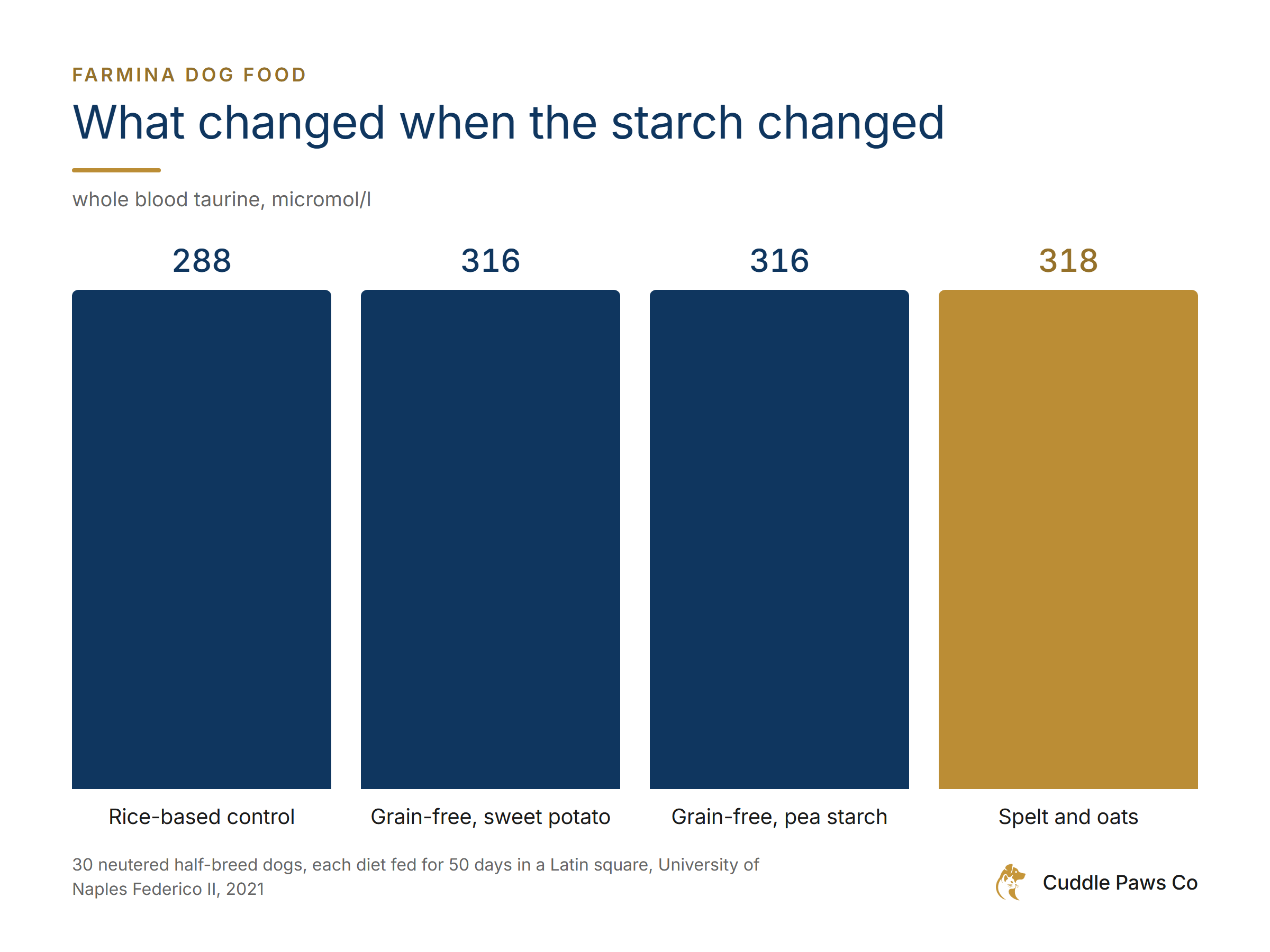
| Diet | Whole blood taurine, micromol/l |
|---|---|
| Rice-based control | 288 |
| Grain-free, sweet potato | 316 |
| Grain-free, pea starch | 316 |
| Spelt and oats | 318 |
Population: 30 neutered half-breed dogs, each diet fed for 50 days in a Latin square, University of Naples Federico II, 2021. Source: Gizzarelli and others, Clinical Findings in Healthy Dogs Fed With Diets Characterized by Different Carbohydrates Sources, Frontiers in Veterinary Science, 2021.
Three caveats, and the first is the one that matters. The trial "was partially supported by Farmina Pet Food (Nola, Italia)", and the test diets' ingredient lists match Farmina's own recipes closely enough that this is the manufacturer's food being measured. Second, the paper reports the differences as not significant. Its words are that "taurine levels were not significantly affected by the administered diet", and every group sat above the reserve levels it cites, "optimal reserve levels indicated by FEDIAF (>40 nmol/l in plasma and >200 nmol/l in whole blood)". Third, the control diet was a rice-and-meal food rather than a fourth N&D recipe, so only the three bars on the right are the comparison you face on the shelf. Blood glucose moved as little as taurine did: 5.03 mmol/l on the control against 4.94 on the pea-starch diet and 4.95 on the spelt-and-oats one.
A second look at taurine, without a pet food company behind it. Eight Labrador Retrievers were fed a commercial grain-free diet for twenty-six weeks in a monadic feeding study. Taurine went up rather than down: "plasma His, Met, Trp, and taurine and whole blood taurine concentrations increased over the course of the study", plasma taurine from 107 to 192 nmol/mL and whole blood from 186 to 295 nmol/mL. Faecal bile acid concentrations rose, and at week 26 "were 1.56 times greater". The authors' conclusion is that the diet "does not affect taurine status or gross indicators of health over a 26-wk period". Eight dogs, one brand of food, and no cardiac imaging, so it settles nothing by itself. Different laboratory and different dogs from the Italian trial too, so read the two as separate studies rather than one scale.
Where the grain-free worry comes from. The US Food and Drug Administration began collecting reports in 2018. "Between January 1, 2014 and April 30, 2019, the FDA received 524 reports of DCM". DCM is dilated cardiomyopathy, a disease in which the heart muscle stretches and pumps weakly. "More than 90 percent of products were 'grain-free'" and "93 percent of reported products had peas and/or lentils". That is a signal worth knowing about and it is not a finding: the agency said plainly that such numbers "do not supply sufficient data to establish a causal relationship with reported product(s)", and described the question as "a complex scientific issue that may involve multiple factors". In December 2022 it stopped publishing updates, saying it "does not intend to release further public updates until there is meaningful new scientific information to share". Nothing has changed since, in either direction.
Prices. Every rupee figure above was read off our own live product pages on 1 October 2026. The per-kilo figures are ours, worked out from the pack prices.
Frequently Asked Questions
Is Farmina N&D grain free?
Some of it. Pumpkin, Ocean and Quinoa are the grain-free lines and Ancestral Grain is the one with grain in it, which Farmina lists as spelt and oats at ten per cent each. The composition on the back of the bag settles it in a second.
Which Farmina N&D should a puppy eat?
The puppy bag in your dog's size band, which for anything that will not stay small is Ancestral Grain Chicken & Pomegranate Puppy Medium & Maxi. It carries five percentage points more protein than the adult version of the same recipe. Starter is not it: Farmina describes that one as a weaning food for puppies up to two months of age.
Is Farmina N&D worth the price for a dog?
It earns it as food. Whether the grain-free bag earns a premium over the grain one is a different question, and on this shelf the answer is no: the two chicken bags carry the same protein and fat and cost about the same per kilo.
Does grain-free dog food cause heart problems in dogs?
Nobody has shown that it does. The FDA collected several hundred reports of heart disease in dogs eating mostly grain-free, mostly pulse-heavy food, never established cause, and stopped publishing updates in 2022. If your dog has a cardiac history, choose the bag with grain in it and talk to your vet, since on this shelf it costs you nothing to do so.
Which Farmina bag suits a small dog?
The Mini bags. Ancestral Grain Chicken & Pomegranate Adult Mini is the everyday one, and because a small dog gets through a bag slowly, the smaller pack is often the better buy here even though it costs more per kilo.
अक्सर पूछे जाने वाले सवाल
Farmina N&D में grain free कौन सा है?
Pumpkin, Ocean और Quinoa वाली रेंज grain free है। Ancestral Grain वाले पैकेट में अनाज है, और Farmina की अपनी वेबसाइट उसमें spelt और oats दोनों दस-दस प्रतिशत लिखती है। पैकेट पलटकर सामग्री की सूची पढ़ लीजिए, जवाब वहीं मिल जाएगा।
मेरे कुत्ते के लिए कौन सा Farmina पैकेट लें?
पहले आकार देखिए, फिर उम्र। छोटे कुत्तों के लिए Mini, उससे बड़े सबके लिए Medium और Maxi, और बढ़ते पिल्ले के लिए puppy वाला पैकेट, जिसमें प्रोटीन और चर्बी दोनों ज़्यादा हैं। सामने लिखे शब्दों से मत चुनिए।
grain free खाना ज़्यादा अच्छा होता है क्या?
सेहतमंद कुत्ते के लिए नहीं। चिकन वाले दोनों पैकेट, grain वाला और grain free, लेबल पर एक ही प्रोटीन और एक ही चर्बी देते हैं और दाम भी प्रति किलो लगभग बराबर है। फ़र्क़ सिर्फ़ इतना है कि एक में spelt और oats हैं, दूसरे में pea starch।
Sources
- N&D Low Ancestral Grain canine, Chicken & Pomegranate adult medium & maxi — Farmina Pet Foods India
- N&D Low Ancestral Grain canine, Chicken & Pomegranate Puppy Medium & Maxi — Farmina Pet Foods India
- N&D Low Ancestral Grain canine, Chicken & Pomegranate Starter Puppy — Farmina Pet Foods India
- N&D Pumpkin Grain Free Canine, Chicken and Pomegranate Adult Medium & Maxi — Farmina Pet Foods India
- Frequently Asked Questions — Farmina Pet Foods India
- Clinical Findings in Healthy Dogs Fed With Diets Characterized by Different Carbohydrates Sources, 2021 — Frontiers in Veterinary Science
- A commercial grain-free diet does not decrease plasma amino acids and taurine status but increases bile acid excretion when fed to Labrador Retrievers, 2020 — Translational Animal Science
- FDA Investigation into Potential Link between Certain Diets and Canine Dilated Cardiomyopathy — U.S. Food and Drug Administration
- Farmina N&D Prime vs Ancestral Grain for Canadian Dogs 2026 — Ashario Pets, cited as the source of the higher-protein claim, not as evidence for it
Prices are current as of October 2026 and do change. The figure on each product page is the live one.