Which Royal Canin does a large breed puppy need?
Maxi Puppy for a 26-44kg adult, Starter only to two months, and what the breed bag really adds. Plus how much to feed a big puppy.
If your puppy will grow past 26 kg, the bag you want is Royal Canin Maxi Puppy. Starter is a weaning food and stops being useful at about two months. The breed bag with your dog's picture on it is optional. How much you feed matters more than which one you pick.
Key Takeaways
- Choose the bag by the weight your puppy will reach as an adult, not by breed.
- Maxi Starter is for weaning. Most puppies come home already past it and belong on Maxi Puppy.
- Feed measured meals and keep your puppy lean. That does more for the joints than the brand on the bag.
Which Royal Canin bag is right for my puppy?
Royal Canin splits its dog food by the adult weight your puppy is heading for. Maxi covers dogs that will finish between 26 and 44 kg, which is most Labradors, Golden Retrievers and German Shepherds. Giant is for dogs going past 45 kg: Great Danes, Saint Bernards, Mastiffs.
Get that band right and you have done the important part. A big puppy grows for well over a year, and a food built for that long growth holds the energy and the calcium where a growing skeleton needs them. An adult food does not, and neither does a small breed puppy food.
| Bag | Who it is for | Pack we stock |
|---|---|---|
| Maxi Starter | Large breed mothers, and puppies up to two months | Rs 11,924 for 15kg |
| Maxi Puppy | Two to fifteen months, adult weight 26 to 44 kg | Rs 14,819 for 20kg |
| Giant Puppy | Puppies expected to pass 45 kg as adults | Rs 10,886 for 15kg |
| Golden Retriever Puppy | Golden Retrievers, up to fifteen months | Rs 10,958 for 12kg |
| German Shepherd Puppy | German Shepherds, up to fifteen months | Rs 10,314 for 12kg |
Why is my puppy too old for Starter already?
Starter is built for the mother at the end of her pregnancy and while she is feeding, and for puppies coming off milk onto solid food. Royal Canin's own page puts the puppy half of that at up to two months.
Most puppies leave the breeder at eight or nine weeks. By the time yours is standing in your kitchen, that window has closed or is closing. Buying a large sack of Starter at that point is money spent on the wrong stage. Maxi Puppy is where your puppy belongs, and it runs to fifteen months.
Is the breed-specific bag worth the extra money?
It is a real product rather than a sticker. Put the Golden Retriever bag next to Maxi Puppy and the protein and fat figures sit within a point of each other. What the breed bag adds is a kibble shaped for that breed's jaw, plus a skin and coat blend, antioxidants and a joint ingredient.
The difference you will feel is at the till. The Golden Retriever bag works out near Rs 913 a kilo here, against about Rs 741 for Maxi Puppy. Part of that gap is pack size, since we stock Maxi Puppy in a 20kg and the Golden bag in a 12kg.
So: if your puppy eats it happily and the budget allows, it is good food. If you are deciding where the money goes, put it into the right size band and the right amount, and buy the plain Maxi bag.
How much should I feed a large breed puppy?
This is the part that changes the dog, and it is the part the shelf cannot tell you.
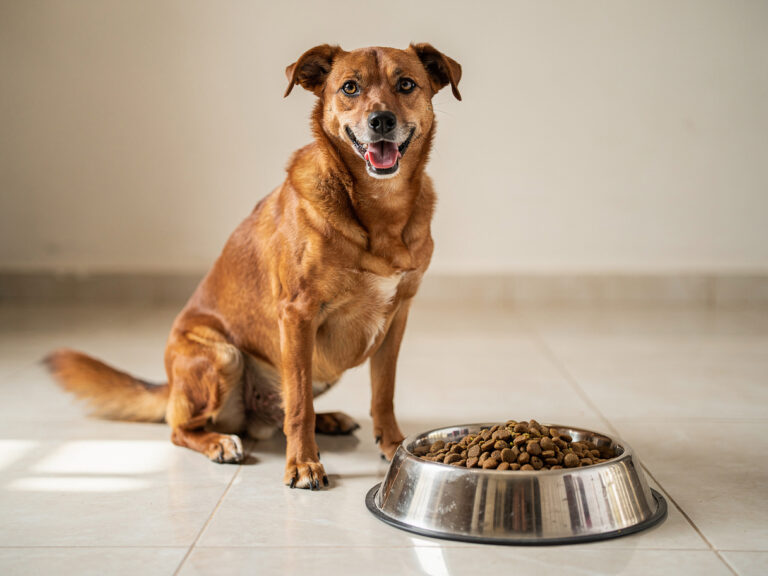
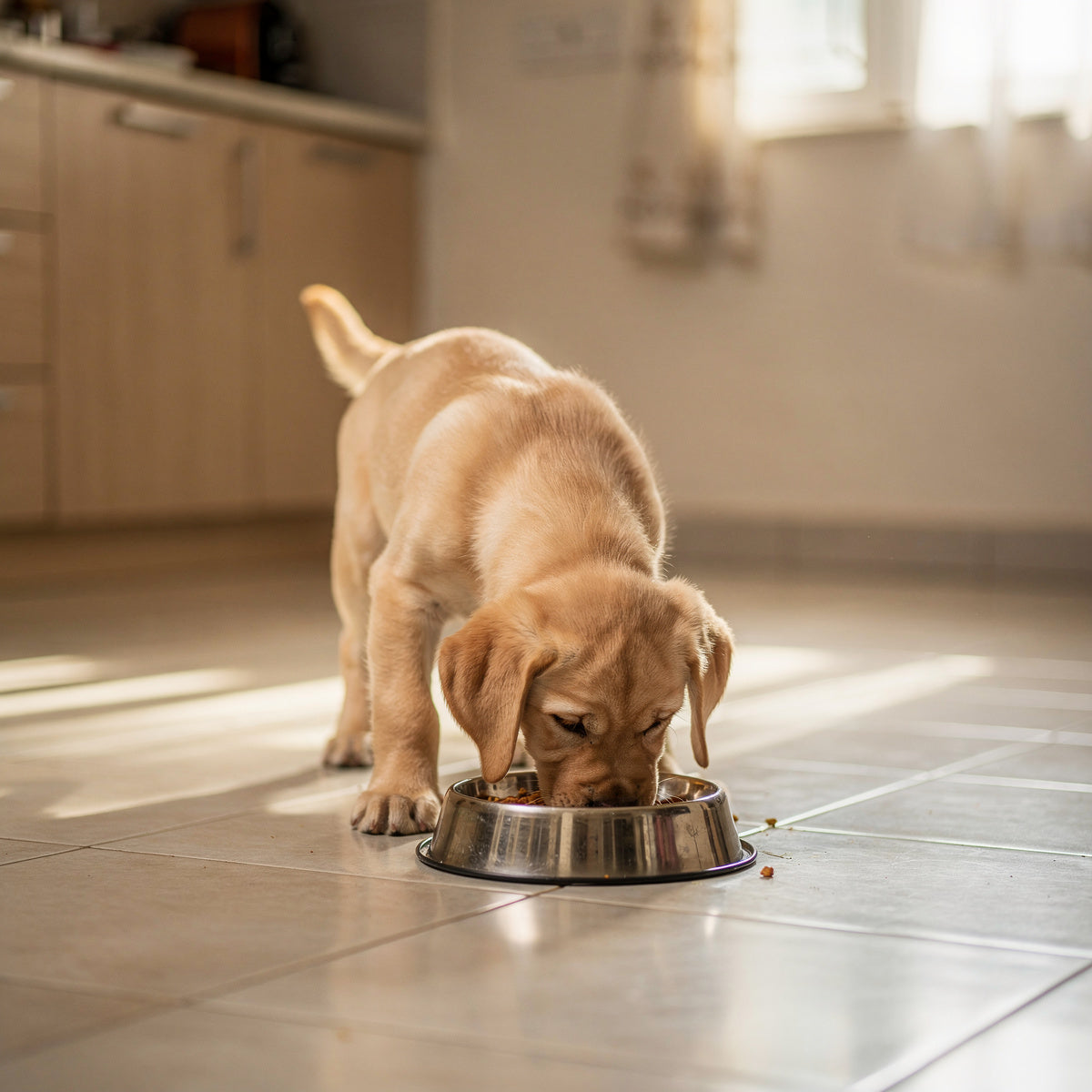
Feed measured meals at set times rather than leaving a bowl down all day. Start from the chart on the back of the bag, weigh the food out, then adjust by how your puppy looks rather than by what the chart says. Three or four small meals while they are young, dropping to two, sits better on a puppy stomach than one big one.
What you are aiming for: ribs you can feel easily under a thin cover, and a waist you can see from above. A big puppy that looks chunky is growing faster than its skeleton wants to, and that is the thing to avoid. In a study that followed Labradors for their whole lives, the ones kept slender had a small fraction of the hip and shoulder arthritis their heavier littermates carried, and they lived longer. The figures are in the research section below.
Treats count towards the day's food. Keep them to roughly a tenth of it, or the measured meals stop meaning much.
What should I not add to the bowl?
Calcium. A complete large breed puppy food already has calcium set for a growing skeleton, and bone powder, calcium tablets or a lot of extra milk push it past where it should sit. Too much calcium in the first months is one of the few feeding habits with a clear link to bone trouble in big breeds, and it is a common one in Indian homes with a new puppy.
Adult food is the other one, however grown-up your puppy looks at six months.
What does this look like in Hyderabad?
Labradors, Golden Retrievers and German Shepherds are most of the big-dog population here, and all three land in the Maxi band. Two local things worth knowing.
A 20kg sack in this humidity can go stale, and the fat in it can turn, before one puppy gets through it. Decant into an airtight container, keep the bag itself inside, and store it off the floor. Smaller packs cost more per kilo and waste less.
The other one is the monsoon. A puppy bought in summer does its fastest growing through the rains, when walks get skipped for days at a time. Same bowl, less exercise, and a lean puppy quietly stops being lean. When the walks stop, the food has to come down with them.
The research behind this
The bags, in their own words. Royal Canin's page for Maxi Puppy describes it as for "large puppies from 2 to 15 months old that will have an adult weight of approximately 26kg-44kg", with analytical constituents of "Protein: 30.0% - Fat content: 16.0%". Maxi Starter is for a "large breed bitch (from 26 to 44 kg) and her puppies: bitch at the end of gestation and during lactation - Weaning puppies up to 2 months old." The Golden Retriever Puppy bag is 29.0% protein and 16.0% fat, for puppies "up to 15 months old", and what it claims to add is that "the kibble's shape, size, texture and formula are adapted to the Golden Retriever puppy", together with a skin barrier complex, antioxidants including vitamin E, and hydrolysed cartilage as a source of chondroitin.
Calcium and body condition. Today's Veterinary Nurse gives the range: "The recommended range for dietary calcium in large-breed puppies is 0.8% to 1.2% on a dry matter basis." The same article says puppies "should maintain a healthy body condition score (BCS) of 4/9 throughout growth", which is the lean end of the nine-point scale, not the middle.
Measured meals against a full bowl. From the same article: "Meal-restricted feeding has been shown to reduce the frequency of developmental orthopedic disease and early osteoarthritis in large- and giant-breed dogs compared to ad lib feeding by preventing the maximal rate of growth".
How much difference body condition makes.
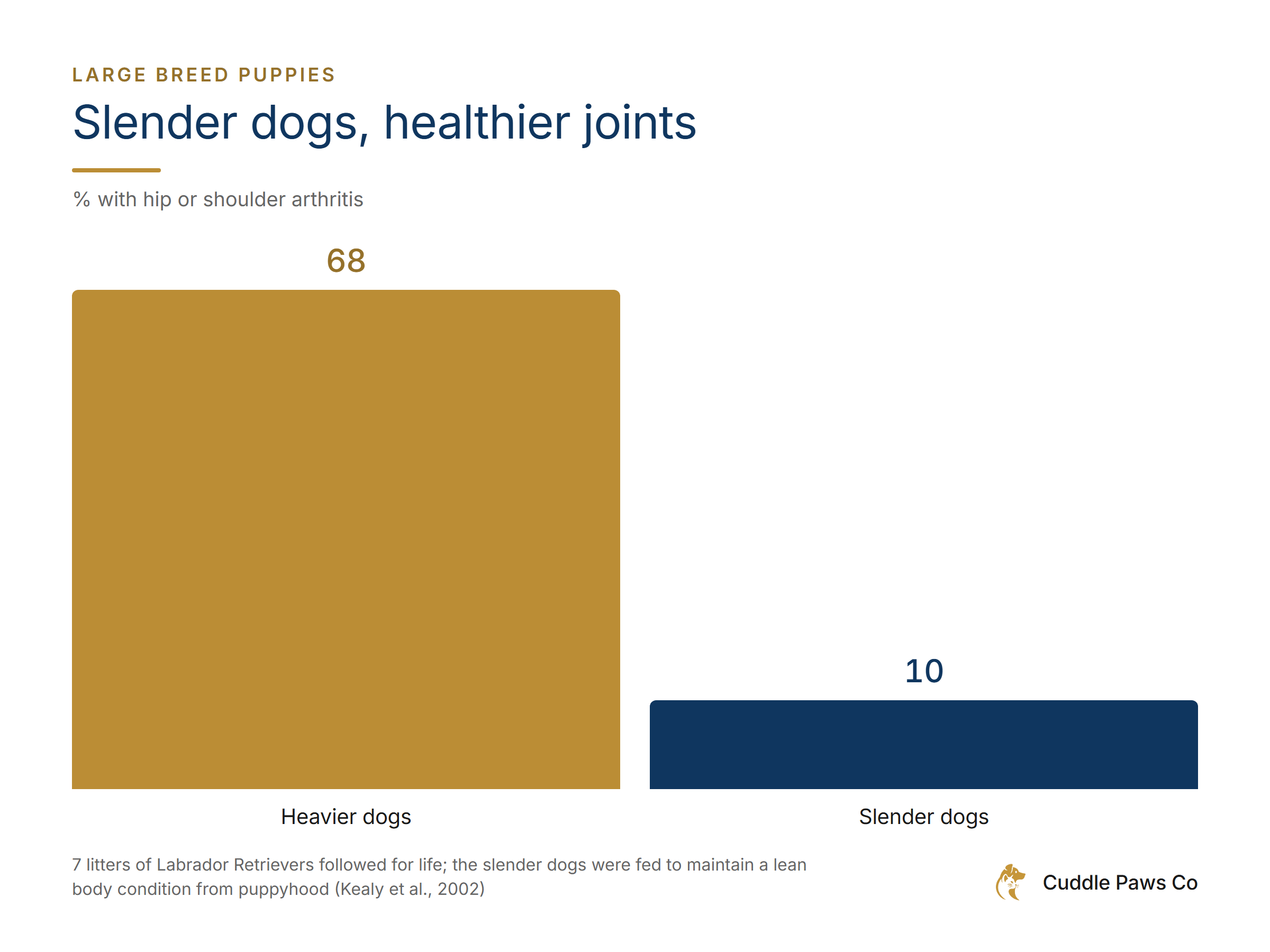
| Group | % with hip or shoulder arthritis |
|---|---|
| Heavier dogs | 68 |
| Slender dogs | 10 |
Population: 7 litters of Labrador Retrievers followed for life; the slender dogs were fed to maintain a lean body condition from puppyhood (Kealy et al., 2002). Source: Marcellin-Little and others, A proposed framework for practical multimodal management of osteoarthritis in growing dogs, Frontiers in Veterinary Science, 2025, reporting Kealy and others, Journal of the American Veterinary Medical Association, 2002.
Two caveats worth stating. The slender dogs were kept lean for their whole lives, not only through puppyhood, so this is a habit rather than a first-year fix. And the same review reports that those dogs "lived on average 1.8 years (15%) longer, than their free fed littermates", which comes from the same small group of dogs rather than from a separate study.
When it shows up. Fifty Labrador puppies were enrolled in a growth study in Italy across 2017 and 2018, and 42 finished it. Hip and elbow dysplasia rates did not move between the two check points: "No significant difference in prevalence of hip and elbow dysplasia in either group, which were the same at 6 and 12 mo." Whatever the first six months do, they have largely done it by six months.
How common it is in these breeds. A Swiss screening programme radiographed 10,638 dogs of five large breeds between 1995 and 2016. Hip dysplasia was found in 32.4% of German Shepherd Dogs, 15.8% of Golden Retrievers and 9.1% of Labrador Retrievers, and it fell in every breed across the period: "Both, prevalence and severity of CHD dropped in each breed between the periods 1995-1999 and 2010-2016." That fall is credited to breeding selection rather than to feeding. These are also Swiss dogs presented for screening, which is not the same population as dogs in Hyderabad homes. Nobody publishes that figure for India.
Prices. Every rupee figure above was read off our own product pages on 20 September 2026. The per-kilo figures are ours, worked out from the pack prices.
Frequently Asked Questions
Which Royal Canin is best for a Golden Retriever puppy?
Either Maxi Puppy or the Golden Retriever Puppy bag will feed it properly, since a Golden sits in the 26 to 44 kg Maxi band. The breed bag adds a kibble shaped for the breed and a skin, coat and joint blend, and costs more per kilo.
What is the difference between Royal Canin Maxi Starter and Maxi Puppy?
Starter is for the mother and for puppies still coming off milk, up to two months. Maxi Puppy is the food for two to fifteen months. A puppy that came home at eight or nine weeks goes straight onto Maxi Puppy.
How much should I feed a large breed puppy?
Start with the chart on the back of the bag for your puppy's age and expected adult weight, weigh it, split it across three or four meals, then adjust. You should be able to feel the ribs easily and see a waist from above.
Should I give my large breed puppy a calcium supplement?
No, not on top of a complete puppy food. The calcium is already set for a growing skeleton, and adding bone powder, tablets or a lot of milk takes it past the right range at the age when that causes problems.
When do I stop feeding puppy food to a big dog?
Royal Canin Maxi Puppy is made to run to fifteen months, which is longer than a small dog stays on puppy food. Change over gradually across a week or so, mixing a little more of the adult food each day.
अक्सर पूछे जाने वाले सवाल
बड़ी नस्ल के पिल्ले के लिए कौन सा Royal Canin लें?
नस्ल के नाम से नहीं, बड़े होने पर वज़न कितना होगा उससे चुनिए। जो कुत्ता बड़ा होकर 26 से 44 किलो का होगा, उसके लिए Maxi Puppy सही है। इसमें लैब्राडोर, गोल्डन रिट्रीवर और जर्मन शेफर्ड आ जाते हैं। 45 किलो से ऊपर जाने वाले पिल्लों के लिए Giant Puppy लीजिए।
Maxi Starter और Maxi Puppy में क्या फ़र्क़ है?
Starter माँ के लिए और दूध छुड़ाने वाले पिल्लों के लिए है, यानी दो महीने की उम्र तक। ज़्यादातर पिल्ले घर आते-आते यह उम्र पार कर चुके होते हैं, इसलिए सीधे Maxi Puppy दीजिए, जो पंद्रह महीने तक चलता है।
क्या पिल्ले को अलग से कैल्शियम देना चाहिए?
नहीं। अच्छे puppy food में कैल्शियम पहले से नापकर डाला होता है। ऊपर से बोन पाउडर, कैल्शियम की गोलियाँ या बहुत सारा दूध देने से मात्रा ज़रूरत से ज़्यादा हो जाती है, और बढ़ती उम्र में यही हड्डियों की तकलीफ़ की वजह बनता है। खाना नापकर दें और पिल्ले को दुबला-पतला रखें।
Sources
- Maxi Puppy — Royal Canin India
- Maxi Starter — Royal Canin India
- Golden Retriever Puppy — Royal Canin India
- Giant Expectations: Nutrition for the Large-Breed Puppy — Today's Veterinary Nurse
- A proposed framework for practical multimodal management of osteoarthritis in growing dogs, 2025 — Frontiers in Veterinary Science
- Effect of a commercially available fish-based dog food enriched with nutraceuticals on hip and elbow dysplasia in growing Labrador retrievers, 2018 — Canadian Journal of Veterinary Research
- Prevalence of Canine Hip Dysplasia in Switzerland Between 1995 and 2016, a retrospective study in 5 common large breeds — Frontiers in Veterinary Science
Prices are current as of September 2026 and do change. The figure on each product page is the live one.