Cat food in India: what to buy, by age and budget
How to choose cat food in India: the label line that proves a food is complete, what changes with age, and what a kilo costs across one real shelf.
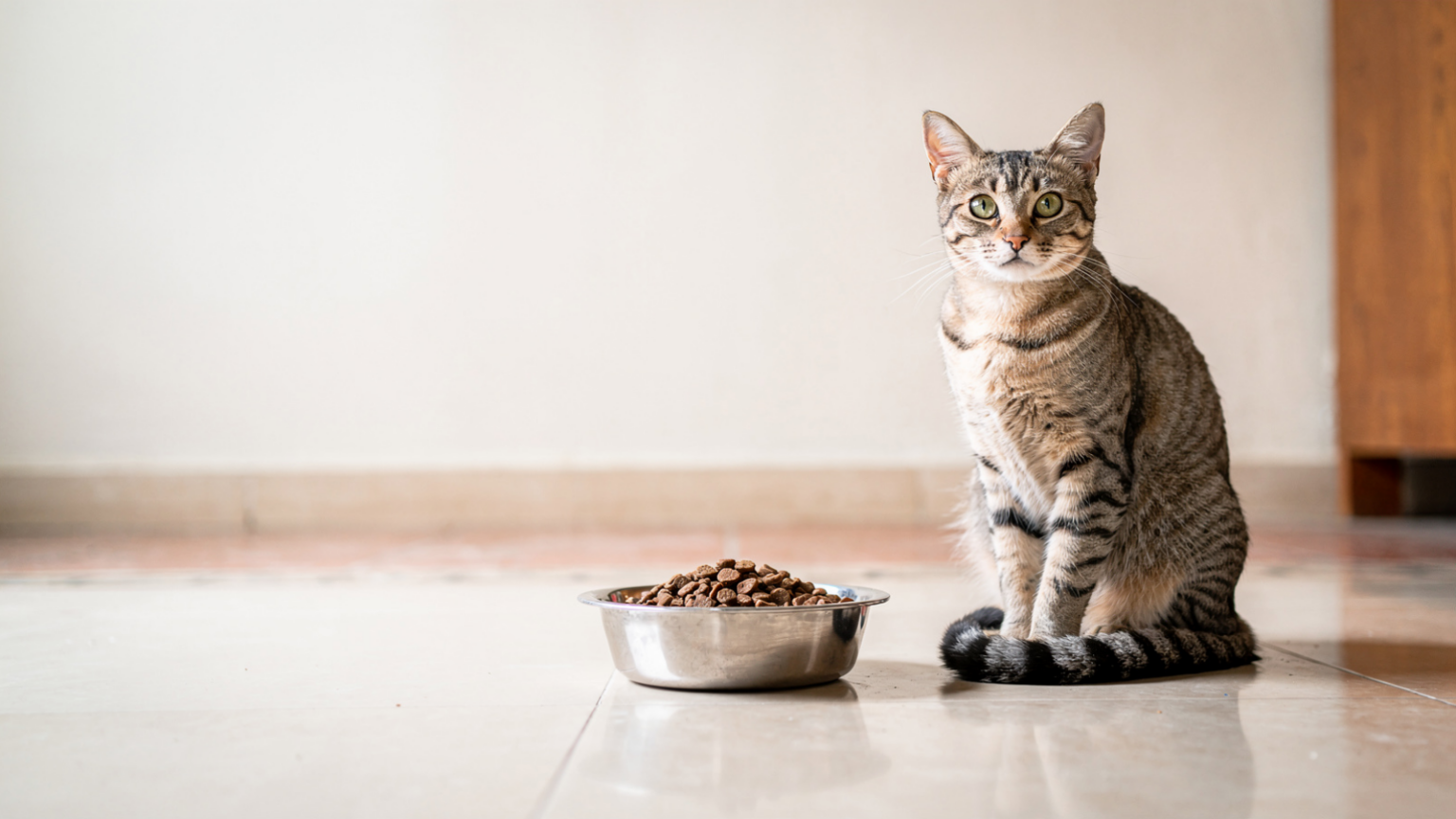
Buy a complete food that matches your cat's age, from a brand you can get again next month, and feed measured meals. Two things decide the rest: the line on the back of the pack saying the food is complete, and what you pay per kilo.
Key Takeaways
- Turn the pack over. The small line naming the age the food is complete for is the real test, not the ingredient list.
- Compare the price per kilo, not the price on the bag. A small pack of the same food costs close to double.
- Move a kitten to adult food between eight and twelve months, when the growing has mostly finished.
*This article is general information, not veterinary advice. If your pet is unwell, please see a vet.*
Dry food, wet food, or both?
Kibble is the practical default here. It keeps in the heat, it costs the least per meal, and the complete ones are complete. Why vets lean towards dry food for cats makes the case, and the dry cat food shelf is where most people should start.
Wet food buys water and appetite. Dry food is under a tenth water; a tray or can is three-quarters or more, which is why Cornell's feline centre calls canned food a dietary source of water. That matters for a cat here, because most of them drink less than you think and the heat does the rest. It suits an older cat with sore teeth, a cat recovering from illness, and a cat that has simply stopped being interested in its bowl. Spoon it over kibble rather than replacing the kibble outright. The cat wet food shelf has trays, pouches and cans, and how to switch your cat to wet food covers the fussy ones.
The honest catch is cost. Wet food is the dearest way to buy food and much of what you pay for is water. Keeping your cat hydrated lists the cheaper ways to get water into a cat, and whether cats should drink milk deals with the one everybody tries first. Home-cooked is the option people assume is safest and it is the hardest to get right: dry cat food against homemade meals and the fuller comparison of all three lay out the trade.
What should the label say?
Turn the pack over. Somewhere in small type sits a sentence saying the food is complete and balanced for a named life stage: growth, adult maintenance, or all life stages. AAFCO, the American body whose wording most packs here copy, calls that statement the most important part of a label and the key to matching a cat to a product. If a pack says it is for intermittent or supplemental feeding only, it is not a meal. Plenty of the trays and tubs sold as cat food are exactly that, and they are fine as a topper and wrong as dinner.
One line on that label is widely misread. "All life stages" sounds like convenience. The veterinary manual says it means the food was formulated or tested for pregnancy and growth as well as for adult cats, so a settled indoor adult eating one is on a kitten-grade food. Worth knowing before you buy, because Cornell calls obesity the commonest nutrition-related problem in cats.
The ingredient list is the part everybody reads and the part that tells you least. The association that writes the global nutrition guidelines for vets says it gives no information about the quality of what went in, and can mislead about the food overall. "Real chicken first" is a weaker signal than it looks. For what a cat's food actually has to contain, balanced nutrition for cats goes further than this page can, and reading cat treat labels covers the rest of the aisle.
One thing a cat's label settles for good: she cannot eat the dog's food. Plant proteins carry no taurine at all, and a cat deprived of it gets heart and eye disease. Cats also need more protein in their food than dogs do. A bag made for dogs is not a cheaper version of the same thing.
What changes as a kitten grows up?
A kitten needs a growth food, an adult needs a maintenance one, and the moment to change is not a birthday. The veterinary manual puts the switch between eight and twelve months, with most of the growing done well before the first year is out. Kitten food costs more per kilo than adult food, so four extra months of it is money spent on a food the cat has outgrown. How your cat's needs change with age walks the whole arc, and which Royal Canin your kitten needs works through one range in detail.
Neutering changes the sums again. A quieter, neutered adult cat needs fewer calories than the bowl she grew up with, which is what the sterilised and indoor formulas are for.
Two measured meals at set times beats a bowl left full all day. That is the single change in this guide that costs nothing, and it is the one most likely to keep weight off an indoor cat. Why a steady feeding schedule matters has the practical version, and the feeding mistakes most cat owners make is worth a read before you change anything.
Which brands are for what?
None of them is the best, and a page that names one is guessing. What differs is the price per kilo and what each range is built for.
Whiskas and Me O are the everyday middle: sold everywhere, complete, cheap enough to keep buying for years, in dry and wet. Purepet and Maxi sit below them and are the cheapest complete food on the shelf. Royal Canin sells by situation rather than by flavour, with indoor, sterilised, hairball, Persian and senior ranges and the widest veterinary line. Farmina Matisse is the step up from the supermarket brands without the grain-free price, and Farmina N&D is the top of the shelf; Matisse or N&D is the comparison between them.
Smylo is worth a word because people search for its dry food and there is none. Every Smylo product here is a wet tray or a bone broth, and the broths are genuinely useful for a cat that will not drink. They are a topper, not a diet. The same goes for most of what gets added to a cat's bowl with good intentions: where supplements fill a real gap is a narrower question than the tubs suggest.
What will a kilo cost?
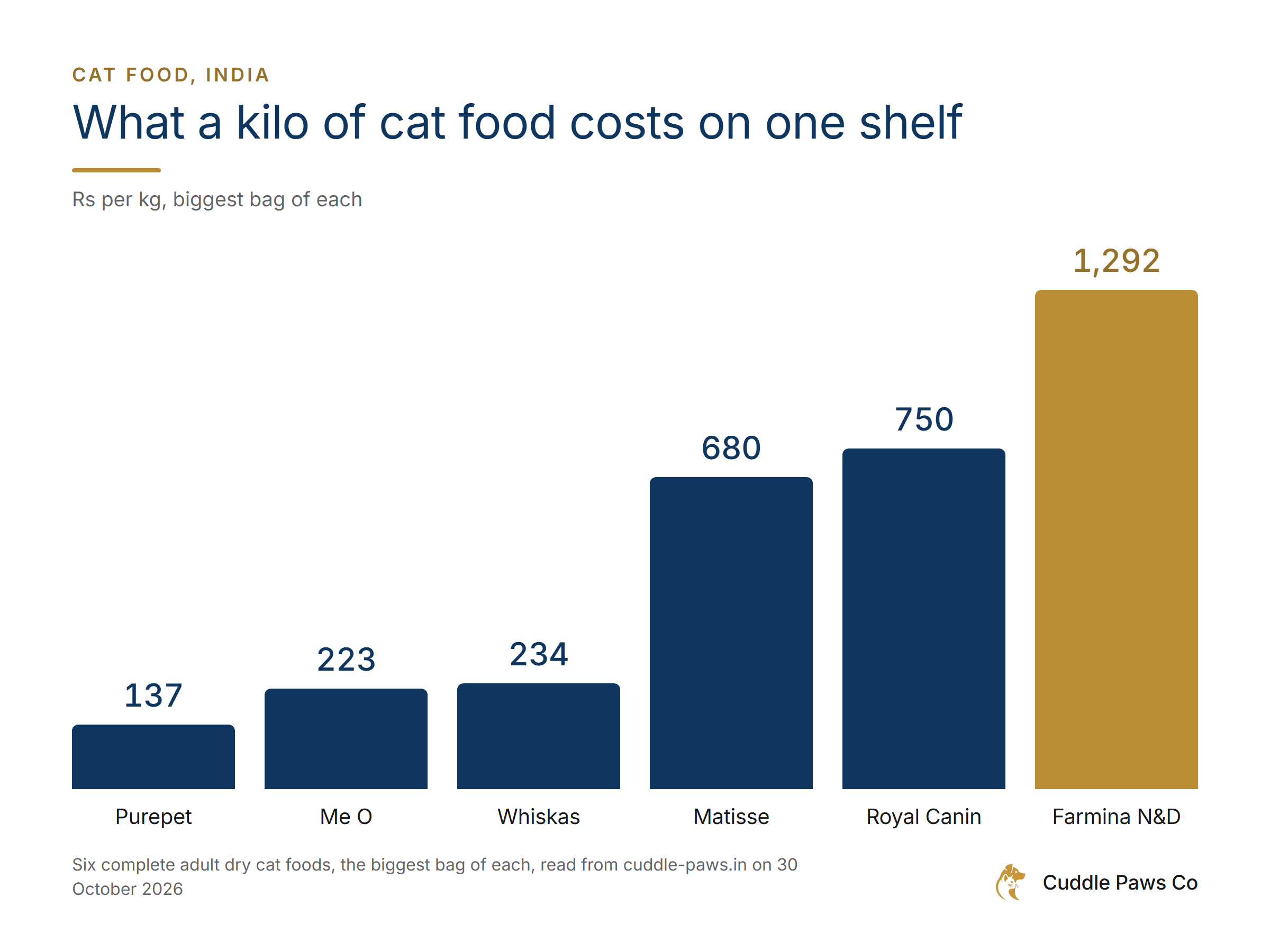
Compare per kilo, never per bag. On our own shelf the biggest bag of Purepet's mackerel adult food works out at Rs 137 a kilo, and Farmina N&D's ocean herring at Rs 1,292. Nine times apart, both complete adult foods. The chart further down has the ladder in between.
The trap is bag size. Whiskas Tuna adult is Rs 234 a kilo in the 20kg bag and Rs 456 in the 480g pack: the same food, close to double. Every product page prints its own per-kilo figure, so checking takes a second. Buy the biggest bag your cat will finish in about a month, then keep it sealed, because Hyderabad's humidity is what eats the saving.
Wet food changes the arithmetic. The cheapest cat wet food here, Me O's tuna in jelly bought by the case, is Rs 356 a kilo against Rs 137 for the cheapest complete kibble, and three-quarters of that kilo is water. Feeding wet food only is a real choice with real benefits, and it is several times the cost. What it costs to feed a cat in India does the monthly sums, and the cat aisle is the rest of it.
When is a vet diet the right answer?
When a vet has diagnosed something. Urinary, kidney, weight-loss and hydrolysed-protein diets are made for a cat with that problem, and the vet chooses which one. A weight-loss food cuts calories while keeping the other nutrients up, which an ordinary food fed in smaller portions does not do. None of these is an upgrade on good adult food. Buying one without a diagnosis means paying premium money for a food your cat does not need, and sometimes delaying the visit that would have found the real thing. If your cat is unwell, the vet comes before the bag.
The research behind this
| Food | Biggest bag | Price | Rs per kg |
|---|---|---|---|
| Purepet Mackerel Adult | 6kg | Rs 819 | 137 |
| Me O Tuna Adult | 20kg | Rs 4,454 | 223 |
| Whiskas Tuna Flavour Adult | 20kg | Rs 4,675 | 234 |
| Farmina Matisse Chicken & Rice Adult | 10kg | Rs 6,799 | 680 |
| Royal Canin Fit 32 Regular Adult | 10kg | Rs 7,498 | 750 |
| Farmina N&D Ocean Herring & Orange Adult | 5kg | Rs 6,462 | 1,292 |
Six complete adult dry cat foods, the biggest bag of each, read from cuddle-paws.in on 30 October 2026, from the dry cat food collection, which held 156 products that day. Every one of those product pages prints its own per-kilo figure, so each row can be checked in one click: Me O Tuna, Farmina Matisse Chicken & Rice and Royal Canin Fit 32 are the three not already linked above.
Three caveats, because the chart is doing real work. Only complete adult maintenance foods are in it: no kitten food, no veterinary diet, no breed formula and nothing sold as all life stages, so the bars are like for like. A smaller bag always reads dearer per kilo, so the Farmina row is a 5kg bag, the only size that listing sells, and the Matisse and Royal Canin rows are 10kg against three larger bags, which flatters none of them. And this is one shop's shelf on one day rather than a national average: across all 324 in-stock dry cat food variants that carry a weight, the span that day ran from Rs 129 to Rs 2,947 a kilo.
The small-pack penalty is the same shelf read a different way, and it is larger for cats than for dogs because cat food is sold in smaller bags. Whiskas Tuna adult is Rs 234 a kilo at 20kg and Rs 456 at 480g. Me O Tuna adult is Rs 223 at 20kg and Rs 429 at 450g. Farmina Matisse kitten is Rs 668 a kilo at 10kg and Rs 1,200 at 400g. Farmina N&D Prime chicken and pomegranate kitten is Rs 1,126 at 5kg and Rs 2,650 at 300g. Orijen Original is Rs 1,095 at 17kg and Rs 2,222 at 1.8kg. Every pair is one product's own variants on 30 October 2026, with both figures printed by the page itself.
On the label, the AAFCO guide to reading labels states that "The nutritional adequacy statement is perhaps the most important part of a label. It is the key to matching a pet's nutritional needs with a product", lists the recognised life stages as "gestation/lactation, growth, maintenance, all life stages", and says a product marked "intended for intermittent or supplementary feeding only" does "not meet any of the normal standards for complete and balanced nutrition". The Merck Veterinary Manual on dog and cat foods is the source for what the phrase commits the maker to: "The term 'all life stages' on a label indicates that the product has been either formulated or tested for gestation/lactation, growth, and adult maintenance." The WSAVA Global Nutrition Committee is the source on ingredient lists: "the ingredient list gives no information on the quality of the ingredients and can be very misleading on the overall quality of the food."
On age, Merck's page on feeding practices says that "Kittens are generally transitioned to an adult diet sometime between 8 months and 12 months", that "The growth rate begins to plateau at 150-160 days old, and growth is usually completed within 200-220 days", and on neutered cats that "Some inactive, neutered adult cats can be fed a reduced-fat diet (9% dry-matter basis) ad lib; however, this may not work well in other cats".
On why a cat is not a small dog, Merck's page on nutritional requirements states that "Taurine is an essential amino acid in diets for cats, and taurine deficiency can cause dilated cardiomyopathy and central retinal degeneration in cats", that "Cats must have some animal-based protein sources in their diet because plant-based protein sources are devoid of taurine", and puts an adult cat's requirement at 26% protein as dry matter against 18% for a dog. It also notes that cats cannot convert beta-carotene to vitamin A and cannot make enough niacin for themselves, which is the same point from two more angles.
On water and weight, the Cornell Feline Health Center records that "Dry food contains between six and 10 percent water", that "Canned cat food has a moisture content of at least 75 percent, making it a good dietary source of water", and that "Obesity is the most common nutrition-related problem in cats, and makes cats susceptible to a number of health problems, including arthritis and diabetes". On home cooking it says "It is generally recommended that cat owners purchase nutritionally balanced commercial foods, unless a veterinarian recommends a home-formulated recipe for medical purposes."
Two things worth saying about what is missing. There is no Indian survey of cat body condition with a stated population that we could find and read, so the obesity point above is Cornell's qualitative one rather than a percentage for India. And none of these sources is Indian, which is why the price work is done on our own shelf instead of borrowed from abroad.
Frequently Asked Questions
Which is the best cat food in India?
There is not one. The best food for your cat is a complete food for her age that she will eat and that you can buy again next month, and the choice between a Rs 137-a-kilo bag and a Rs 1,292-a-kilo bag is about your budget more than about her health. Check the back of the pack for the line saying it is complete and balanced, then compare per kilo.
Is Royal Canin cat food worth the price?
It is a good food, and what you are mostly paying for is the range: indoor, sterilised, hairball, senior, Persian and a wide veterinary line, so there is usually a formula aimed at your cat's situation. Its regular adult food works out around Rs 750 a kilo on our shelf against Rs 234 for Whiskas. If your cat is healthy and does well on the cheaper bag, that is a real answer too.
Can I feed my cat dog food if I run out?
No, not as a habit. Plant proteins contain no taurine, a cat deprived of taurine develops heart and eye disease, and cats need more protein in their food than dogs do. One stolen mouthful is not an emergency. A week of it is a problem, and a dog food bought to save money on the cat is the wrong saving.
How much does it cost to feed a cat in India per month?
Work it from the per-kilo figure rather than a monthly band. An adult cat on about two kilos of food a month costs roughly Rs 275 on the cheapest complete kibble and around Rs 2,580 on the dearest bag in our chart, before treats and litter. Wet food raises it several times over, because most of what you buy is water.
Does my kitten need kitten food, or will adult food do?
She needs kitten food, and then she needs to come off it. Growth food carries more of nearly everything, which a growing kitten uses and a settled adult stores. The veterinary manual puts the switch between eight and twelve months.
अक्सर पूछे जाने वाले सवाल
बिल्ली का खाना चुनते समय सबसे पहले क्या देखना चाहिए?
पैकेट पलटकर पीछे छोटे अक्षरों में लिखी वह लाइन देखिए जो बताती है कि यह खाना किस उम्र के लिए complete और balanced है। अगर पैकेट पर लिखा है कि यह सिर्फ़ supplemental feeding के लिए है, तो वह पूरा खाना नहीं है, ऊपर से डालने वाली चीज़ है। सामने लिखी बातों और ingredient list से यह लाइन ज़्यादा काम की है।
बिल्ली के बच्चे को kitten food से बड़ी बिल्ली का खाना कब देना चाहिए?
आठ से बारह महीने के बीच। पहले जन्मदिन का इंतज़ार करने की ज़रूरत नहीं, क्योंकि बढ़ना उससे पहले लगभग पूरा हो जाता है। Kitten food प्रति किलो महँगा होता है, इसलिए ज़रूरत से ज़्यादा महीने उसे खिलाना सिर्फ़ पैसे का नुक़सान है।
क्या बिल्ली को कुत्ते का खाना दिया जा सकता है?
नहीं। पौधों से मिलने वाले प्रोटीन में taurine नहीं होता, और taurine के बिना बिल्ली को दिल और आँखों की बीमारी हो जाती है। बिल्लियों को कुत्तों से ज़्यादा प्रोटीन भी चाहिए। एक-दो कौर खा लेने से कुछ नहीं होगा, लेकिन रोज़ देना ठीक नहीं है।
*This article is general information, not veterinary advice. If your pet is unwell, please see a vet.*
Sources
- Reading Labels - Association of American Feed Control Officials (AAFCO)
- Dog and Cat Foods - Merck Veterinary Manual
- Feeding Practices in Small Animals - Merck Veterinary Manual
- Nutritional Requirements of Small Animals - Merck Veterinary Manual
- Global Nutrition Guidelines - WSAVA Global Nutrition Committee
- Feeding Your Cat - Cornell Feline Health Center, Cornell University College of Veterinary Medicine
- Dry Cat Food - Cuddle Paws Co, the shelf the chart was read from
- Whiskas Tuna Flavour Adult Cat Dry Food - Cuddle Paws Co, the product page behind the small-pack figures
Prices are current as of November 2026 and do change. The figure on each product page is the live one.