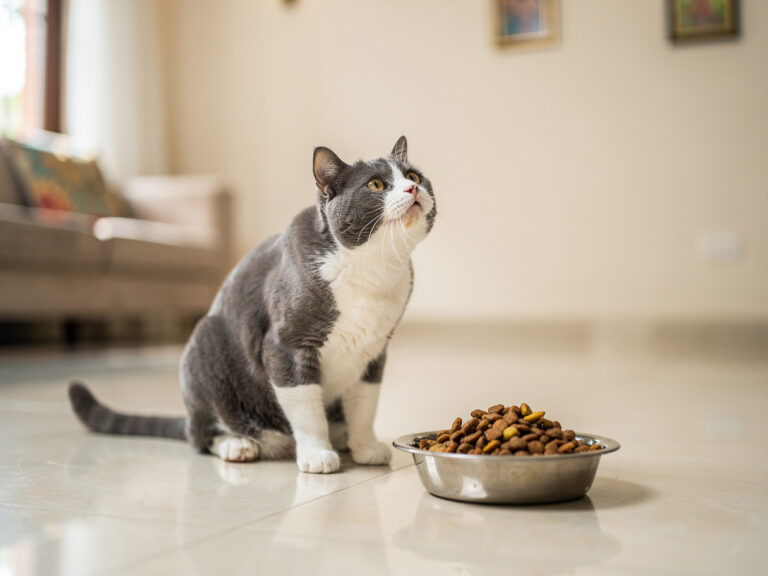
Which Royal Canin does your kitten need?
Mother & Babycat, Kitten or Persian Kitten? Pick the bag by your kitten's age, what the Persian formula changes, and what each costs in Hyderabad.
Under four months old, your kitten wants Royal Canin Mother & Babycat. From four months to a year, the plain Kitten bag. Persian Kitten is worth buying only if your flat-faced kitten keeps missing the kibble. You are paying for the shape of the biscuit.
Key Takeaways
- Pick the bag by your kitten's age. Mother & Babycat until four months, then the Kitten bag until a year old.
- The Persian bag changes the shape of the kibble and the coat blend. It carries slightly less protein than the standard Kitten food.
- Buy a pack your kitten will finish. An opened bag sitting through a Hyderabad summer loses the fat that makes it smell like food.
Which Royal Canin bag does my kitten need?
Royal Canin splits its kitten food by age, and that is the decision that matters. Mother & Babycat is the weaning food: for a nursing mother, and for kittens from about one month to four. The plain Kitten bag picks up there and runs to a year old, which is when a cat has finished growing.
Persian Kitten covers the same window as the plain bag. It is a version of that stage built for a flat face rather than an extra step in the ladder.
| Bag | Who it is for | Pack we stock |
|---|---|---|
| Mother & Babycat | A nursing mother, and kittens from one to four months | Rs 6,653 for 6kg, as three 2kg bags |
| Kitten | Four months to a year old | Rs 7,744 for 8kg, as two 4kg bags. Also Rs 1,122 for 1kg |
| Persian Kitten | Flat-faced kittens, four months to a year | Rs 9,486 for 8kg, as two 4kg bags |
Is the Persian bag worth the extra money?
It is a real product rather than a sticker on the same food. The biscuit is small, rectangular and soft, so a cat with a short jaw can get its teeth and tongue around it. The formula leans on coat and on fibre for hairballs, which is a fair reading of what a long-haired cat needs.
Two things surprise people. The first is at the till: the Persian bag works out about a fifth dearer per kilo than the plain Kitten bag. The second is on the back of the pack. The breed food carries a little less protein than the standard Kitten food, not more. Exact figures are in the research section below.
So the honest split is this. If your kitten eats it and clears the bowl, it is good food and the coat argument holds up. If your kitten already clears the plain Kitten bag without fuss, the extra money buys nothing you will see.
Why does a flat face change how a cat eats?
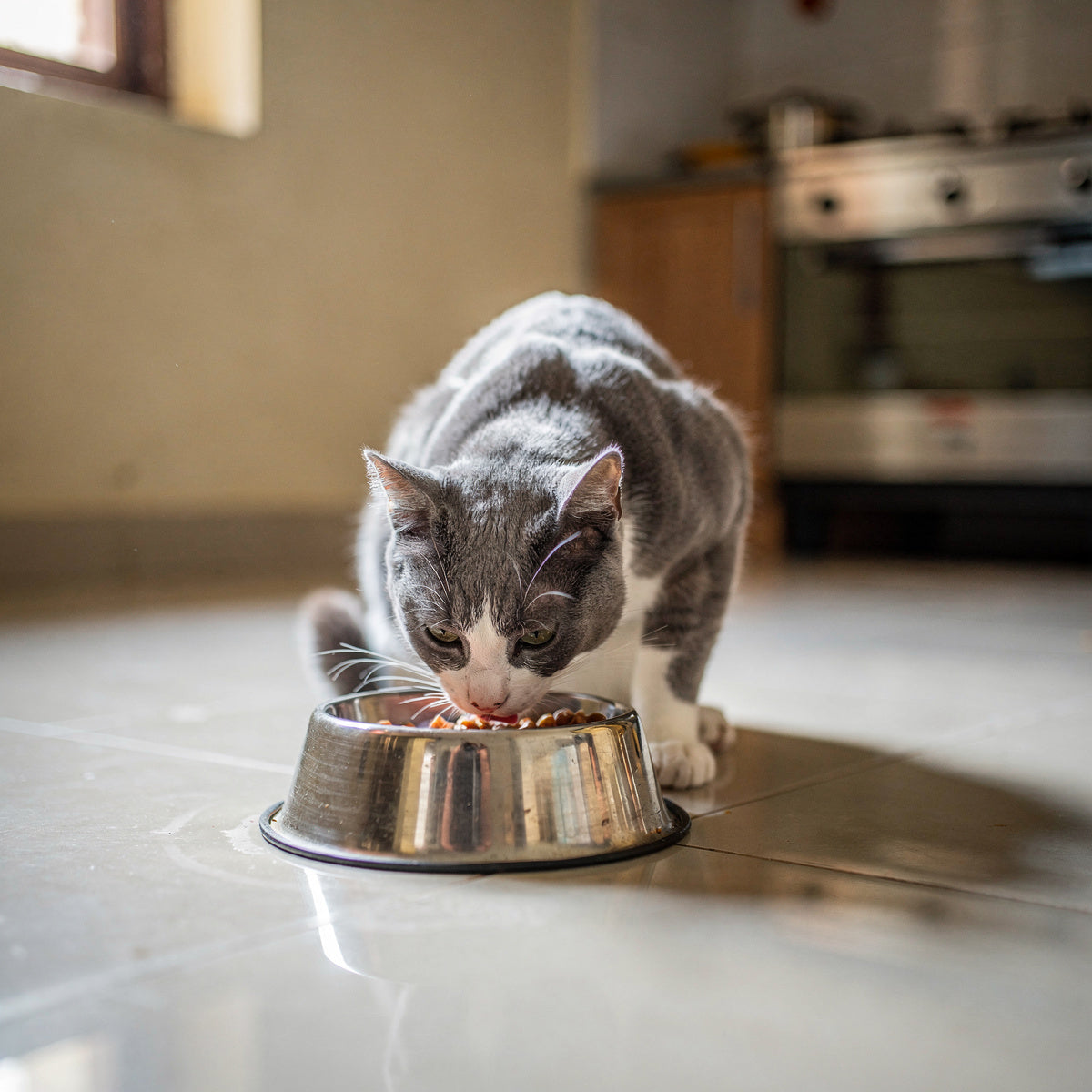
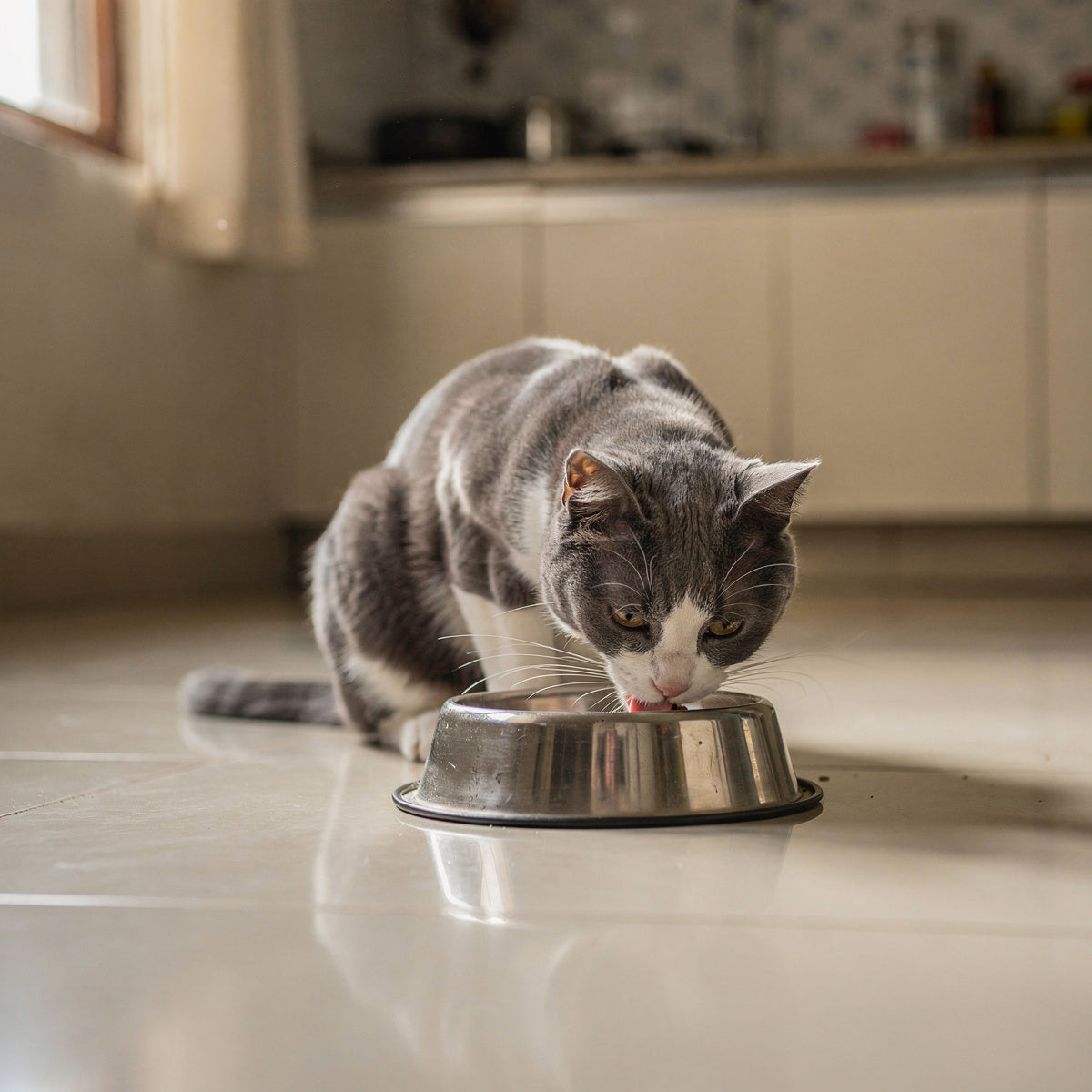
Watch a Persian kitten eat off a flat plate and you can see the problem. The lower jaw sits forward of the upper one, the front teeth often do not meet, and the cat scoops rather than picks up. Thin, flat kibble skids away from a mouth built like that.
There is a measurement behind this, not only a marketing line. A German team put a group of Persians through head scans and compared them with ordinary shorthaired cats. The Persians had far more teeth sitting out of line, in both jaws, and three in four had at least one. The numbers are below.
The useful part is the remaining quarter. A doll-faced Persian with a normal bite, and there are plenty in Hyderabad homes, eats standard kibble without any trouble at all. Buy the breed bag for a cat that struggles with the bowl, not for a pedigree certificate.
How much will my kitten actually eat?
Royal Canin's own chart is the place to start, and for most kittens it lands between fifty and seventy grams of dry food a day through the middle of the first year. Weigh it out rather than guessing with a cup. Split it across three or four meals while they are small, then let your kitten's shape correct the chart: ribs you can feel under a thin cover, no pot belly.
Run that against the pack sizes and the arithmetic gets awkward. An eight-kilo bag is more than four months of food for one kitten. The six-kilo Mother & Babycat pack outlasts the stage it exists for, because a single kitten eats roughly four kilos between one month and four and then moves up a bag. Both packs come split into smaller inner bags, which helps. Neither is sized for one cat in a flat.
What does this mean in a Hyderabad kitchen?
Heat and damp are what work against a big bag here. The oils sprayed onto kibble to make it smell like food go first, and a bag opened at the start of summer smells like cardboard to a cat that used to like it. The closest measurement anyone has published was taken in a European kitchen held at a steady twenty degrees, and the fat in the food still dropped across six months. Nobody has run that test in Telangana.
Three habits cover most of it. Decant into an airtight box and keep the original bag inside it, because the inner liner is part of the barrier. Store it off the floor and away from the balcony sun. And if you are trying Royal Canin for the first time, the one-kilo Kitten bag at Rs 1,122 tells you in a fortnight whether your cat will eat it, which an eight-kilo twin pack cannot.
One last thing about the wet pouches, since people ask at the counter. Mixing wet food in is good for a kitten and better for a cat that drinks little, and it changes the dry amount: Royal Canin's chart drops the biscuit by roughly a third once a pouch a day goes in. Do not feed both at full measure.
The research behind this
The bags, in their own words. Royal Canin's India page for Persian Kitten lists "Protein: 32%" and describes the biscuit like this: "This specially designed tiny rectangular kibble with a soft texture is easy for the Persian kitten to pick up and chew". The page attributes that design to the breed's "Special brachycephalic jaw". The standard Kitten page lists "Protein: 36%" and is "Suitable for kittens up to 12 months old", the same upper age as the breed bag. Mother & Babycat is for "1st age kittens (from 1 to 4 months old) during weaning" as well as for gestating and nursing queens, with "Adapted kibble that can be easily rehydrated to facilitate the transition from milk to solid food."
Pack sizes. Royal Canin India lists Persian Kitten in 400g, 2kg and 4kg, and Mother & Babycat in 400g and 2kg. The packs that reach this shop are the 8kg twin-pack of Persian Kitten and the 6kg triple-pack of Mother & Babycat. Small packs of the breed food do exist in this country, so ask rather than assume.
Feeding amounts. The Mother & Babycat table runs from 26g a day for a 0.4kg kitten at one month to 61g a day for a 2kg kitten at four months. The Kitten table runs 29-48g at one to two months, 61-66g at three to four, 69-67g at five to six, and 64-51g from seven to twelve months. The same tables give the dry-plus-wet column, which is where the drop of roughly a third comes from: 61g of dry food alone at three months against 11g plus a pouch.
How far out of line a Persian's teeth sit.
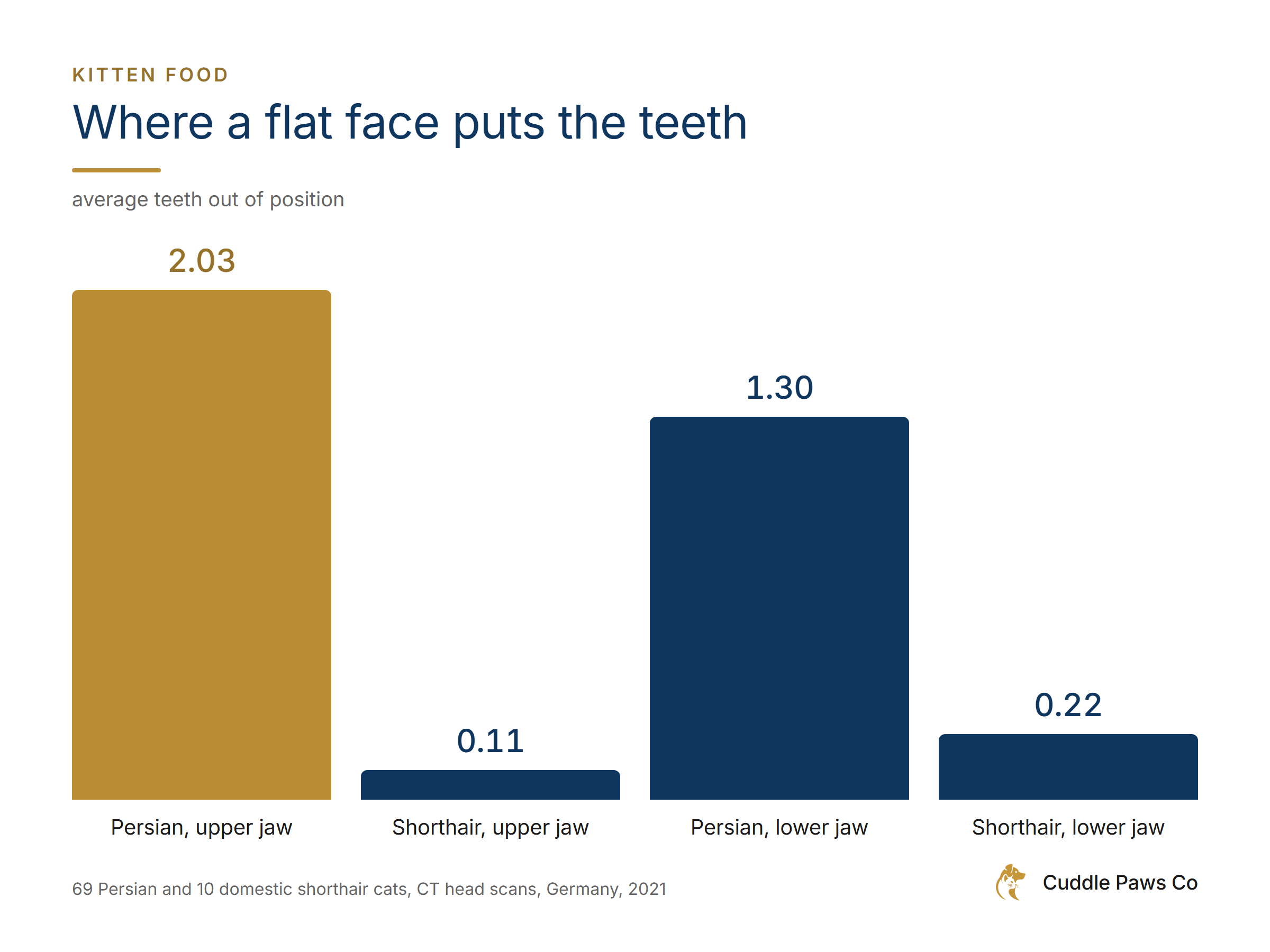
| Group | Average teeth out of position |
|---|---|
| Persian, upper jaw | 2.03 |
| Shorthair, upper jaw | 0.11 |
| Persian, lower jaw | 1.30 |
| Shorthair, lower jaw | 0.22 |
Population: 69 Persian and 10 domestic shorthair cats, CT head scans, Germany, 2021. Source: Correlation of brachycephaly grade with level of exophthalmos, reduced airway passages and degree of dental malalignment in Persian cats, PLOS ONE, 2021.
The paper puts it this way: "Persian cats had significantly more tooth malposition in the maxilla (2.03 ± 1.58 teeth) than the DSH (0.11 ± 0.33 teeth; p < 0.001)", and "Similarly, the Persian cats had significantly more tooth displacements in the mandible (1.30 ± 0.99 teeth) than DSH (0.22 ± 0.67 teeth; p = 0.002)." On how many cats were affected rather than how badly: "Only a quarter of the Persians did not show any deviating tooth positions."
Two caveats. Ten shorthaired cats is a small comparison group. And these were breeding-club Persians recruited in Germany, which is not the same population as the cats walking into a Gachibowli clinic.
What that looks like in a skull. A 2026 study measured 15 skulls, 10 Persian and 5 domestic shorthair, and found the lower jaw jutting past the upper in most of the Persians: "Prognathism was observed in 9 out of 10 Persian cats (90%)", with a reverse scissor bite in the same 9 and an open bite, where the front teeth do not meet at all, in 4. Fifteen skulls is a description of the shape rather than a prevalence figure, and it should be read that way.
An opened bag. Six dry foods were opened and kept in ordinary household conditions in Poland at 20 °C and 40% humidity. Average crude fat "decreased from 18.37 g/100 g DM to 16.87 g/100 g DM after 6 months". Those were dog foods, six of them, in conditions milder than a Hyderabad kitchen in May. Nobody has published the equivalent for cat kibble in India, so treat it as the direction of travel rather than a number for your own bag.
Prices. Every rupee figure above was read off our own product pages on 21 September 2026. The per-kilo comparison is ours, worked out from the pack prices.
Read next: Just Brought a Kitten Home? Here's What to Do First; Matisse or N&D: which Farmina cat food?; Cat Vaccination Costs in India: What You Actually Need to Know.
Frequently Asked Questions
Which Royal Canin is best for a Persian kitten?
Either Persian Kitten or the plain Kitten bag will feed it properly, and both run to twelve months. Persian Kitten adds a small, soft, rectangular biscuit for a short jaw and a coat and hairball blend, and costs about a fifth more per kilo.
What is the difference between Royal Canin Mother & Babycat and Kitten?
Age. Mother & Babycat is the weaning food, for a nursing mother and for kittens from roughly one month to four. Kitten takes over at four months and runs to a year. A kitten that came home at ten weeks belongs on Mother & Babycat for a few more weeks, then moves up.
Can I feed a Persian kitten normal kitten food?
Yes, if it eats it. Plenty of Persians have a bite close enough to normal that ordinary kibble gives them no trouble. The sign that the shape is the problem is a kitten that noses food around the plate, picks at it and walks away while still looking hungry.
How long does an 8kg bag of Royal Canin kitten food last?
For one kitten, more than four months at the middle of Royal Canin's own feeding range. It comes as two sealed 4kg bags, so only half is open at a time, but in Hyderabad's heat a one-kilo bag is the safer first purchase.
When do I switch my kitten to adult cat food?
At about twelve months for most cats. Change over across a week or so, mixing a little more of the adult food into the kitten food each day, which gives the gut time to keep up.
अक्सर पूछे जाने वाले सवाल
नई बिल्ली के बच्चे के लिए कौन सा Royal Canin लें?
उम्र देखकर चुनिए। चार महीने से छोटे kitten के लिए Mother & Babycat सही है, जो दूध छुड़ाने वाला खाना है। चार महीने से एक साल तक सादा Kitten बैग दीजिए। एक साल के बाद adult खाने पर लाइए, वह भी एक हफ़्ते में धीरे-धीरे मिलाकर।
क्या Persian बिल्ली के बच्चे को अलग खाना चाहिए?
ज़रूरी नहीं। Persian Kitten का दाना छोटा, चपटा और नरम होता है ताकि चपटे मुँह वाली बिल्ली उसे आसानी से उठा सके। अगर आपका kitten सादा दाना बिना दिक़्क़त खा रहा है तो अलग बैग की ज़रूरत नहीं। अगर वह दाने को प्लेट में इधर-उधर घुमाकर छोड़ देता है, तो Persian वाला बैग लीजिए।
बड़ा बैग लें या छोटा?
हैदराबाद की गर्मी और नमी में खुला हुआ बड़ा बैग जल्दी बासी हो जाता है और उसकी महक चली जाती है, फिर बिल्ली खाना छोड़ देती है। जितना खाना एक-दो महीने में ख़त्म हो जाए उतना ही लीजिए, उसे डिब्बे में बंद रखिए और अंदर की मूल थैली भी साथ रखिए।
Sources
- Persian Kitten, dry food for cats — Royal Canin India
- Kitten, dry food for cats — Royal Canin India
- Mother & Babycat, dry food for cats — Royal Canin India
- Correlation of brachycephaly grade with level of exophthalmos, reduced airway passages and degree of dental malalignment in Persian cats, 2021 — PLOS ONE
- Morphological and Morphometric Craniofacial Variations in Persian Cats: Anatomical Basis for Brachycephalic-Related Disorders, 2026 — Animals
- Changes in the Fatty Acid Composition and Antioxidant Properties in Mono-Protein Commercial Dry Dog Foods During Storage, 2025 — Animals
Prices are current as of September 2026 and do change. The figure on each product page is the live one.