What can hamsters eat? Safe foods, foods to avoid and what to buy
What a hamster should eat every day, which fresh foods are safe, what to keep out of the cage, and what each hamster food on our shelf costs.
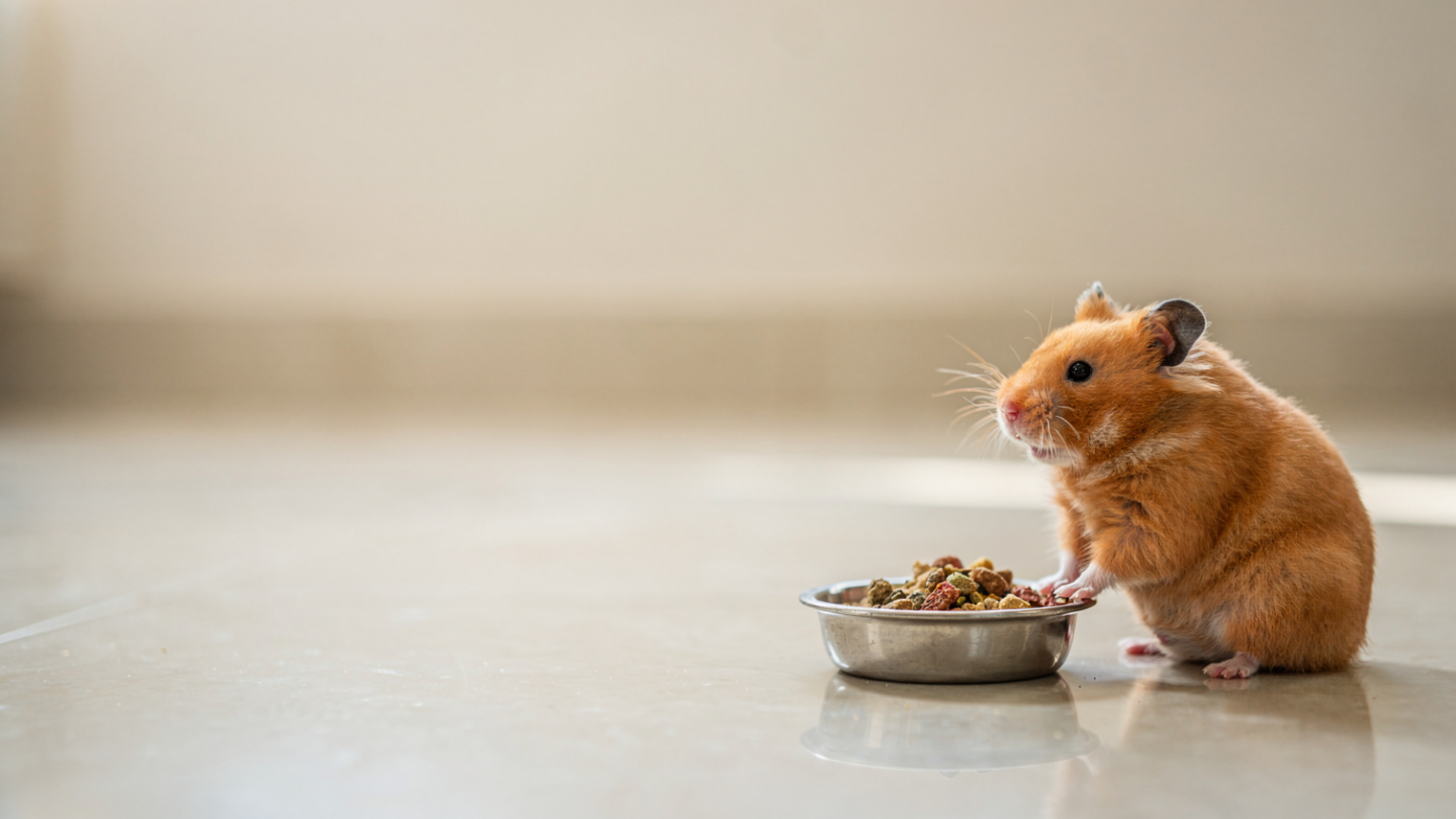
A hamster's main meal is a complete hamster food. Add a teaspoon of fresh vegetable most days, keep fruit to a rare treat, and keep salt, sugar, onion, garlic and anything spiced out of the cage.
Key Takeaways
- Buy a complete hamster food as the daily meal. A seed mix works only if your hamster eats all of it.
- A teaspoon or two of fresh vegetable a day is enough. Take what is left out the same day.
- Sticky, salty, sweet and spiced food stays out. A lump in one cheek that does not go down needs a vet.
*This article is general information, not veterinary advice. If your pet is unwell, please see a vet.*
What should a hamster eat every day?
One food, in a small heavy bowl. Hamster food comes in two shapes, and the difference matters more than the brand.
A seed mix is loose: seeds, grains, flakes, dried bits. Your hamster enjoys sorting through it, which is the problem. The sunflower seeds go first, the plain brown pieces get left, and what the pack promised on the side is not what the hamster ate. Vitapol Economic Food for Hamsters is the mix we stock, at Rs 523 for a 1.2 kg pack.
A uniform food is the opposite: every piece is the same recipe, so there is nothing to pick out. Oxbow Essentials Hamster & Gerbil Food is that kind, Rs 689 for 454 g. Oxbow's own page gives the reason for making it this way, and the Merck Veterinary Manual agrees from the other side: it tells owners to go easy on a generic seed mix for exactly this reason, and to make a complete hamster or hamster-and-gerbil food the base instead.
So the honest answer is not "buy the expensive one". It is this: if your hamster finishes its mix, the mix is fine. If you keep finding the same brown pieces left in the bowl, that hamster is feeding itself on seeds, and a uniform food fixes it in a week.
Check the protein figure on the pack. The manual puts a hamster's needs at about 15 per cent protein. Oxbow prints its figure on the box. Our page for the Vitapol mix prints no analysis at all, and we could not read one from Vitapol tonight, so read the side of the pack in your hand.
One more thing about our own shelf, since it is easy to get wrong. Six of the fifteen things on our hamster page are hay. Neither of the veterinary guides we read puts hay in a hamster's diet. Hay has its uses in a cage, but it is not the meal, and a bag of it does not replace the food in the bowl.
How much food, and what a month costs
A hamster eats about eight grams of dry food a day, which is less than most owners pour. That single figure is what turns a shelf price into a monthly one.
| Food | Pack | Price | Per 100 g | Roughly how long |
|---|---|---|---|---|
| Vitapol Economic Food for Hamsters | 1.2 kg | Rs 523 | Rs 44 | 4 to 7 months |
| Oxbow Essentials Hamster & Gerbil Food | 454 g | Rs 689 | Rs 152 | 7 to 12 weeks |
Prices read from our own product pages on 12 November 2026; the time each pack lasts is that weight divided by what a hamster eats in a day. Weight for weight the uniform food costs over three times the mix, which is what you pay for nothing being left in the bowl. There is a third pellet on the same shelf, Vitapol's Karmeo, but its label is for rodents and rabbits rather than hamsters, so it is not the one to make the daily meal.
Feed in the evening. Hamsters sleep through the Hyderabad afternoon and get going after dark, so food put out at night is food that gets eaten. Your hamster will carry some of it off and bury it. That is normal, and the hoard is worth finding every few days so you can throw out anything damp.
Which fresh foods are safe?
A teaspoon or two a day, washed, cut small. PDSA puts the portion at that, and it is smaller than it sounds.
Safe, in small pieces:
- Cucumber, carrot, broccoli, cauliflower
- Spinach and other leafy greens
- Peas and green beans
- Apple with the seeds and core taken out, or pear
- A crumb of plain boiled egg, or plain cooked chicken with no oil and no masala
Give one new food at a time and wait a day. If the droppings go soft, drop that food. In November the kitchen is cool enough to make you careless, so keep the habit from the hot months anyway: whatever is uneaten comes out the same day, and that includes what went into the nest.
What to keep out of the cage
This is the half of the list that matters.
- Chocolate, sweets, mithai, biscuits, anything sugary
- Chips, namkeen, bhujia, salted peanuts, anything fried
- Onion and garlic
- Citrus: orange, mosambi, lemon
- Raw potato and raw beans
- Anything with masala, pickle or chilli
- Tea, coffee, fizzy drinks
- Sticky things: peanut butter, chikki, jaggery
The sticky ones are the quiet danger. A hamster loads food into its cheeks to carry it, and something sticky can stay there. If one cheek stays swollen after the hamster should have emptied it, that is a job for a vet: the pouch is emptied with fine instruments, and the teeth get checked at the same time, because bad teeth are often why it happened. Nothing about that is a home job.
Dwarf hamsters and sweet food
If you have a dwarf, be stricter with fruit. PDSA names Russian Dwarf hamsters as particularly prone to diabetes and says not to overfeed sugary fruit and vegetables. No source we read tonight puts a number on how common it is, so we will not invent one. Apple and banana stay occasional, and a mix heavy with syrupy dried fruit is the wrong pack for that hamster.
Water, and treats
Water in a bottle with a metal spout, fixed to the side, changed daily. A hamster drinks more for its size than you would guess. A bowl gets tipped, soaks the bedding, and a damp hamster gets cold.
Treats are a tenth of the diet at most, which is one small thing a day and not a handful. We stock Vitapol Smakers Vegetable Treat for Rodents at Rs 246 for two sticks, and Oxbow's baked treats from Rs 618. They are treats. They do not do the work of the food.
Cuddle Paws Co does not sell hamsters. We sell what goes in the cage: food, hay, bedding and treats, on the hamster shelf and across the wider small pet range. In Hyderabad an order placed by 4:30 PM arrives the same day. Elsewhere we send by courier to addresses across India, and the courier's charge for the parcel's weight and pin code shows at checkout before you pay.
If you have just brought a hamster home, the beginner's guide to hamster care covers the cage, handling and cleaning, and how long hamsters live sets out what you are signing up for.
The research behind this
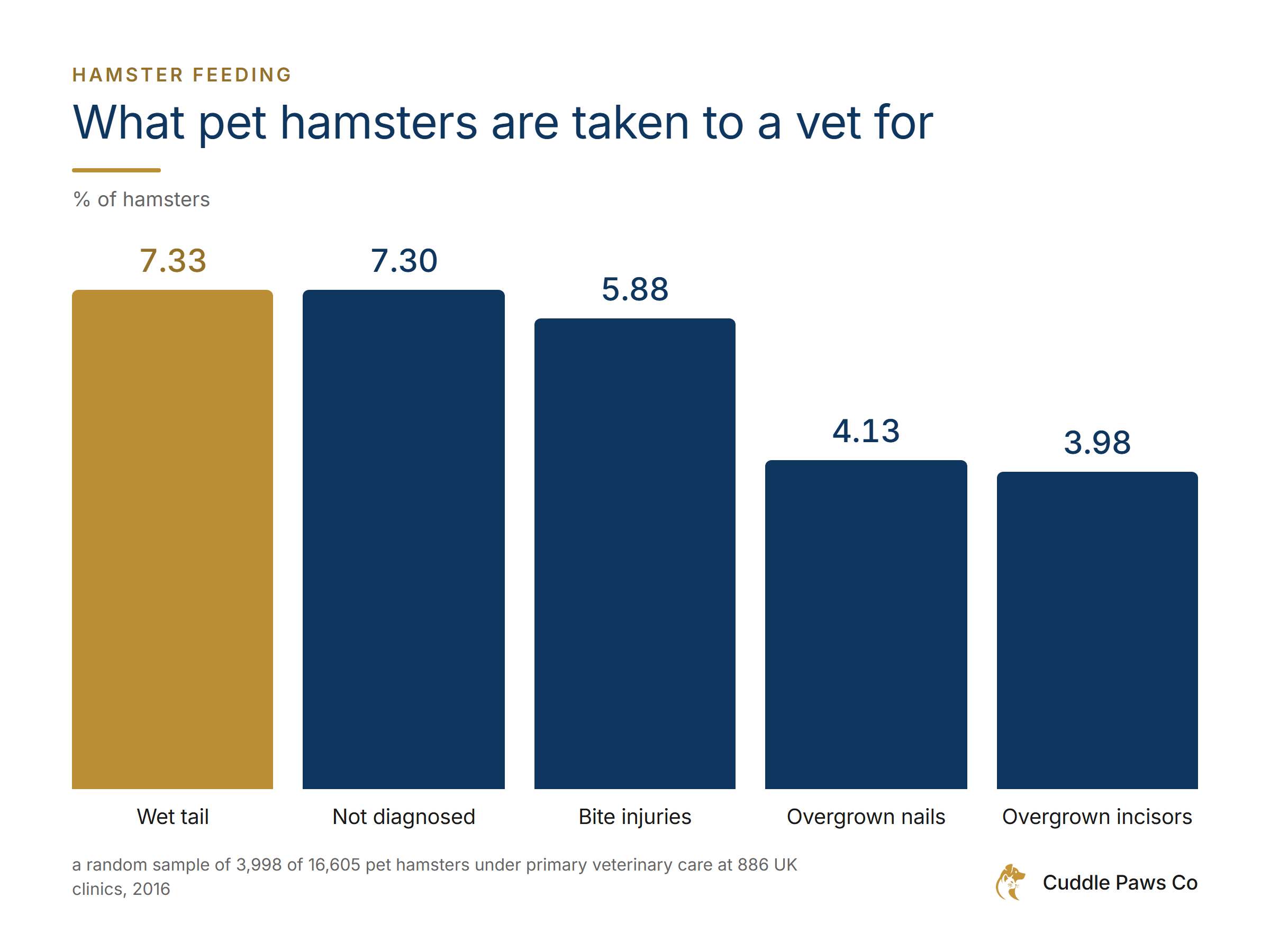
The largest count of what actually goes wrong with pet hamsters comes from Britain. Researchers took a random sample of 3,998 of 16,605 pet hamsters under primary veterinary care at 886 UK clinics, 2016, and read every clinical record.
| Recorded disorder | % of hamsters | 95% confidence interval |
|---|---|---|
| Wet tail | 7.33 | 6.54 to 8.18 |
| Not diagnosed | 7.30 | 6.51 to 8.15 |
| Bite injuries | 5.88 | 5.17 to 6.65 |
| Overgrown nails | 4.13 | 3.53 to 4.79 |
| Overgrown incisors | 3.98 | 3.40 to 4.63 |
Source: Demography, disorders and mortality of pet hamsters under primary veterinary care in the United Kingdom in 2016, Journal of Small Animal Practice, 2022.
Read it carefully. These are British hamsters in 2016, not Indian ones now, and the study records what a vet diagnosed, not what caused it, so none of these bars proves food was to blame. "Not diagnosed" is the paper's own category for a hamster brought in unwell with no diagnosis written down. What the table does show is that the problems a hamster turns up with are small, physical and husbandry-shaped, and that two of the five sit near the bowl: loose droppings, and front teeth grown long because, as the authors put it, nothing was wearing them down. The same paper puts the median age at death at 1.75 years, with a range from 0.01 to 3.65 years.
The feeding advice above comes from three places. The Merck Veterinary Manual's owner-facing hamster page gives the protein figure as "a commercial rat or mouse pellet containing 15–20% protein meets their needs", caps treats at "no more than 10% of the diet", and says seeds "should be limited because hamsters might eat them instead of their balanced pellets". Its professional page is blunter: "Generic seed mixes should be avoided because hamsters selectively pick out seeds and ignore pellets." PDSA explains what the picking-over costs - a hamster eating "the bits that are high in sugar" and leaving "the bits that are high in fibre", which it links to dental problems and obesity - sets the fresh portion at "just a teaspoon or two a day", and is the source for the dwarf hamster warning.
The eight grams is a measured figure, not a guess at a spoonful. Laboratory Animal Medicine (Elsevier, 2015) reports that "Syrian hamsters consume approximately the same amount of food daily, between 5.5 and 8.9 g, during growth and development", and puts fluid needs at about 8.5 ml per 100 g of body weight. The ranges in the table above are that 5.5 to 8.9 g span applied to each pack weight. On the cheek pouch, Ferrets, Rabbits, and Rodents (Elsevier, 2012) states that "sometimes the cheek pouches become impacted, and removal of the material from the pouch with fine forceps is necessary", with the teeth checked for the cause. Neither book gives a figure for how often it happens, so neither do we.
Two gaps worth naming. We could not read a composition for the Vitapol mix from the maker, and our own product page does not print one, so this article gives no protein figure for it. And there is no Indian survey of what pet hamsters here are fed or what they are treated for, which is why the chart is British. Oxbow's own page for the uniform food declares 15% minimum crude protein, 4.5% minimum fat and 10 to 15% fibre, and says the food is "100% uniform to prevent the unhealthy selective eating habits that come with muesli and foraging mixes".
Frequently Asked Questions
How much does hamster food cost per month?
About Rs 70 to Rs 120 a month on the Vitapol mix, or about Rs 250 to Rs 400 a month on the Oxbow food. A 1.2 kg pack at Rs 523 feeds one hamster for four to seven months; a 454 g box at Rs 689 lasts seven to twelve weeks.
Can hamsters eat rice or roti?
A small crumb of plain cooked rice or plain dry roti will not hurt a hamster, but it adds nothing the proper food does not already give. No ghee, no salt, no masala. Keep it rare and keep it tiny.
Can hamsters eat banana?
A piece the size of your fingernail, now and then. Banana is mostly sugar, so it is a treat rather than a food, and for a dwarf hamster it should be rarer still.
Can a hamster live on seed mix alone?
It can live on one, but watch the bowl. If the same plain pieces are always left behind, your hamster is eating the seeds and skipping the rest, and a uniform food or a few pellets mixed in will even it out.
What should I do if my hamster stops eating?
See a vet who treats small animals, and do not wait a day to decide. A hamster is small enough that a day without food matters, and the commonest reasons are its teeth or its gut, neither of which you can sort out at home.
अक्सर पूछे जाने वाले सवाल
हैम्स्टर रोज़ क्या खाता है?
रोज़ का खाना एक कम्प्लीट हैम्स्टर फ़ूड होना चाहिए, छोटे भारी कटोरे में। साथ में एक-दो चम्मच ताज़ी सब्ज़ी दे सकते हैं। खाना शाम को दें, क्योंकि हैम्स्टर रात में सक्रिय रहता है।
कौन सी चीज़ें हैम्स्टर को नहीं देनी चाहिए?
चॉकलेट, मिठाई, बिस्कुट, नमकीन, चिप्स, प्याज़, लहसुन, नींबू और संतरे जैसे खट्टे फल, कच्चा आलू, और मसाले वाला कोई भी खाना नहीं। चिपचिपी चीज़ें जैसे पीनट बटर और चिक्की गाल की थैली में फँस जाती हैं।
हैम्स्टर का खाना महीने में कितने का पड़ता है?
लगभग 70 से 300 रुपये महीना, खाना कौन सा लिया है इस पर निर्भर करता है। 1.2 किलो का पैक एक हैम्स्टर के लिए चार से सात महीने चल जाता है, क्योंकि वह दिन में करीब आठ ग्राम ही खाता है।
Sources
- Providing a Home for a Hamster, Merck Veterinary Manual
- Hamsters, Merck Veterinary Manual (Exotic and Laboratory Animals)
- Hamsters as pets, PDSA
- Demography, disorders and mortality of pet hamsters under primary veterinary care in the United Kingdom in 2016, Journal of Small Animal Practice
- Biology and Diseases of Hamsters, in Laboratory Animal Medicine, Elsevier
- Disease Problems of Small Rodents, in Ferrets, Rabbits, and Rodents, Elsevier
- Essentials Hamster & Gerbil Food, Oxbow Animal Health
*This article is general information, not veterinary advice. If your pet is unwell, please see a vet.*
Prices are current as of November 2026 and do change. The figure on each product page is the live one.