Pyometra in dogs: the signs that mean a vet today
Your unspayed dog is dull, off her food and drinking more, weeks after her season. That is a womb infection until a vet says otherwise. Go today.
If your dog has not been spayed and she has gone dull, off her food and thirsty in the weeks after a season, take her to a vet today. A womb infection called pyometra does that, and it kills the dogs whose owners wait.
Key Takeaways
- Dullness is what owners notice most, not discharge. Close to three dogs in ten with pyometra never show a discharge at all.
- It follows a season, usually one to three months later, and nearly always in a dog who has never had a litter.
- No tablet, shampoo or home remedy treats it. Surgery does, and it works well when it happens early.
*This article is general information, not veterinary advice. If your pet is unwell, please see a vet.*
What is pyometra?
Her womb fills with pus. After a season, the hormone that prepares the womb for puppies also turns it into a warm, closed, welcoming place for bacteria, and in an older dog that has gone through this cycle many times the lining thickens and the bacteria win. The infection then poisons her from the inside, because the toxins seep out of the womb and into her blood.
Nothing about it resolves on its own.
Why discharge is the wrong sign to rely on
Most advice tells you to watch her back end for a bloody or creamy discharge. That is true, and it misses the dangerous half of the illness.
When the neck of the womb stays open, the pus drains out. You see it. She is often not desperately ill. When the neck closes, nothing comes out: the pus stays in, the womb stretches, and the poison goes into her blood instead of onto your floor. The dog with no discharge is the dog in more trouble.
Two ordinary things hide it further. A clean dog licks herself and the evidence is gone. And a dog alone in a flat all day leaves it on a floor that gets mopped before anyone looks.
What to watch for instead
In the largest Indian series on this, dullness was the sign owners reported most often. She is flat. She is not herself. She does not get up for the things she always gets up for.
The combination that should move you is:
- a female dog who has not been spayed,
- a few weeks to three months since her last season,
- suddenly dull and off her food, drinking and weeing far more than usual.
Vomiting or a swollen, tight belly makes it more urgent, not less.
One sign almost nobody lists: she can turn up stiff or lame in her back legs. A veterinary review records gait trouble and hind-limb lameness as recognised presentations, and commoner in the closed form where you see no discharge at all.
When does it happen after a season?
Cornell's canine health centre puts it at one to two months after her last heat. An Indian clinical series in Udaipur measured the gap in its own cases and found an average of about two months, with the latest arriving three and a half months after the season. So a dog who seemed fine three weeks ago is still inside the window.
Which dogs get it?
Any female dog who has not been spayed, and it climbs with age. Middle-aged and older dogs make up most cases.
Two things surprise people. The first is that having puppies is not the risk, and never having them is: in the Kerala series, three-quarters of the dogs with pyometra had never whelped. Most pet dogs in this city have never had a litter, which puts them squarely in that group.
The second is the breed list. The names you usually read come from Swedish insurance records and are all imported large breeds. Measured by rate in the Kerala hospitals, the Spitz came top and the Indian non-descript dog second, both ahead of the Labrador. The Labrador leads only on raw numbers, because there are more Labradors.
Can it wait until morning?
No, and the reason is specific. How ill she looks tells you nothing about the state of her womb. The veterinary review on this says no relationship has been shown between the signs a dog shows and how bad the damage inside is, so "she is still eating a little" is not information you can use. A stretched, infected womb can rupture.
A vet can rule it out with a scan and some blood work in an evening. That is a cheap evening compared with the other kind.
What will the vet do?
Fluids into a vein, antibiotics, and an operation to remove the womb and the ovaries. The Merck veterinary manual recommends that surgery in every case except where an owner strongly wants to breed from the dog, and it notes that when medicine alone works, the result should be treated as temporary, because pyometra comes back. Most dogs come through the operation well, which is the whole argument for going early rather than at four in the morning.
Give her nothing from your own medicine cupboard on the way.
Nothing on our shelves treats this
Our catalogue carries 3,721 products today. Not one of them is for a womb infection. Ten of them are diapers for female dogs, in stock, and a diaper is exactly what someone reaches for after seeing a stain following a season. It covers up the one sign you wanted. If that is why you put one on her, take it off and ring a vet.
That is an odd thing for a pet shop to write. It is still the useful thing to write.
Can you prevent it?
Only one thing does, and it is spaying. Cornell states it flatly: pyometra is entirely preventable if a dog is spayed before an infection starts in the uterus. Once the womb is out, there is no womb to fill. When to do it, and whether to do it for your particular dog, is a conversation with a vet rather than something to decide off a blog.
The research behind this
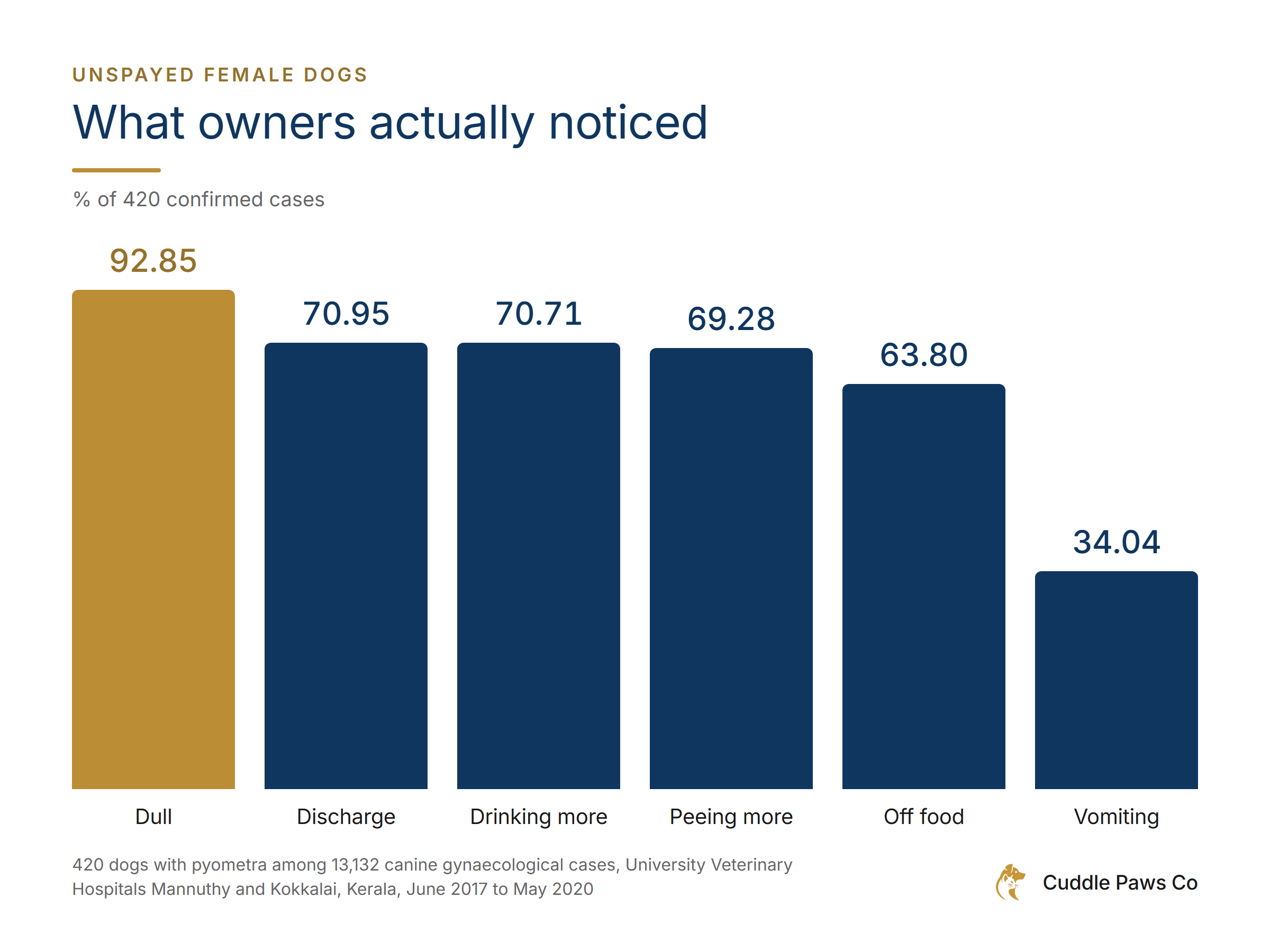
| Sign reported by the owner | % of 420 confirmed cases |
|---|---|
| Dull | 92.85 |
| Discharge | 70.95 |
| Drinking more | 70.71 |
| Peeing more | 69.28 |
| Off food | 63.80 |
| Vomiting | 34.04 |
Population: 420 dogs with pyometra among 13,132 canine gynaecological cases, University Veterinary Hospitals Mannuthy and Kokkalai, Kerala, June 2017 to May 2020. Source: Nayana Devarajan and colleagues, "Occurrence of pyometra among dogs - a retrospective study", *Journal of the Indian Veterinary Association* 22(3), 2024. The paper's own terms are dullness, vaginal discharge, polydipsia, polyuria, anorexia and vomiting; the labels above are those in plain English. The symptoms are as the owner described them at the hospital, which is why they are the right list for an owner at home rather than a list of what a vet finds on examination.
Three more figures from the same paper. Pyometra accounted for 3.20 per cent of all canine gynaecological cases over those three years, 420 of 13,132. Dogs over six years old were 47.86 per cent of cases. Nulliparous dogs, meaning those that had never whelped, were 75 per cent. By breed measured as a rate of the dogs of that breed presented, the Spitz was highest at 7.25 per cent, the non-descript dog second at 6.19 per cent and the Labrador 2.58 per cent, though the Labrador supplied the most cases in absolute numbers at 82.
On timing, the Udaipur series of 16 cases at the Veterinary Polyclinic recorded a mean interval of 8.63 weeks between the last season and diagnosis, ranging from 4 to 14 weeks: Juneja and colleagues, "Study on the factors affecting occurrence of pyometra in reported canine clinical cases of Udaipur region", *Haryana Veterinarian* 60(2), 2021. Sixteen dogs is a small series and it is reported here as what one Indian clinic measured, not as a national figure.
On the closed form, the sentence this article leans on is from Wallace and Casal's review in *Clinical Theriogenology*, volume 10, number 4, 2018: "closed-cervix pyometra cases typically present without overt vaginal discharge, but marked systemic signs of illness are often apparent". The same review records the lameness presentation, notes that careful grooming can mask a discharge, states that no relation has been shown between the nature of the clinical signs and the severity of the uterine lesions, and gives survival after surgery as 92 per cent. That survival figure is the review's own statement citing its sources; it does not print the population behind it on the page, so treat it as a general picture rather than a measured rate.
What could not be found: no Indian study with a stated population reporting how many cases are the closed kind. So this article says the closed form is the dangerous one and does not tell you how common it is. The cost of an emergency spay in Hyderabad is not here for the same reason.
The veterinary statements come from the Merck Veterinary Manual's page on the cystic endometrial hyperplasia-pyometra complex, last modified July 2026, and from the Cornell University Riney Canine Health Center's page on pyometra, both read on 2 November 2026. The catalogue figures were read the same day.
Frequently Asked Questions
Can pyometra be treated with tablets instead of surgery?
Not reliably. The Merck veterinary manual recommends removing the womb and ovaries in every case except where an owner strongly wants to breed from the dog, and says that when drug treatment does work, the success should be regarded as temporary because the infection returns. Whether your dog is a candidate for anything other than surgery is a decision for the vet examining her.
My dog has no discharge. Can it still be pyometra?
Yes, and that is the version to worry about. If the neck of the womb has closed, nothing drains out, so there is nothing to see while she gets sicker. Judge her by how she is behaving, not by what is on the floor.
Can it wait until morning?
Treat it as a same-day problem. How mild a dog looks does not tell you how bad the infection is, and a stretched womb can rupture. A vet can confirm or rule it out the same evening with a scan and blood tests.
Does spaying prevent pyometra?
Yes. Cornell's canine health centre says pyometra is entirely preventable if a dog is spayed before an infection develops in the uterus. The right age for your dog is a conversation with your vet.
अक्सर पूछे जाने वाले सवाल
हीट के कितने दिन बाद पायोमेट्रा हो सकता है?
आमतौर पर सीज़न के एक से तीन महीने के भीतर। उदयपुर के एक क्लिनिक में दर्ज मामलों में औसत लगभग दो महीने था, और कुछ मामले साढ़े तीन महीने बाद भी आए। यानी तीन हफ़्ते पहले ठीक दिखने वाली कुतिया अब भी इस दायरे में है।
डिस्चार्ज नहीं दिख रहा, फिर भी खतरा है क्या?
हाँ, और यही ज़्यादा खतरनाक रूप है। अगर गर्भाशय का मुँह बंद हो जाए तो मवाद बाहर नहीं आता, इसलिए दिखने को कुछ नहीं होता जबकि हालत बिगड़ती रहती है। फ़र्श पर क्या दिख रहा है उससे नहीं, कुतिया के व्यवहार से अंदाज़ा लगाइए।
क्या घर पर कोई दवा या इलाज काम करेगा?
नहीं। इसका इलाज सर्जरी है, और उसके साथ नसों में फ़्लूइड और एंटीबायोटिक। घर की अलमारी से कोई भी दवा न दें। अगर आपकी कुतिया की स्पे नहीं हुई है और वह सुस्त है, खाना छोड़ रही है और पानी ज़्यादा पी रही है, तो आज ही वेट के पास ले जाइए।
Sources
- Occurrence of pyometra among dogs - a retrospective study, *Journal of the Indian Veterinary Association* 22(3), 2024, College of Veterinary and Animal Sciences, Mannuthy, Kerala Veterinary and Animal Sciences University
- Study on the factors affecting occurrence of pyometra in reported canine clinical cases of Udaipur region, *Haryana Veterinarian* 60(2): 279-281, 2021, College of Veterinary and Animal Sciences, Navania, Udaipur
- A review of pyometra in small animal medicine: incidence, pathophysiology, clinical diagnosis, and medical management, *Clinical Theriogenology* 10(4), 2018, Society for Theriogenology
- Cystic Endometrial Hyperplasia-Pyometra Complex in Small Animals, Merck Veterinary Manual, professional edition, last modified July 2026
- Pyometra, Cornell University College of Veterinary Medicine, Riney Canine Health Center
*This article is general information, not veterinary advice. If your pet is unwell, please see a vet.*