Which Royal Canin for a Shih Tzu, Pug or other small dog?
Royal Canin sells a Mini bag and a Shih Tzu bag for the same puppy. What each is for, what the breed bag costs extra per kilo, and when to switch.
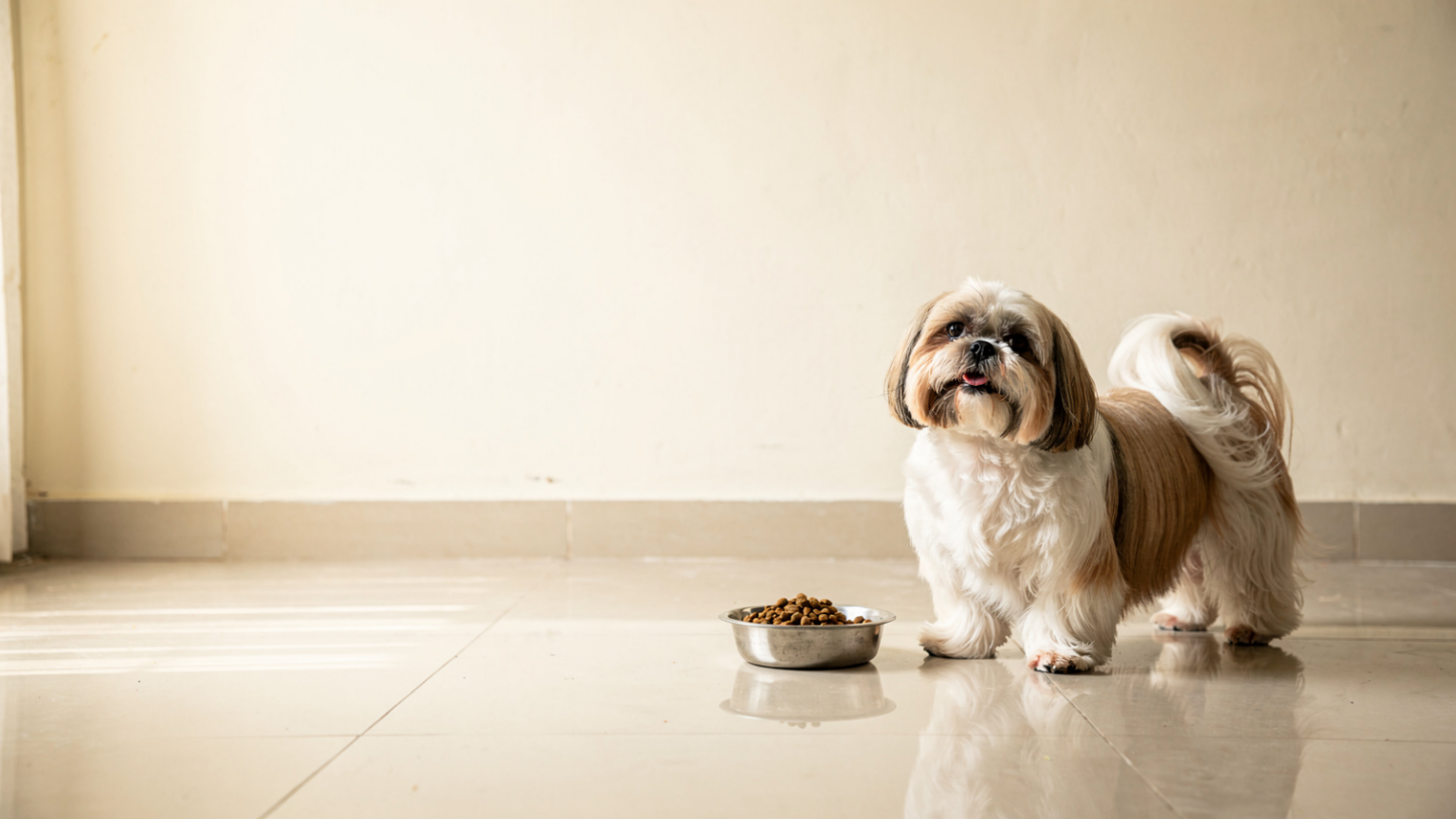
For a small-breed puppy, Royal Canin Mini Puppy does the same job as the Shih Tzu or Pug bag, and costs less per kilo. Buy the breed bag if the kibble suits your dog's mouth. Buy Mini if you would rather have the saving.
Key Takeaways
- Mini Puppy and the Shih Tzu bag carry the same label guarantee. The breed bag costs about forty per cent more per kilo.
- Small dogs come off puppy food earlier than big ones. Most are done growing between eight and twelve months, not at a year.
- Watch a small dog's teeth from the start. Gum disease is far commoner in dogs under ten kilos than in big breeds.
*This article is general information, not veterinary advice. If your pet is unwell, please see a vet.*
Which bag does my small dog need?
Royal Canin lays its small-dog shelf out two ways at once, which is why it looks confusing.
One way is by size. Mini Starter is for a nursing mother and for a puppy coming off milk. Mini Puppy takes over until ten months. Mini Adult is for a dog under ten kilos from ten months onwards. X Small Adult is the same thing for a dog under four kilos, the Chihuahua and Pomeranian end of the shelf. Mini Adult 8+ is for a small dog in its later years.
The other way is by breed. Shih Tzu Puppy and Pug Junior stop at the same ten months as Mini Puppy. Shih Tzu Adult and Poodle Adult pick up from there.
A Shih Tzu puppy therefore has two right answers in front of it. A Lhasa Apso, a Pomeranian, a small crossbreed or a seven-kilo indie dog has one, and it is Mini. Nothing is missing from the Mini bag because your dog's face is not on the front of it.
Is the breed bag worth the extra money?
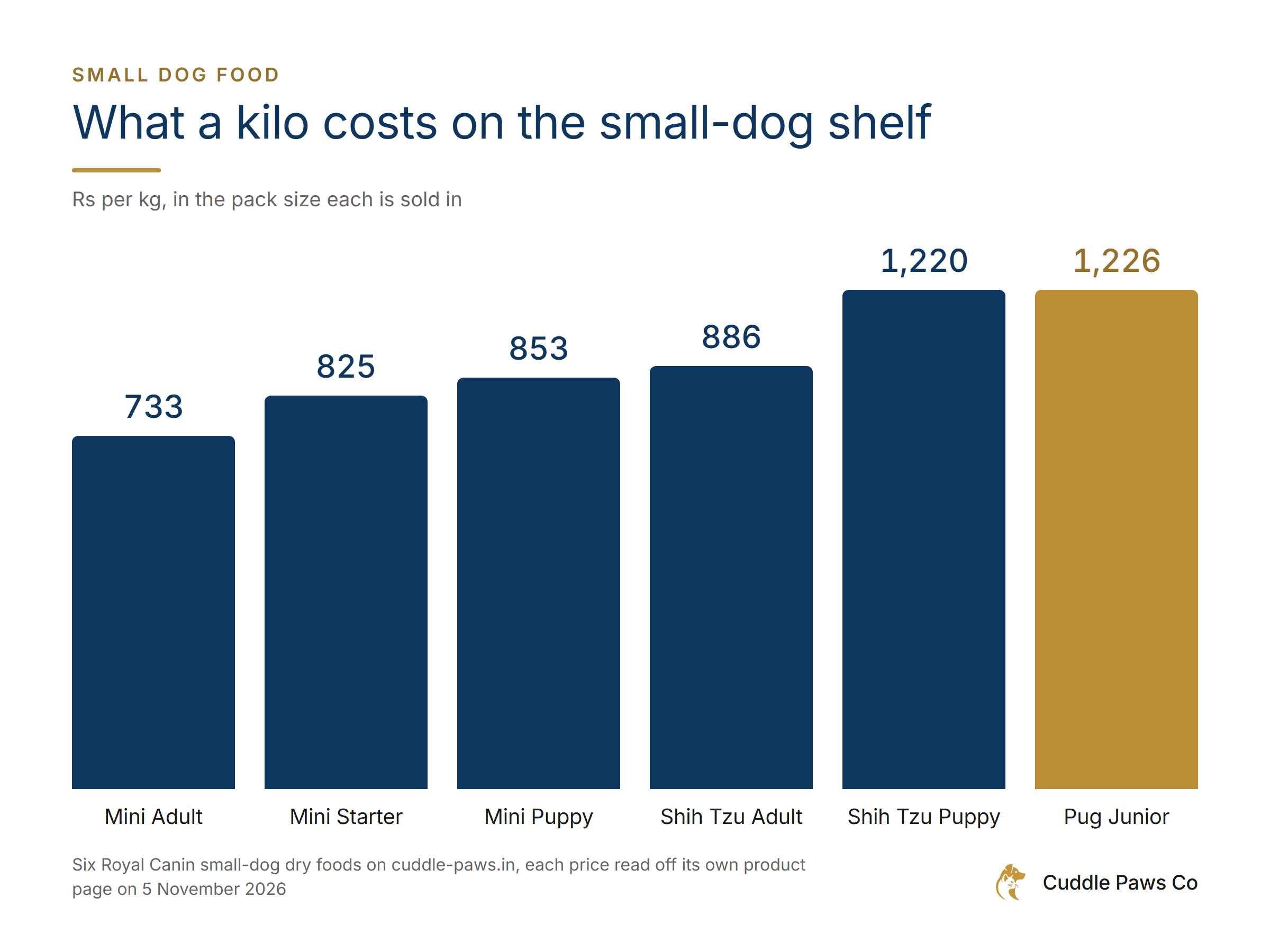
Work in rupees per kilo rather than rupees per bag, because the bags are different sizes. Shih Tzu Puppy works out at Rs 1,220 a kilo here and Pug Junior at Rs 1,226, against Rs 853 for Mini Puppy. Every one of those product pages prints the per-kilo figure itself, so you can check it in a click.
What the extra money buys is a kibble shaped so that a short-muzzled dog can pick it up and chew it, and a recipe weighted towards the coat. That is Royal Canin's own case for the bag, and for a Pug or a Shih Tzu it is not a silly one. A flat-faced dog does push food around the bowl before it manages a mouthful.
What the extra money does not buy is a higher standard of food. The sentence on the back of a pack saying the food is complete and balanced is written for a life stage, and the life stages that exist are growth, maintenance, pregnancy and nursing, and all life stages together. There is no breed among them. The Shih Tzu Puppy bag and the Mini Puppy bag are certified for the same thing.
The ingredient list will not settle it either. The body that writes the nutrition guidelines vets work from says plainly that the ingredient list tells you nothing about the quality of what went in, and can mislead you about the food as a whole.
Where the size half of the shelf does rest on something real is calories. A small dog is not a big dog scaled down, and the veterinary manual is clear that calorie needs do not rise in a straight line with body weight. A Mini food is denser than a Maxi food for that reason, not for marketing.
So: if your dog eats better from the breed kibble, buy it and stop worrying. If your dog clears the bowl either way, Mini is the same food for less money.
When should a small dog come off puppy food?
Earlier than most owners think, and this is the one place small-dog owners go wrong in the opposite direction from Labrador owners. Growing and skeletal maturity may be finished between eight and twelve months in a small or medium breed. That is why Mini Puppy, Shih Tzu Puppy and Pug Junior all stop at ten months.
The better test is weight, not the calendar. Once a dog is at roughly ninety per cent of the adult weight you expect, the veterinary manual recommends dropping to something less rich. With a small dog you can settle that on a kitchen scale, which you cannot do with a Great Dane.
Until then, feed a small puppy often. Very small puppies may need more than three meals a day, because there is not much room in a tiny stomach and not much fuel in reserve.
The part of a small dog to watch is its teeth
Not the coat. Gum disease gets steadily commoner as dogs get smaller: in a large study of dogs seen in ordinary practice, the under-ten-kilo group carried about three times the odds of the thirty-to-forty-kilo group. A Shih Tzu, a Pug, a Pomeranian and most indie dogs of that size are all in the worst band.
An Indian survey points at the bowl as well as the breed. It found gum disease commonest in older dogs, in smaller breeds, and in dogs fed a soft diet rather than a mixed or hard one. In a Hyderabad household a small dog is often eating roti, rice and curd, and that is the diet the survey ties to the most trouble.
This is also the honest reason to take the kibble-shape claim seriously. Royal Canin says the texture of the adult Shih Tzu biscuit helps hold tartar down; it makes no such claim for the puppy bag. Either way, a chew and a brush do more than a biscuit shape, and a small dog's mouth is worth a look from a vet once a year rather than at eight years old when something hurts.
Which bag size, in this weather
The biggest bag is always the cheapest per kilo, and for a small dog that is often the wrong buy. A four-kilo dog eats around a hundred grams a day. A 16kg bag of Mini Puppy opened in a Hyderabad August is still half full in November, and kibble that has sat open through that humidity goes stale and can go mouldy.
This is where the breed bags happen to win. Shih Tzu Puppy and Pug Junior come as a 4.5kg pack holding three sealed 1.5kg bags, so you open a small one at a time. Mini Starter also comes in small sizes, right down to a trial pack. If you want Mini Puppy and the only size is the 16kg, decant it into airtight boxes and keep them out of the kitchen heat. The rest of the range, including the Mini and breed bags for every life stage, sits on the Royal Canin dog shelf.
The research behind this
| Food | Pack size | Price | Rs per kg |
|---|---|---|---|
| Mini Adult | 16kg (2x8kg) | Rs 11,722 | 733 |
| Mini Starter, Mother & Babydog | 16kg (2x8kg) | Rs 13,200 | 825 |
| Mini Puppy | 16kg (2x8kg) | Rs 13,640 | 853 |
| Shih Tzu Adult | 7.5kg | Rs 6,644 | 886 |
| Shih Tzu Puppy | 4.5kg (3x1.5kg) | Rs 5,491 | 1,220 |
| Pug Junior | 4.5kg (3x1.5kg) | Rs 5,518 | 1,226 |
Six Royal Canin small-dog dry foods on cuddle-paws.in, each price read off its own product page on 5 November 2026, from the Royal Canin dog food collection, which described itself as 78 products that day. Each of those pages prints its own per-kilo figure, so every row is checkable in one click.
Two caveats, because the chart is doing real work. The bags are not the same size, and that is part of the finding rather than a flaw in it: the smallest Shih Tzu Puppy pack this shelf sells is 4.5kg, so there is no small bag quietly inflating the figure and no large one to bring it down. Two more bags on the same shelf are left out because they are a different life stage: X Small Adult is Rs 1,276 for 1.5kg, or Rs 851 a kilo, and Mini Adult 8+ is Rs 2,851 for 4kg, or Rs 713 a kilo. Poodle Adult, the third bag named after a breed, is Rs 1,584 for 1.5kg, or Rs 1,056 a kilo.
On the label, the AAFCO guide to reading labels says "The nutritional adequacy statement is perhaps the most important part of a label. It is the key to matching a pet's nutritional needs with a product", and lists the recognised life stages as "gestation/lactation, growth, maintenance, all life stages". Breed is not among them. The WSAVA Global Nutrition Committee is the source on ingredient lists: "The ingredient list gives no information on the quality of the ingredients and can be very misleading on the overall quality of the food."
On growth and the switch, Merck's page on feeding practices states that "Growth and skeletal maturity may be completed by 8-12 months in small and medium breeds", that "After a dog has reached ~90% of its expected adult weight, a diet less nutrient dense than the growth diet is generally recommended", and that "Small-breed puppies may have to be fed more than three times a day". The same page notes that "Small- and medium-breed puppies can be fed a growth or all-life-stage diet that does not meet the criteria for growth of large-size dogs", which is why an all-life-stages food can be right for a Shih Tzu and wrong for a Labrador. On calories, Merck's page on nutritional requirements states that "Energy requirements for dogs and cats are not a linear function of body weight", and records breed itself shifting the figure, noting that "Newfoundlands appear to require fewer calories/day than Great Danes".
On teeth, the numbers come from O'Neill and colleagues in the Journal of Small Animal Practice, a study of 22,333 dogs under primary veterinary care at 784 UK clinics in 2016. The one-year period prevalence of periodontal disease was 12.52%, and "Increasing adult bodyweight was associated with progressively decreasing adjusted odds of periodontal disease". The adjusted odds ratios, against a base of dogs weighing 30 to under 40kg, were 3.07 for dogs under 10kg, 2.48 for 10 to under 15kg, 1.50 for 15 to under 20kg, 1.29 for 20 to under 25kg, 1.23 for 25 to under 30kg (a confidence interval of 0.97 to 1.56, so not separable from the base), and 0.58 for dogs of 40kg and over. These are British dogs and they are diagnoses recorded in a year of consultations rather than a mouth-by-mouth survey, so read them as the shape of the risk rather than as an Indian prevalence.
The Indian reading comes from "Occurrence of Canine Periodontal Disease" in the Indian Journal of Veterinary Medicine, volume 45 number 1, 2025, by Konjeti, Suresh, Pavan Kumar and Kamalakar, which reports that "The occurrence in relation to diet revealed highest in dogs fed with soft diet when compared with to those fed with mixed and hard diets", and the same for older dogs and smaller breeds. That paper also carries an overall occurrence figure, which is not quoted here: its abstract page states no study population, no location and no study period, and a percentage without the group it describes is not a fact. No Indian study of small-breed dog nutrition with a stated population could be found at all, which is why every nutrition figure above is from AAFCO, WSAVA or the Merck manual rather than from Indian data.
The maker's own case for the breed bag is on Royal Canin India's Shih Tzu Puppy page: "A kibble exclusively designed to make it easier for the shih tzu puppy to pick up and to encourage him to chew", a "Complete feed for dogs - specially for shih tzu puppies - up to 10 months old", with "EPA, DHA, and vitamin A help promote the growth of a healthy coat". There is no dental or tartar claim on that page. The tartar line belongs to the adult bag.
Frequently Asked Questions
Which Royal Canin is best for a Shih Tzu puppy?
Either Shih Tzu Puppy or Mini Puppy. Both are complete growth foods for a dog of that size and both run to ten months. The breed bag has a kibble shaped for a short muzzle and costs around Rs 1,220 a kilo against Rs 853 for Mini Puppy, so the question is whether your puppy eats better from it.
Can I give my Shih Tzu puppy Royal Canin Mini Puppy instead?
Yes. It is made for small-breed puppies and carries the same growth statement on the label. The only thing you give up is the kibble shape, which matters for some flat-faced puppies and not for others. Watch whether the bowl empties as cleanly.
When should a Shih Tzu move to adult food?
Around ten months for most, and the bag itself stops there. Growing is largely finished between eight and twelve months in a small breed, and the better signal is reaching roughly ninety per cent of expected adult weight. Then move across over a week or so, mixing a little more adult food in each day.
What should I feed a small indie dog or a Pomeranian?
Mini Adult if the dog is over four kilos, X Small Adult if under. Neither has a breed bag, and neither needs one. Pick by adult weight and life stage, which is what the label is actually certified for.
Is Royal Canin X Small different from Mini?
Yes, by the weight band. X Small Adult is for dogs up to four kilos and Mini Adult for dogs under ten. The smaller the dog, the denser its food has to be, because a two-kilo stomach has to carry a day's calories.
अक्सर पूछे जाने वाले सवाल
Shih Tzu के पिल्ले के लिए कौन सा Royal Canin लें?
दोनों चल जाएँगे: Shih Tzu Puppy या Mini Puppy। दोनों छोटी नस्ल के बढ़ते पिल्लों के लिए पूरे खाने हैं और दोनों दस महीने तक चलते हैं। फ़र्क़ सिर्फ़ बिस्कुट की बनावट और प्रति किलो दाम का है। अगर आपका पिल्ला breed वाले दाने आसानी से उठा लेता है तो वही लीजिए, वरना Mini वही काम सस्ते में करता है।
छोटे कुत्ते को puppy food से बड़ा खाना कब देना चाहिए?
ज़्यादातर छोटे कुत्तों के लिए दस महीने के आसपास, और बैग भी वहीं ख़त्म होता है। छोटी नस्लों में बढ़ना आठ से बारह महीने के बीच लगभग पूरा हो जाता है। जन्मदिन गिनने से बेहतर है वज़न देखना: जब कुत्ता अपने अनुमानित पूरे वज़न के लगभग नब्बे फ़ीसदी पर पहुँच जाए, तब हफ़्ते भर में धीरे-धीरे बदल दीजिए।
मेरा कुत्ता देसी है, उसके लिए कौन सा बैग?
वज़न से चुनिए, नस्ल से नहीं। चार किलो से ऊपर के कुत्ते के लिए Mini Adult, और उससे हल्के के लिए X Small Adult। देसी कुत्ते के नाम का कोई बैग नहीं आता और ज़रूरत भी नहीं है, क्योंकि पैकेट पीछे जो लाइन खाने को पूरा बताती है वह उम्र के हिसाब से लिखी होती है, नस्ल के हिसाब से नहीं।
Sources
- Reading Labels - Association of American Feed Control Officials (AAFCO)
- Global Nutrition Guidelines - WSAVA Global Nutrition Committee
- Feeding Practices in Small Animals - Merck Veterinary Manual
- Nutritional Requirements of Small Animals - Merck Veterinary Manual
- Epidemiology of periodontal disease in dogs in the UK primary-care veterinary setting - O'Neill, Mitchell, Humphrey, Church, Brodbelt and Pegram, Journal of Small Animal Practice, 2021
- Occurrence of Canine Periodontal Disease - Konjeti, Suresh, Pavan Kumar and Kamalakar, Indian Journal of Veterinary Medicine 45(1), 2025
- Shih Tzu Puppy - Royal Canin India, the maker's own page for the breed bag
- Royal Canin Dog Food - Cuddle Paws Co, the shelf the chart was read from
*This article is general information, not veterinary advice. If your pet is unwell, please see a vet.*
Prices are current as of November 2026 and do change. The figure on each product page is the live one.