Yeast, bacteria or mites: what's wrong with your dog's ear?
More of the infected dog ears in one south Indian study grew yeast than bacteria. Why a vet should look before you buy drops, and what a cleaner can do.
If your dog's ear smells, itches or leaks, get a vet to look in it before you buy anything. The drops that clear a yeast ear do nothing for a bacterial one, and nobody can tell them apart from the outside. A cleaner cleans. It does not cure.
Key Takeaways
- An ear that smells or leaks needs a vet to look inside it first. What is in there decides the treatment.
- Ear cleaners lift wax and discharge out. They do not treat an infection, and they do not reach its cause.
- A dog whose ears go wrong again and again often has a skin allergy underneath. Treat the ear alone and it comes back.
*This article is general information, not veterinary advice. If your pet is unwell, please see a vet.*
What is actually in there
A sore ear comes down to three suspects: yeast, bacteria or mites. From outside they produce much the same picture, and the outside is all you can see. A dog's ear canal bends partway down, so whatever sits at the bottom of it is hidden from you and from whoever is standing behind a shop counter.
A vet settles it in one visit, with an otoscope to look down the canal and a swab under a microscope to name what is growing. The otoscope earns its place for a second reason that has nothing to do with the bug. Several ear medicines damage hearing and balance if the eardrum behind them is torn, and a dog with a long-running ear problem is exactly the dog whose eardrum might be. The Merck Veterinary Manual states the rule flatly: check that the eardrum is intact before putting anything topical in.
Mites belong mostly to puppies and kittens. In a grown dog, the American College of Veterinary Surgeons names allergy as the usual thing underneath, to something in the food or something in the air. That comes back later on this page.
Why the wrong bottle does nothing
An antibiotic drop kills bacteria and has no effect on yeast. An antifungal does the reverse. Guess at either one and you have close to even odds of treating something that is not there, while the ear gets another week worse.
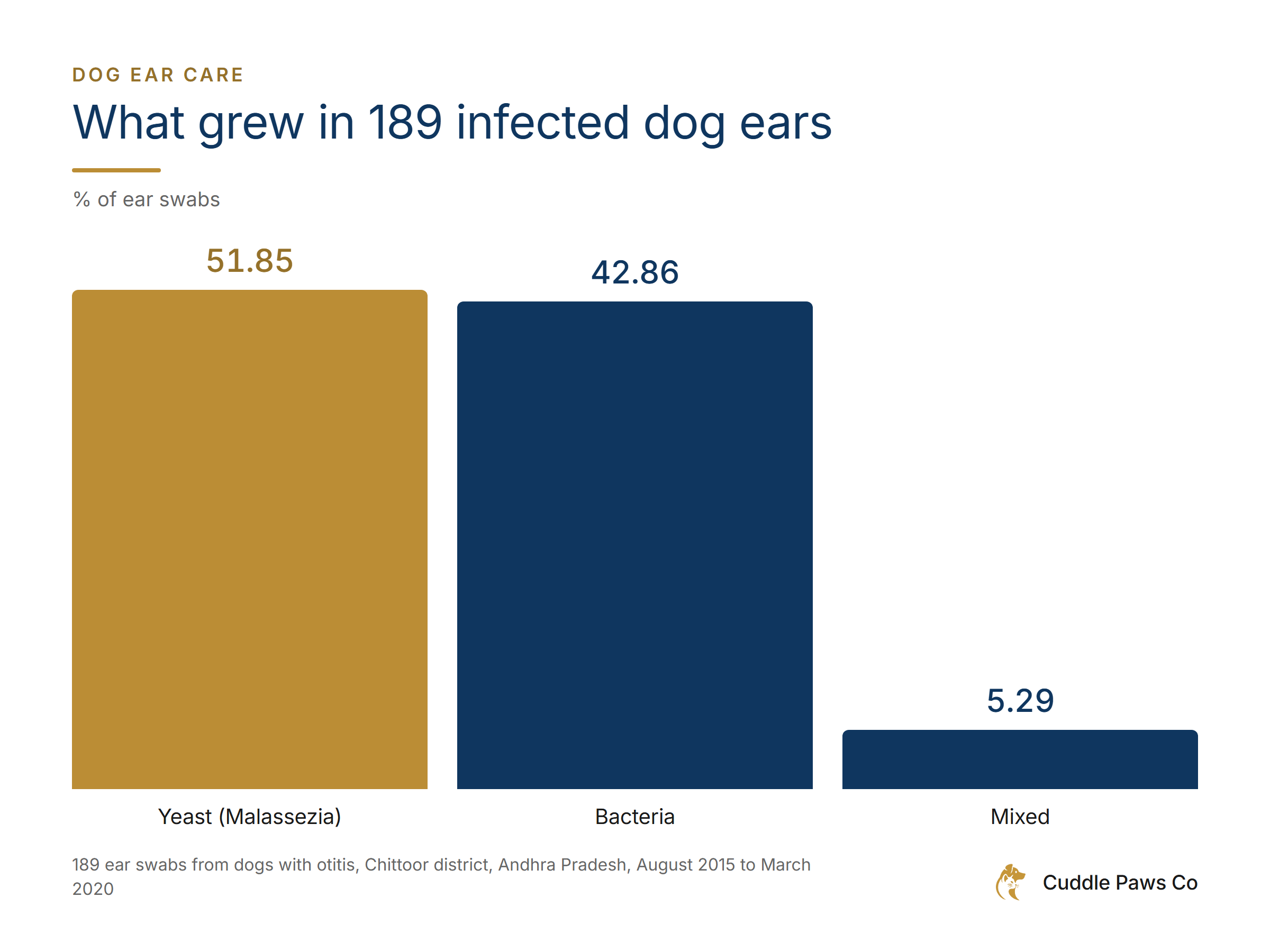
The nearest local evidence comes from a veterinary diagnostic laboratory in Chittoor district, Andhra Pradesh, which cultured ear swabs from dogs brought in with ear infections over five years. More of those ears grew yeast than bacteria. Just over half grew Malassezia, which is also a yeast that lives in small numbers in perfectly healthy dog ears, so finding it does not close the question either. The exact split is further down.
What an ear cleaner can and cannot do
A cleaner lifts wax, discharge and debris out of the canal, and that job is worth doing. Medicine dropped on top of a crust of discharge gets soaked up by the crust, which is why a vet cleans an ear before treating it.
What it will not do is cure an infection. It does not reach the cause, and no cleanser can tell you whether the trouble is yeast or bacteria. For a sound ear that gets damp after a bath or a wet-weather walk, wiping the outer ear once a week is sensible upkeep. For an ear that already smells, it is not a treatment.
Two more rules from the owner edition of the Merck manual. Skip the cotton buds: the canal bends, so a bud packs discharge down against the eardrum instead of lifting it out. And if mites turn up in a house with more than one animal, every animal in contact needs treating, or the untreated one puts them straight back.
Which bottle is which on our shelf
This is the part worth knowing before you order from us or from anybody else. Our ear and eye care collection held seventy-eight products when this was written, and it mixes four unrelated things in one list: cleansers and flushes, wipes, medicated ear drops, and eye products. Across the catalogue there are around twenty ear cleansers against nine medicated ear drops for dogs and cats, and two of those drops carry an antibiotic name on the label. Nothing on the page sorts them out for you.
So, to sort them. Virbac Epiotic Ear Cleanser, Rs 134 for a 50 mL bottle, is a cleanser, for lifting wax out of an ear that is basically sound. Pawpaya Ear Wipes, Rs 170 for a pack of twenty-five, do the outer ear and nothing deeper. The medicated drops sitting beside them belong in a different conversation: which one, and for how long, is a question your vet answers after looking in the ear. We will not guess it for you at the counter, and a shop that does is guessing.
When an ear needs a vet the same day
A head tilt, circling, falling towards one side or a sudden loss of balance means the trouble has gone past the outer ear. So does an ear too painful to let you near it. None of that waits for a bottle to arrive.
The dog whose ears keep coming back
Here is the common story, and the answer disappoints people: the ear is the symptom. Where allergy is driving it, clearing the infection without touching the allergy buys you a few months. The manual is blunt. Unless every cause gets treated, the problem returns.
Letting that cycle run has a price. The surgeons' college describes what a canal becomes after years of inflammation: the lining thickens and narrows it, and once the cartilage has calcified the whole ear canal may have to be removed in surgery. Against that, one examination and one swab is cheap.
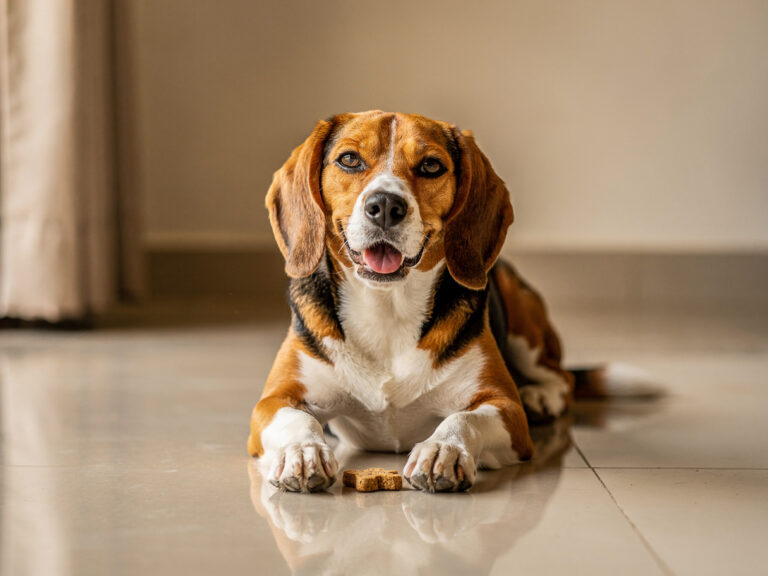
Ear shape matters as well. In a large study of dogs in British general practice, dogs with drop or pendulous ears were close to twice as likely to get an ear infection as dogs with erect ears. Beagles, Cocker Spaniels, Labradors and any other dog with drop ears sit in that group. If yours does, look in those ears weekly rather than waiting for a smell.
Hyderabad's warm, humid months are a reason to be thorough after a bath. Dry the base of a heavy ear properly every time.
The research behind this
| What grew | % of ear swabs |
|---|---|
| Yeast (Malassezia) | 51.85 |
| Bacteria | 42.86 |
| Mixed | 5.29 |
Population: 189 ear swabs from dogs with otitis, Chittoor district, Andhra Pradesh, August 2015 to March 2020, cultured at the State Level Diagnostic Laboratory of Sri Venkateswara Veterinary University, Tirupati, and reported by Rani Prameela and colleagues in the International Journal of Current Microbiology and Applied Sciences, 2020. Of the 81 bacterial isolates, Staphylococcus accounted for 79.01% and Pseudomonas for 20.99%.
Three caveats on that chart. These dogs had already been brought in with ear disease, so the figures say what a vet finds in a sore ear and not what share of dogs get one. Chittoor district is around 550 km from Hyderabad: the same hot, humid south, not the same city. And the paper contradicts itself, giving one set of ear-swab figures in its abstract and another in its results. The numbers above are the ones its Table 2, its results and its discussion all agree on, and they are also the only set that adds up to its 189 samples.
The Merck Veterinary Manual's professional page on otitis externa, last revised in April 2026, is where the two rules in this article come from. On yeast: "Yeast, specifically Malassezia pachydermatis, may be present in low numbers in healthy ears of dogs and cats but frequently multiply with otitis externa." On the eardrum: "It is important to verify that the tympanic membrane is intact before applying topical treatments, as many agents (such as aminoglycosides) can cause ototoxic effects." The owner edition adds the line about recurrence: "Identifying all possible causes is essential. Unless every cause is treated, the condition often returns."
On ear shape, the figures come from UK primary veterinary care rather than India. O'Neill and colleagues looked at a random sample of 22,333 dogs under veterinary care in 2016 and found a one-year prevalence of otitis externa of 7.30% (95% CI 6.97 to 7.65). Against erect ears, V-shaped drop ears carried 1.84 times the odds (95% CI 1.53 to 2.21) and pendulous ears 1.76 times (1.48 to 2.10), while semi-erect ears made no difference at 1.03 (0.86 to 1.24). Breed prevalence ran from 28.81% in Basset Hounds, 17.76% in Chinese Shar Peis, 14.72% in Beagles and 14.11% in Golden Retrievers down to 2.30% in Border Collies and 1.26% in Chihuahuas. Ear anatomy travels; a British prevalence figure does not, and none of those percentages should be read as an Indian risk.
One gap worth stating. No Indian or Telangana figure for how common canine ear infection is turned up in this search. A 2025 Indian series on the same question exists, but its text could not be read when this was written, so nothing from it appears here.
Frequently Asked Questions
Why does my dog's ear smell?
Something is growing in the canal, usually yeast or bacteria. The smell is the waste they produce, and it means the ear is already inflamed rather than just dirty. Get a vet to look before you buy drops, because the two need different medicines.
Can I use an ear cleaner instead of going to a vet?
No. A cleaner lifts wax and discharge out, which helps, but it does not kill what is causing the infection and it cannot tell you what that is. Use a cleanser for upkeep on a healthy ear, and a vet for an ear that smells or hurts.
How do I know if it is ear mites?
You do not, from looking. Mites, yeast and bacteria all cause scratching, head shaking and dark discharge, and a vet separates them with a swab under a microscope. Mites are far more a puppy and kitten problem; in a grown dog, allergy is the more likely thing underneath.
Can I put human ear drops in my dog's ear?
No. Several of them are the wrong medicine for a dog's ear, and some can damage hearing if the eardrum is already torn, which you cannot see. Whatever goes in the canal is your vet's call.
How often should I clean my dog's ears?
For a dog with erect ears and no history of trouble, when they look dirty is often enough. For a dog with heavy drop ears, or one that swims or gets caught in the rain, a weekly wipe of the outer ear is reasonable. Stop and ring a vet if the ear is red, sore or smelly.
अक्सर पूछे जाने वाले सवाल
कुत्ते के कान से बदबू क्यों आ रही है?
कान के अंदर कुछ बढ़ रहा है, आम तौर पर यीस्ट या बैक्टीरिया। बदबू का मतलब है कि कान सिर्फ गंदा नहीं, उसमें सूजन है। कोई भी ear drops खरीदने से पहले वेट को कान अंदर से दिखाएं, क्योंकि दोनों की दवा अलग होती है।
क्या ear cleaner से इन्फेक्शन ठीक हो जाता है?
नहीं। क्लीनर कान से मैल और डिस्चार्ज निकालता है, इतना ही। वह इन्फेक्शन की वजह तक नहीं पहुंचता और यह भी नहीं बताता कि दिक्कत यीस्ट की है या बैक्टीरिया की। ठीक कान की सफाई के लिए क्लीनर, और बदबू या दर्द वाले कान के लिए वेट।
कान में दवा डालने से पहले वेट को दिखाना क्यों ज़रूरी है?
क्योंकि कान का परदा फटा हो तो कुछ दवाएं सुनने की ताकत और बैलेंस को नुकसान पहुंचाती हैं, और परदा आप बाहर से देख नहीं सकते। वेट otoscope से कान के अंदर देखकर ही तय करता है कि कौन सी दवा सही है।
Sources
- Ear Infections and Otitis Externa in Dogs, Merck Veterinary Manual, dog-owner edition, revised April 2026
- Otitis Externa in Animals, Merck Veterinary Manual, professional edition, revised April 2026
- Mite Infestation (Mange, Acariasis, Scabies) in Dogs, Merck Veterinary Manual, dog-owner edition, revised April 2026
- Otitis Externa, American College of Veterinary Surgeons
- Prevalence of Bacterial and Fungal Pathogens of Canine Dermatitis and Otitis in Chittoor District, Andhra Pradesh, Rani Prameela, Shobhamani, Mangadevi and Karthik, International Journal of Current Microbiology and Applied Sciences 9(11), 2020
- Frequency and predisposing factors for canine otitis externa in the UK, O'Neill and colleagues, Canine Medicine and Genetics, 2021, full text via Europe PMC
*This article is general information, not veterinary advice. If your pet is unwell, please see a vet.*
Prices are current as of October 2026 and do change. The figure on each product page is the live one.