Doberman Price in India 2026: What You'll Actually Pay
Doberman prices in India range from ₹20,000 to ₹1,50,000 depending on lineage, health testing, and breeder quality. Here's what every Indian pet parent should know before buying in 2026.
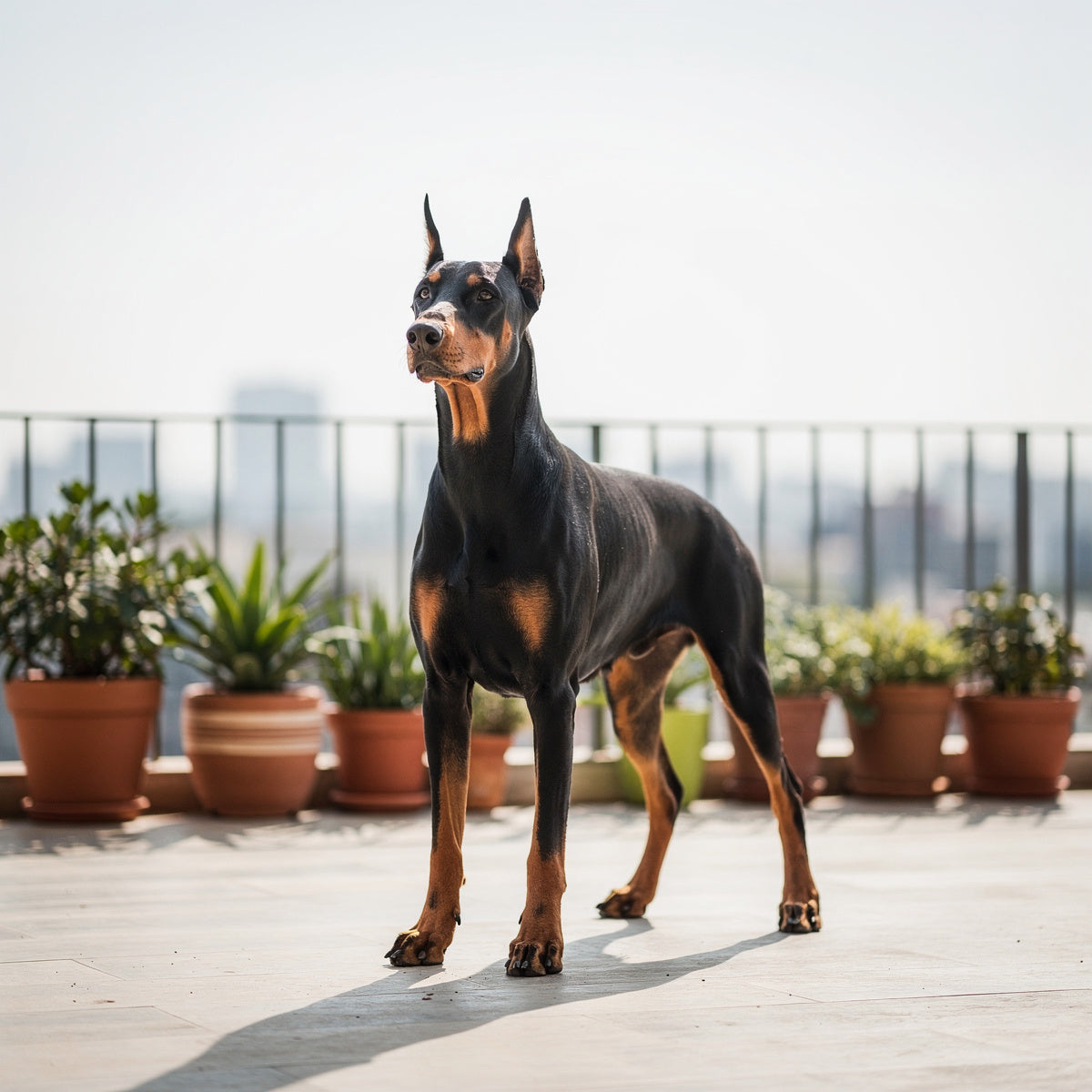
The Doberman price in India runs from about ₹20,000 to ₹1,50,000 or more, depending mostly on the breeder and the bloodline.
Walk a Doberman through any apartment complex in Gachibowli and you'll see what we mean — heads turn, children go quiet, and people immediately want to know whose dog that is. There's something about the breed's posture alone that commands attention. Sleek, alert, built like they were designed with purpose. Which, of course, they were.
We get a steady stream of questions about Dobermans at our store — from IT professionals in Kondapur who want a dog that can actually keep up with their active lifestyle, to families in Manikonda looking for a loyal, intelligent companion who also doubles as a credible deterrent at the gate. The interest is real, and it's growing.
What most people don't have going in is a clear picture of what a Doberman actually costs — not just to buy, but to own responsibly month after month. That's what this guide is for. We're going to walk you through the real numbers, what drives price variation across breeders and bloodlines, and what life with this breed looks like financially in 2026.
What does a Doberman puppy cost in India in 2026?
The honest range is ₹20,000 to ₹1,50,000 or more — and that spread is not random. It reflects real differences in lineage verification, health testing of parent dogs, breeding environment, and the breeder's long-term accountability to buyers. Let's break it down properly.
Unregistered or backyard breeders — ₹10,000 to ₹25,000. These puppies often look the part. Black and tan, clean face, the right proportions. But without documentation, you have no way to verify that the parents were health-tested, that the lineage is genuinely purebred, or that the breeding pair didn't carry known genetic diseases. And Dobermans carry some serious ones — Dilated Cardiomyopathy (DCM) is frighteningly prevalent in the breed, von Willebrand's Disease (a clotting disorder) is another, and hip dysplasia is a concern in poorly-bred lines. A puppy bought for ₹15,000 from a WhatsApp seller can easily cost you ₹40,000 in veterinary bills by year one. We've seen it happen with customers. The upfront saving is not real.
KCI-registered reputable breeder — ₹25,000 to ₹50,000. This is where most responsible Indian pet parents should be looking. KCI registration isn't a guarantee of perfection, but it does mean the breeder has documented the lineage, submitted to breed standard verification, and has records you can inspect. For a family companion and guard dog — which is most people's actual use case — this tier gives you a legitimate, well-bred Doberman. Expect to pay 20 to 35% more than unregistered breeders, and understand that premium is paying for verifiable information about the dog you're bringing home.
Show quality or champion bloodline dogs — ₹50,000 to ₹1,00,000+. If a breeder is specifically offering dogs from cardiac-screened and vWD-tested parent lines, that premium is genuinely worth considering. DCM is a disease that can shorten a Doberman's life significantly — knowing the parents were cardiac-clear at the time of breeding is meaningful, not just prestige. If it's purely about conformation trophies and show ring points, that's a different conversation, and for most family homes, not a necessary one.
European working-line imports — ₹1,00,000 to ₹1,50,000+. These dogs come from IPO or Schutzhund-trained lineages in Germany or Eastern Europe, and they are genuinely different animals to manage. Drive, intensity, the need for structured work. Unless you have real experience with working-line dogs, or you're specifically building a protection sport programme, this is not the right starting point for a first-time Doberman owner. The dog will not be satisfied with two walks around Inorbit Mall.
Rescue and rehoming — ₹2,000 to ₹5,000. Dobermans do show up in shelters. Often because someone bought one without understanding what the breed requires, and then couldn't manage. An adult Doberman from a rescue organisation — partially or fully trained, temperament assessed, vaccinations current — is absolutely worth considering. For an experienced dog owner, it's sometimes the most sensible choice on the list. Check with organisations like Blue Cross of Hyderabad or CUPA in Bengaluru.
What drives price variation beyond the breeder tier?
Coat colour is one factor that moves the price considerably, and it's worth understanding before a breeder uses it to upsell you.
The standard black and tan is the most common, and typically sits at the lower end of a breeder's pricing within their tier. Red (brown and rust) is slightly rarer and commands a small premium. Blue and fawn Dobermans — which are dilute colour variants — are often priced higher because buyers treat rarity as value. Our honest opinion: blue and fawn Dobermans are more prone to a skin condition called Colour Dilution Alopecia, which causes patchy hair loss and chronic skin issues. Paying more for a colour that carries health risk is not a good trade. The classic black and tan is black and tan for a reason.
Gender also affects pricing — females tend to be priced slightly lower than males in most Indian breeding operations, though for a family companion the difference in suitability is largely overstated.
City matters too. Mumbai and Bengaluru tend to price 15 to 25% higher than Hyderabad for comparable dogs, simply because demand is higher and operating costs for breeders are steeper. Hyderabad has a reasonable local Doberman breeding community, so you don't necessarily need to source from outside the city.
What does monthly Doberman ownership cost in Hyderabad?
This part of the conversation gets skipped far too often, and it's actually where the real financial commitment lives.
Food is the biggest recurring cost. A Doberman adult male weighing 35 to 40 kg needs roughly 3 to 4 cups of a quality large-breed dry food daily. Premium kibble runs ₹3,500 to ₹6,000 per month depending on brand. Raw or home-cooked diets can vary widely — if you're feeding home food, factor in the cost of chicken, eggs, and a good calcium supplement. Don't skip the supplement; large breeds need proper bone support.
Routine vet care — annual vaccinations, rabies boosters, quarterly deworming, monthly tick and flea prevention — adds roughly ₹8,000 to ₹12,000 per year when things are going well. Hyderabad's climate means tick exposure is a real issue, especially during and after monsoon. A dog this size with a tick infestation is not a minor problem. Stay consistent with your prevention protocol.
Training is non-negotiable for this breed. A Doberman that hasn't been properly socialised and trained is a liability, not a companion. Budget ₹3,000 to ₹8,000 for a professional trainer in Hyderabad, either group classes or one-on-one. We'd suggest starting obedience training before the puppy turns four months. The longer you wait, the harder it gets.
Grooming is actually one of the lower ongoing costs for a Doberman — short coat, minimal shedding by large-dog standards. A basic grooming session at home once a week handles most of it. If you bring them into our grooming services for a full bath and nail trim, that's around ₹500 to ₹800 per session.
Then there's the unpredictable stuff. Given the breed's cardiac predispositions, a baseline echocardiogram at age two and regular cardiac monitoring after age four is something we'd strongly recommend discussing with your vet. An echo in Hyderabad runs ₹2,500 to ₹5,000 at a specialist clinic. Pet insurance is worth exploring — the market in India is still maturing but options exist, and for a breed with known health risks, it makes financial sense.
All told, a responsibly-owned Doberman in Hyderabad costs ₹6,000 to ₹12,000 per month in routine expenses, before any medical emergencies.
What gear does a Doberman actually need?
Let's keep this practical. A Doberman puppy needs a properly fitted collar — not a slip lead, not a choke chain, a flat buckle or quick-release collar with an ID tag from day one. As they grow, a well-fitted harness for walks is worth investing in, especially while leash training. A dog this strong pulling hard on a collar puts real strain on the trachea. We'd suggest transitioning to a harness for street walks by four months.
Bedding matters more than people think for large breeds. A Doberman is a lean dog with minimal fat padding — hard floors are genuinely uncomfortable for them. An orthopedic or memory foam bed protects the joints over time. You can browse our dog bed collection and filter by size. For a breed that will hit 35 to 40 kg, look for beds labelled XL or XXL with at least 3 inches of foam.
A stainless steel or ceramic bowl is better than plastic for a dog you'll have for 10 or more years — plastic scratches and harbours bacteria over time. Our bowls and feeders section has options that work well for deep-chested breeds.
One thing we always tell new Doberman owners: invest in a good leash before the puppy gets big. A 1.5-metre flat leash with a sturdy snap hook — not a retractable lead. Retractable leads and large dogs are a bad combination, especially on busy roads near Gachibowli's tech park exits during evening rush.
Is a Doberman the right dog for an apartment in Hyderabad?
We get asked this constantly, and the answer is genuinely: it depends more on your lifestyle than your floor plan. A Doberman in a 3BHK flat whose owner runs 5 kilometres every morning, works from home, and commits to daily structured exercise can thrive. A Doberman in a 4BHK villa with an owner who leaves for the office at 8am and returns at 8pm will be miserable, destructive, and anxious by month three.
This breed bonds intensely. They don't do well with long periods alone. They are not the dog you set up with toys and walk twice quickly. If your work schedule or travel pattern means the dog is regularly alone for 8 to 10 hours, please consider a more independent breed. It's not about space — it's about time and attention.
If the lifestyle genuinely fits, a Doberman is one of the most rewarding dogs you can own. Loyal in a way that's almost uncomfortable when you first experience it. Fast to learn, genuinely interested in working with you, and physically spectacular. We're not going to pretend we don't love the breed. We just want people to go in knowing what it asks of them.
Read next: German Shepherd Price in India 2026: What You'll Actually Pay; Best Guard Dog Breeds for Indian Homes; Which Royal Canin does a large breed puppy need?
Frequently Asked Questions
Is a Doberman a good first dog for Indian families?
Honest answer — no, not usually. The breed needs confident, consistent handling, early socialisation, and structured training from a knowledgeable owner. First-time dog parents who haven't done serious research or worked with a professional trainer from the start often struggle. That's not a knock on the breed; it's a realistic assessment of the commitment level required. If you're set on a Doberman as your first dog, hire a trainer before the puppy even comes home.
What is the KCI and why does KCI registration matter when buying a Doberman?
KCI is the Kennel Club of India — it's the closest thing India has to an official purebred dog registry. A KCI-registered Doberman comes with a pedigree certificate that documents the dog's lineage going back several generations. It doesn't guarantee perfect health, but it confirms the dog is purebred and that the breeder operates with some level of accountability. It's the minimum standard we'd recommend for a large-breed purchase of this nature.
Are Dobermans good guard dogs or are they overrated for that role in India?
They are genuinely excellent at it, but probably not in the way most people imagine. A well-bred, properly socialised Doberman isn't aggressive by default — it's alert, perceptive, and deeply protective of its family. It will detect something wrong before you do and react accordingly. The dogs you see that are aggressive and uncontrollable are usually poorly bred, poorly socialised, or kept in conditions that created behavioural problems. A Doberman raised correctly is a far more effective deterrent than a chained, reactive dog — and far safer to live with.
Is ear cropping legal in India for Dobermans?
No. The Prevention of Cruelty to Animals Act makes cosmetic surgical procedures like ear cropping illegal in India. You will occasionally see cropped-ear Dobermans in India — these are either imported dogs or dogs where the procedure was done illegally. Reputable Indian breeders do not perform ear crops. The natural floppy ear Doberman is the legal standard here, and honestly, they look fine. This shouldn't be a deciding factor in your purchase.