Best Dental Treats for Dogs: What Actually Works
Destructive chewing and poor dental hygiene are often the same problem in disguise. Here's what actually works to clean your dog's teeth while keeping them happily occupied.
Most dog parents in Gachibowli come to us about chewing problems before they come to us about dental problems. Their Lab is destroying sofa cushions, their Beagle is gnawing chair legs, their Indie pup has discovered the TV remote. What they don't always realize is that these two problems, the destructive chewing and the dental health, have the same solution. Give your dog something worth chewing, and you solve both at once.
Medically reviewed by Dr. Rafi Suhail, Master's in Small Animal Internal Medicine and Master's in Small Animal Dermatology
This article is for general informational purposes and isn't a substitute for professional veterinary diagnosis or treatment. Always consult your vet for advice specific to your pet's health.
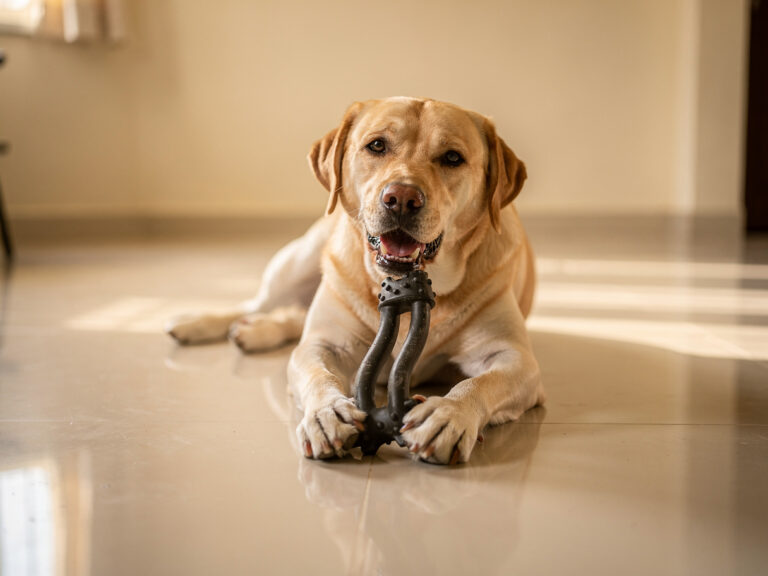
Dog teeth don't clean themselves. Without brushing or some kind of mechanical action, plaque builds up, hardens into tartar, and causes gum disease that most owners never notice until a vet points it out. The good news is that the right dental chew or treat creates exactly that mechanical action — your dog thinks they're just having fun, and their teeth are getting scrubbed in the process.
 Photo by Vidak on Unsplash
Here's what we stock and recommend at Cuddle Paws Co, based on what our customers actually come back to buy again and again.
Why do dogs need dental treats in the first place?
Wild dogs chewed bones, bark, and tough meat that naturally scraped their teeth clean. Pet dogs eat soft kibble, cooked food, or home-cooked meals — things that leave residue sitting on the teeth. Hyderabad's heat doesn't help either; dogs pant more, drink more, and often eat softer, moisture-rich food that sticks.
We see this in the store regularly. A customer brought in their 4-year-old Golden Retriever last month — lovely dog, great coat, seemingly healthy — and mentioned the vet had flagged early-stage tartar buildup at the annual checkup. The owner was surprised. The dog looked fine. But dental disease in dogs often has no obvious symptoms until it's already causing pain. The fix the vet suggested was simple: consistent dental chews a few times a week, alongside whatever brushing the dog would tolerate.
That's where this list comes in. These aren't just treats that taste good. They're treats that do a job.
Basil Dental Care Sticks
This is probably the product we recommend most often for first-time buyers. Basil Dental Care Sticks are hard, twisted chews, and that twisted shape is the real reason they work. The ridges and grooves reach between teeth and along the gum line in a way that a flat chew simply can't. Your dog isn't just biting down — they're working the stick from multiple angles, which means more surface coverage.
They contain calcium and phosphorus, which supports tooth and bone strength over time. For puppies going through teething, or for older dogs whose gums need some attention, this is a solid everyday option. The sticks are firm enough to keep a dog engaged for a while, which solves the furniture problem as a bonus.
Goodies Long-Lasting Dental Bar (Chicken)
If you have a medium to large dog who gets bored with most chews in under three minutes, the Goodies Dental Bar is worth trying. It's designed to last, which matters because the longer your dog chews it, the more cleaning action happens. A chew that's gone in 90 seconds isn't doing much for tartar.
This one is grain-free, with no added corn or soy, which makes it a reasonable choice if your dog has a sensitive stomach. The chicken flavour tends to go down well with most dogs — we've had very few complaints on that front. It's primarily aimed at medium and large breeds, so if you have a small dog like a Shih Tzu or a Pomeranian, you'd want to size down.
Gnawlers Dentalight Dental Bone
This one has something most dental chews don't: the Veterinary Oral Health Council (VOHC) Seal of Acceptance for tartar control. That seal actually means something. The VOHC tests products before awarding it, so it's not just marketing. For pet parents who want something with a bit more verification behind it, Gnawlers Dentalight is worth the attention.
It contains chlorophyll, which helps with breath (and if your dog's breath makes you wince, you'll appreciate this), plus fibre for gut health and calcium for strong teeth. It covers a few bases at once, which is why it's popular with owners who are trying to simplify their dog's supplementation routine.
Dogsee Chew Yak Cheese Turmeric Mini Pops
These are something a little different. Handcrafted in the Himalayas from yak milk, these hard cheese chews are about as natural as it gets, and Indian pet parents in particular have taken to them quickly. Part of that is the turmeric angle — turmeric is something many of our customers already use in their own kitchens, and knowing it's in their dog's treat too feels reassuring.
They're low in fat, high in protein, and free from artificial additives. They work well as training rewards for dogs who are high food-motivated, because the smell is strong enough to hold attention without being overpowering. We'd suggest these for dogs who've already worked through the harder dental sticks and need some variety, or for owners who prefer a more natural, ingredient-transparent product.
Captain Zack Tropical Apeel Crisp Banana Treats
Not every dog does well with meat-based chews, and some pet parents — particularly vegetarian households — prefer a plant-based option. Captain Zack's banana treats fill that gap. They're crispy, not soft, so they still provide some chewing action rather than just dissolving immediately.
The banana base means they're naturally sweet without added sugar, and they're low in salt, which matters more than people realize. Many commercial dog treats carry a surprisingly high sodium load. These are chemical-free, potassium-rich, and go down well with dogs who prefer lighter flavours. Smaller breeds tend to love them.
How often should you give dental treats?
Most dental chews are designed for daily use, though a few of the harder, denser ones like yak cheese are better given 3 to 4 times a week rather than every day. Always check the packaging guidelines and factor in the rest of your dog's daily calorie intake — dental treats still count toward their overall diet.
For dogs who are heavy chewers, rotating between two or three types of chews keeps things interesting and ensures different areas of the mouth get attention. If your dog has existing dental disease or has had dental surgery, check with your vet before introducing hard chews — you don't want to aggravate anything.
If you're also in the market for updated feeding gear, our Bowls & Feeders collection has some great options to pair with any new feeding or treat routine. And if you haven't already had your dog's teeth looked at, a vet can do a quick oral health check and give you a clearer picture of where your dog currently stands.
Browse our full range of treats, chews, and health products in the Dog Products collection at Cuddle Paws Co. We update stock regularly, and if you're unsure which chew suits your dog's size, age, or breed, just ask us in-store or reach out through the Contact page.
Brushing and chewing do different jobs
The global vet dental guidelines say brushing works best on the front teeth, and chewing works best on the back teeth. It makes sense: a brush reaches where your hand can easily go, and chewing happens at the back of the mouth.
So a dog on dental chews alone has front teeth that never get cleaned. A dog brushed only at the front has back teeth that never get cleaned. The biggest tooth at the back, used for heavy chewing, is often where gum problems are worst.
Dry food doesn't clean teeth
Many people believe kibble scrapes teeth clean. The vet guidelines say standard dry food doesn't help dental health.
Many dogs in India eat soft home food like rice, curd and roti. An Indian survey found gum disease was most common in dogs on soft diets. That isn't a reason to switch to kibble. It means a soft-fed dog needs brushing and chewing, because its food does none of the work.
The research behind this
Which teeth each method cleans. The WSAVA Global Dental Guidelines, written by veterinary dentists from nine countries, state: "It has been shown that active homecare is most effective on the rostral teeth (incisors and canines). In contrast, passive homecare (chew based) is more effective on the caudal teeth (premolars and molars)." On frequency: "Daily homecare is recommended since plaque accumulates in 24 hours." On food: "Standard dry dog food is not beneficial for oral health." On toothpaste, veterinary pastes "greatly increase the acceptance of the toothbrush by the pet".
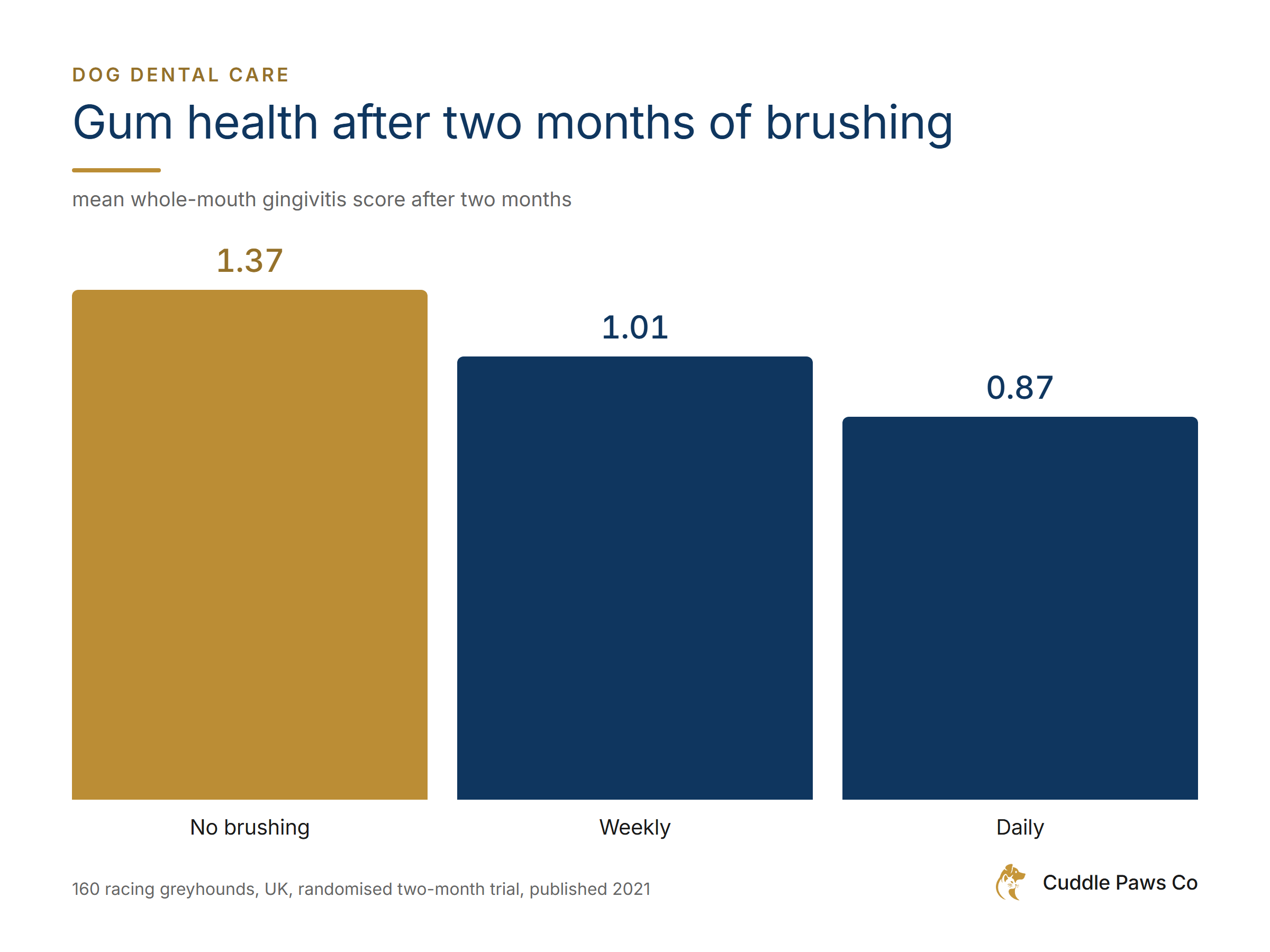
Daily against weekly brushing. A randomised two-month trial compared no brushing, weekly brushing and daily brushing. On tartar, "both weekly and daily brushing resulted in significant reductions". On gum inflammation, "only daily brushing resulted in a significant reduction".
| Brushing | Gingivitis score after two months |
|---|---|
| No brushing | 1.37 |
| Weekly | 1.01 |
| Daily | 0.87 |
Population: 160 racing greyhounds, UK, randomised two-month trial, published 2021. Source: Rooney and colleagues, Animals (Basel), 2021.
Starting scores were 1.19, 1.03 and 1.01 respectively, so the unbrushed group started highest and still got worse. These were kennelled racing greyhounds brushed by trained staff, not pet dogs brushed at home, so the trial points the way rather than predicting what happens to your dog.
Tested products. The Veterinary Oral Health Council's accepted list for dogs includes "C.E.T. VEGGIEDENT FR3SH Chews for Dogs, all sizes", accepted for plaque and tartar. Pedigree Dentastix appears on the list as "Dentastix Advanced" and a set of UK packs, which are not the Dentastix Oral Care packs sold in India. The toothbrush entry is a specification rather than a brand: "ADA-compliant soft-bristle, flat head toothbrush".
Diet in India. A 2025 survey in the Indian Journal of Veterinary Medicine recorded periodontal disease in 83.44% of dogs, highest in dogs fed a soft diet. The abstract does not say how many dogs, where or over what period, and we could not access the full text, so treat the percentage with caution.
The fingernail test. Cornell's Riney Canine Health Center: "you should be able to make a dent in the item with your fingernail."
अक्सर पूछे जाने वाले सवाल
कुत्ते के दाँत कितनी बार ब्रश करने चाहिए?
हर दिन, भले ही थोड़ी देर के लिए। दाँतों पर जमने वाली परत एक दिन में फिर बन जाती है। रोज़ रात आगे के दाँतों पर बीस सेकंड ब्रश करना, हफ़्ते में एक बार लंबा ब्रश करने से बेहतर है।
क्या कुत्ते के लिए इंसानों वाला टूथपेस्ट इस्तेमाल कर सकते हैं?
नहीं। इंसानों का टूथपेस्ट थूकने के लिए बना होता है, जबकि कुत्ता उसे निगल लेता है। हमेशा कुत्तों के लिए बना टूथपेस्ट ही इस्तेमाल करें।
क्या डेंटल च्यू देने से ब्रश करने की ज़रूरत नहीं रहती?
नहीं। च्यू पीछे के दाँत साफ़ करता है और ब्रश आगे के दाँत। इसलिए कुत्ते को दोनों की ज़रूरत है।
Read next: Is your dog's chew toy too hard?; How to Read Dog Treat Labels the Right Way; How to Bond With Your Dog Using Treats the Right Way.
Frequently asked questions about dog dental treats
Can puppies have dental chews?
Yes, but choose carefully. Puppies under 4 months are still teething and need softer options — very hard chews can hurt sensitive gums or even damage baby teeth. Look for chews labelled for puppies or small/young dogs specifically. Once your pup is past the teething stage, you can gradually move toward firmer dental sticks.
My dog finishes chews too fast. Are they still effective?
Probably not as effective as they should be. If your dog inhales a dental chew in under two minutes, look for a denser, longer-lasting option. Size up if needed. The whole benefit relies on sustained chewing action — the longer they work at it, the more tartar gets scraped away. You can also try freezing some chews to slow your dog down.
Are dental treats a replacement for brushing?
Honestly, no. They help a lot, and for many dogs they're the most practical option, but brushing reaches areas that even a good chew can't. If your dog tolerates it, even a quick brush two or three times a week alongside regular dental chews will give you significantly better results than either alone.
Which dental treat is best for Indian breeds like Indie dogs?
Indie dogs tend to have strong teeth naturally, but they're just as prone to tartar buildup as any breed. We've found that they generally do well with medium-hardness chews like Basil Dental Sticks or Gnawlers Dental Bones. Avoid extremely hard chews for older Indies who may have worn enamel. If your Indie is food-motivated, the yak cheese chews are often a big hit.