How to Pick the Right Dog Toy Based on Play Style
Buying your dog a toy and watching them ignore it is frustrating — and completely avoidable. Here's how to match toys to what your dog actually wants to do, based on what we see daily at our Gachibowli store.
We see it at our store in Gachibowli almost every week. Someone walks in, picks up a bright squeaky ball because it looks fun, goes home, and their dog sniffs it once and walks away. Then they come back wondering if their dog is broken. The dog isn't broken. The toy was just wrong for that particular animal.
Matching a toy to your dog's actual play style changes everything. It's the difference between a toy that sits in the corner for six months and one your dog carries around like a prized possession. So here's how we think about it — based on what we've seen working (and not working) with dogs across Hyderabad.
How Do You Actually Know Your Dog's Play Style?
Before you spend money on anything, just watch your dog for a few days. Not during a structured walk — during free time at home. What do they do when they're restless? Do they pace near the door wanting to run? Do they shred newspapers or dig at the sofa? Do they carry their existing toys around the apartment and guard them? Or do they mostly just want to be near you, doing whatever you're doing?
These small behaviors tell you a lot. A dog that paces and nudges you toward the door has high physical drive. A dog that shreds things has a strong jaw-and-prey instinct. A dog that hoards toys is possessive and comfort-oriented. And a dog that just wants to be near you might actually benefit more from interactive play with you than from any toy on its own.
Once you have a rough read on that, picking toys becomes much less guesswork.
High-Energy Dogs: Give Them Something They Can Chase or Tug
Labs, Indian Spitzes, Dalmatians, young Indie dogs — if your dog would run for 45 minutes given the chance, they need toys that can keep up. Fetch balls and rope toys are the obvious picks, but durability matters more than people realize. Hyderabad heat means outdoor play happens early morning or after 6 PM, and in those windows your dog is going full speed. A cheap rubber ball cracks after three sessions.
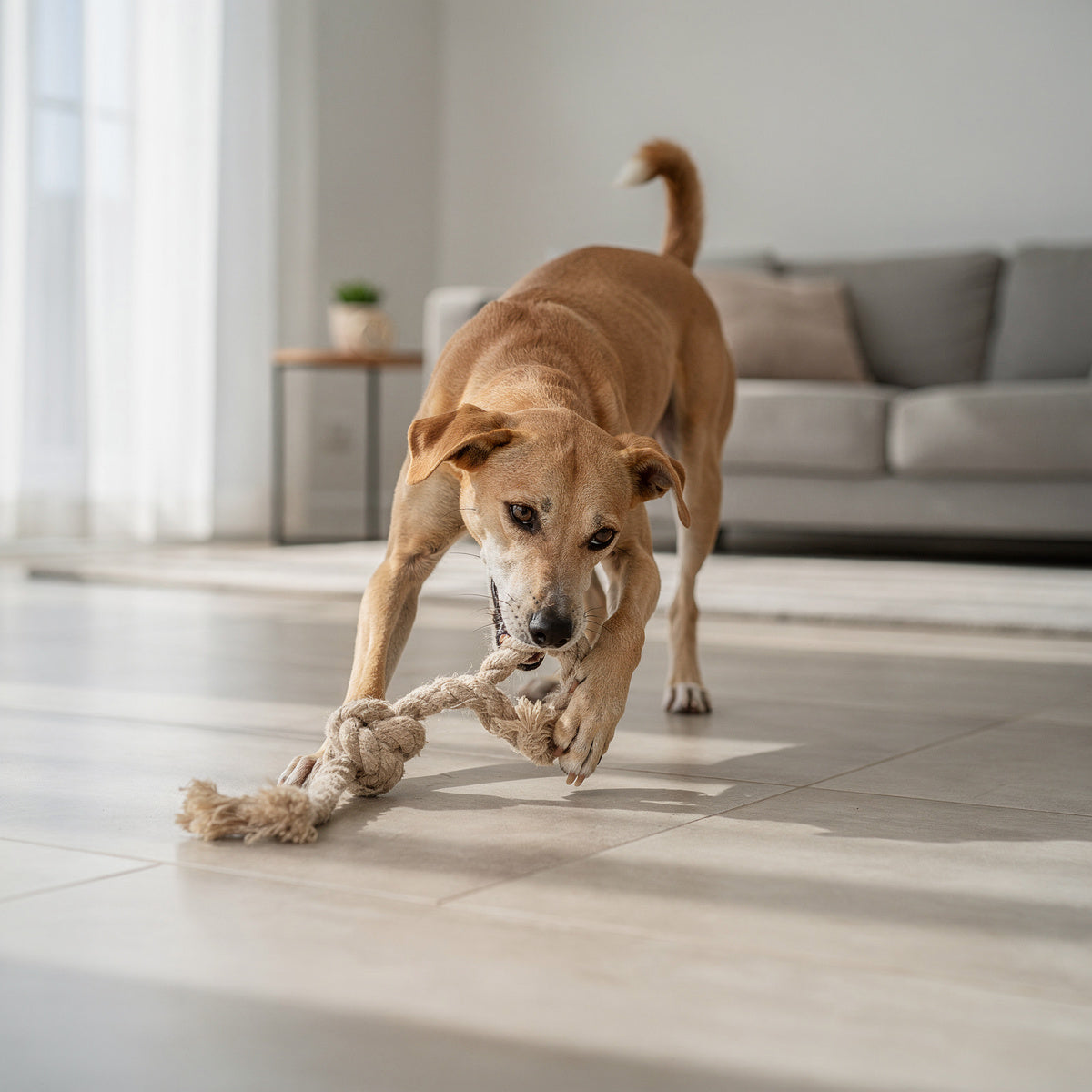
Look for natural rubber fetch toys or thick braided rope tugs that won't fray immediately. Tug games are actually excellent for high-drive dogs because they include you in the play — which burns mental energy alongside physical. A solo fetch toy is fine, but a tug session with a real back-and-forth gives your dog social engagement too.
One thing we tell customers: if your dog is destroying every toy within a day, they're not being bad — they're under-stimulated. Physical toys should be part of a bigger routine, not the whole answer.
Curious, Problem-Solving Dogs: Puzzle Feeders Are Worth Every Rupee
Some dogs aren't wild about physical play but will spend 20 focused minutes working a puzzle feeder. These are usually the dogs that figure out how to open cabinets, watch you closely when you're cooking, or learn commands unusually fast. Border Collies are the famous example, but plenty of mixed-breed Indian dogs have that same working-dog brain that needs a job.
Treat-dispensing puzzle toys — where the dog has to slide, flip, or roll pieces to get kibble out — are genuinely tiring for these dogs in a way that a walk sometimes isn't. We had a customer last month with a 3-year-old Beagle in a Gachibowli apartment who was chewing furniture out of boredom. She switched to feeding half his daily meals through a puzzle feeder, and the chewing stopped within two weeks. That's not magic, that's just a dog whose brain finally had something to do.
Start with a Level 1 or Level 2 puzzle if your dog hasn't used one before. If it's too hard immediately, they'll get frustrated and give up — you want them to succeed first, then make it harder.
Gentle, Low-Key Dogs: Plush Toys for Comfort, Not Combat
Not every dog wants to chase or solve problems. Some dogs — older rescues, anxious dogs, certain small breeds — mostly want a soft companion to carry around or sleep next to. These dogs often adopt one plush toy and treat it like a puppy. If your dog does this, lean into it.
The mistake people make is buying a plush toy and then worrying when the dog doesn't throw it in the air or squeak it constantly. That's not what this dog wants from the toy. They want to hold it, carry it, sleep on it. That's completely valid play behavior, and it's usually a dog that's found a way to self-soothe.
If your dog is a gentle player, check out our dog product range — we stock a few plush toy options alongside harder-wearing alternatives so you can find what suits your dog's temperament without buying five wrong things first.
Dogs With Strong Prey Drive: Motion Is Everything
Sighthounds, Dobermanns, and plenty of Indie dogs have prey instincts that make them respond to movement more than anything else. A static toy does nothing for them. But the second something moves unpredictably — a flirt pole, a toy on a string, a crinkle toy that skitters across the floor — they're locked in.
Flirt poles are probably underused in India. They look like a giant cat wand — a long stick with a rope and a toy on the end — and you can give a prey-driven dog a serious workout in a small apartment corridor or on a balcony. Five minutes on a flirt pole is the equivalent of a 20-minute walk for a lot of these dogs.
One warning: prey-drive play should always end with the dog catching and holding the toy for a few seconds. If you always end the game with the dog not catching it, you're building frustration. Let them win sometimes.
What About Rotating Toys?
This is one of the cheapest things you can do to keep toys feeling new. If your dog has access to all eight of their toys constantly, every single one becomes boring background noise. Pack away six of them and leave two out. Swap them every few days. The toys don't change, but they feel novel again to the dog because they haven't seen them for a while.
It's a trick that actually works, and we've had customers come back saying it saved them from buying more toys when they had plenty — they just needed to manage access better.
Size and Safety — This Part Isn't Optional
A toy that's too small for your dog is a choking hazard. Full stop. If you have a large-breed dog — a Labrador, a German Shepherd, a Husky — the small rubber balls sold for Rs. 50 at general pet shops are genuinely dangerous. They can be swallowed or lodged in the throat. Size the toy to the dog's mouth, not the dog's age or weight alone.
Also check toys regularly. Rope toys fray, plush toys get eyes and noses chewed off, rubber toys develop cracks. Once a toy is in pieces, it comes out of rotation. A shredded rope toy becomes a hazard if your dog eats the fibers.
For dogs that are still working through leash manners on walks — which is often where high-energy and prey-drive dogs cause the most stress for owners — a proper harness makes those outdoor play sessions safer for everyone. Our no-pull harness collection is worth a look if your dog is a puller during fetch time in the park.
Building a Simple Toy Kit for Your Dog
You don't need 20 toys. You need maybe four to six across different categories, rotated well. A fetch toy for physical days. A puzzle feeder for mental days. A tug toy for play sessions with you. A plush or comfort toy for downtime. That covers most dogs across most moods.
If you're not sure where to start, come into the store and tell us about your dog — their age, breed, energy level, what they've responded to before. We'll point you toward something that actually makes sense rather than just what's selling. And if you want to browse first, our full dog products collection has the categories broken out so you can explore by type.
FAQs: Dog Toys in India
My dog destroys every toy in minutes. What should I buy?
Heavy chewers need toys rated for power chewers specifically — thick natural rubber, solid rubber Kongs, or heavy-duty nylon chews. Avoid rope toys and plush entirely until you find something they can't immediately demolish. Also consider whether your dog is actually under-exercised; destruction often correlates with pent-up energy more than jaw strength alone.
Are puzzle feeders suitable for Indian summer? My dog barely wants to eat in the heat.
Hyderabad summers genuinely suppress appetite in dogs, so this is a real concern. If your dog is eating less during peak heat (April-June), don't force puzzle feeder sessions with dry kibble — they'll disengage. Try them in the early morning or after 7 PM when it's cooler, or use small high-value treats instead of regular kibble to maintain motivation.
My dog ignores all toys. Is something wrong?
Usually not. Some dogs — especially rescues who spent time on the street — never learned to play with objects as puppies. That window is easier to develop young but not impossible later. Start with food-motivated play rather than toys: hide treats under cups, use a snuffle mat, hand-feed meals. Once they're engaged with food games, you can slowly introduce toys that have food hidden inside them.
How many toys does a dog actually need?
Honestly, four to six is plenty if you rotate them. More than that and the dog often pays attention to none of them. Focus on quality and variety across play types rather than volume. One good puzzle feeder, one durable fetch toy, one tug rope, and one comfort plush covers most dogs well.