How to Pick the Right Toys for Your Cat's Play Style
Not every cat plays the same way, and buying the wrong toy is a mistake we see constantly at our Gachibowli store. Here's how to match the toy to your cat's actual personality.
Here's something we notice almost every week at our store in Gachibowli: a customer walks in, picks up a feather wand, goes home, and comes back three days later because their cat completely ignored it. Then we ask a few questions, and it turns out their cat is a 6-year-old Persian who has never chased anything in his life and would much rather bat at something on the floor. Wrong toy, wrong cat. Happens constantly.
Choosing cat toys isn't about what looks fun to you. It's about reading what your cat actually does with her time and matching the toy to that behavior. Get it right, and playtime becomes the best part of her day. Get it wrong, and you've got an expensive toy collecting dust under the sofa.
Why does my cat ignore the toys I buy?
Cats are not indifferent creatures by nature. They're actually wired to hunt, stalk, pounce, and problem-solve. When a toy gets ignored, it usually means it isn't triggering any of those instincts. A ball that just sits there does nothing for a cat who needs movement. A crinkle toy means nothing to a cat who hunts by sight rather than sound.
The first thing to do is watch your cat for a few days without trying to play with her. Does she stalk the ceiling fan? She's a visual hunter. Does she paw behind the TV cabinet for no apparent reason? She likes to fish things out of tight spaces. Does she carry her plush mouse around in her mouth and drop it at your feet? She's a retriever type, which honestly surprises most people because they think only dogs do that. Knowing what she does naturally tells you exactly what kind of toy will hold her attention.
Matching toys to the four main cat personalities
Most cats fall into one of four broad play types, though plenty of cats are a mix. Think of these as starting points, not fixed categories.
The Active Hunter: This is the cat who darts across the room at full speed, leaps off furniture, and treats every moving thing as fair game. In Hyderabad apartments, these cats are the ones knocking things off counters at 2 AM. For this type, feather wands, motorized toys that move unpredictably, and laser pointers are excellent choices. The key is unpredictable movement. Steady, predictable motion bores them fast. Vary the speed and direction when you play, and give them a physical toy to actually catch at the end of a laser session so they don't feel frustrated.
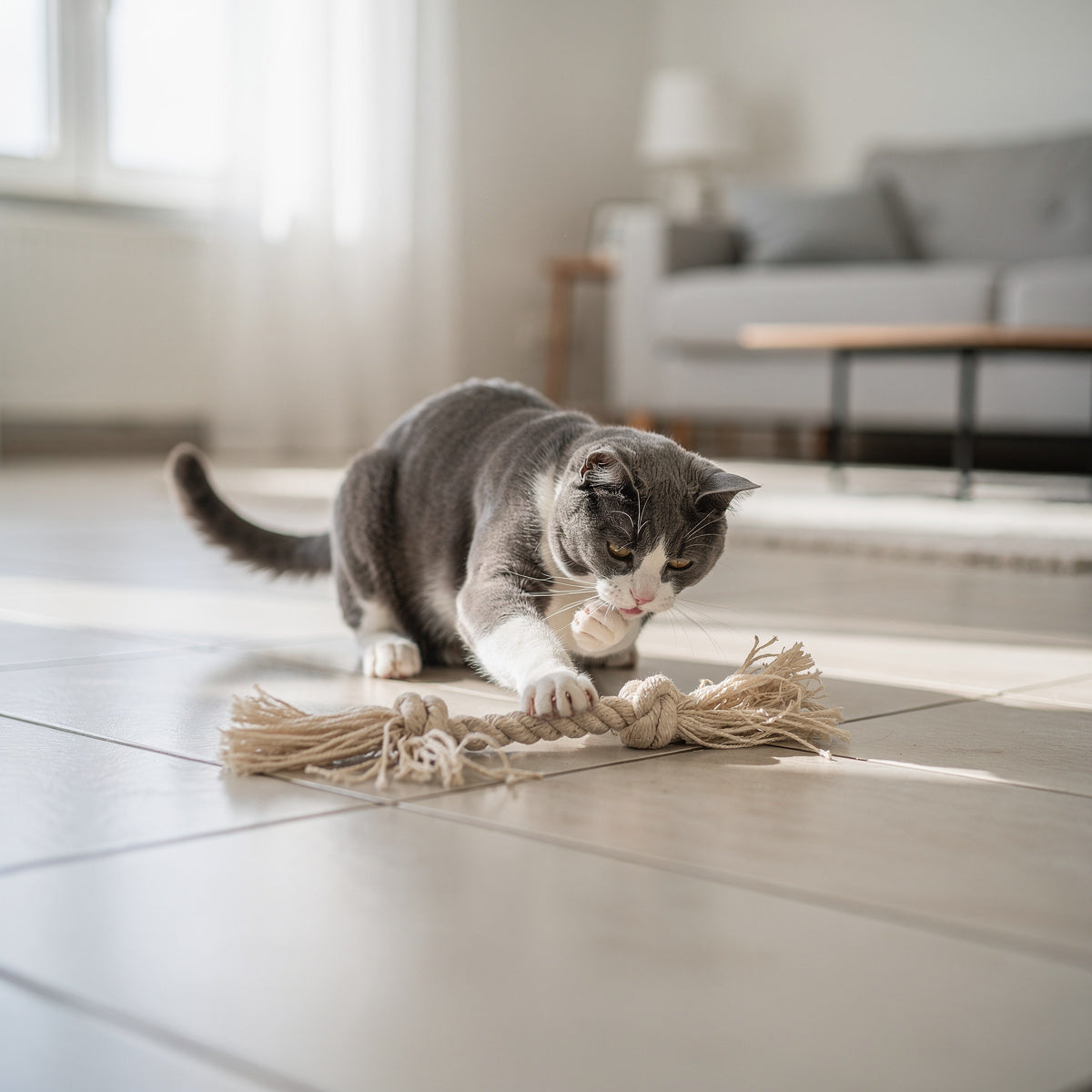
The Problem Solver: Some cats are less interested in sprinting and more interested in figuring things out. They'll sit and study a puzzle feeder for ten minutes before attempting it. They tend to be calmer cats, often indoor breeds like British Shorthairs or older cats who've slowed down physically. Treat-dispensing toys and multi-level puzzle feeders work brilliantly here. You can also hide small pieces of kibble around the house to turn their entire environment into a game. We've seen customers with indoor cats in Kondapur and Manikonda report that puzzle toys genuinely calmed down stress behaviors like over-grooming.
The Ambush Predator: This cat doesn't chase. She waits. She'll crouch behind the sofa and explode outward the moment something moves past her. For this type, toys that move along the ground work better than aerial toys. Wand toys dragged slowly along the floor, remote-controlled mice, and crinkle balls rolled across hard floors are ideal. These cats often love the fishing-rod style toys where you can flick the feather just within reach and then pull it away.
The Comfort Seeker: Not every cat wants high-intensity play, and that's completely fine. Senior cats, recently rescued cats still adjusting to your home, and some naturally gentle personalities prefer soft plush toys they can carry, knead, or sleep next to. Catnip-infused plush toys are particularly good here because they encourage gentle interaction without demanding physical exertion. These cats still need stimulation, just delivered more quietly.
Does my cat's age change what toys she needs?
It absolutely does. A 4-month-old kitten will go absolutely berserk with almost anything that moves, so variety matters more than specificity at that stage. By the time your cat is 2 to 5 years old, her preferences become clearer and she'll show you what she likes if you pay attention. After 8 or 9 years, most cats slow down physically, but mental stimulation becomes more important, not less. Puzzle feeders and gentler wand toys keep older cats sharp. We've had customers tell us their senior cats showed renewed interest in play after we suggested switching from fast-moving toys to slow, ground-level ones.
One thing we always tell people with kittens: rotate the toys. Cats habituate quickly. A toy that was fascinating on Monday becomes furniture by Friday. Pull it away for a week and reintroduce it, and often the excitement comes back. This works particularly well with feather wands and catnip toys.
A few practical things worth knowing before you buy
Safety matters more with cat toys than people realize. Cats chew. Check that any feathers, strings, or small attachments are secured well and can't be swallowed. Ribbon toys and string toys should only be used during supervised play sessions, never left out when you're not around. We've seen cats in our grooming sessions with digestive issues traced back to swallowed toy parts, so this isn't us being overly cautious.
For households with multiple cats, buy more toys than you think you need. Cats are territorial about play resources. One wand toy between three cats will cause more tension than fun. Each cat ideally has her own set, and puzzle feeders should be placed in separate spots so the dominant cat can't monopolize all of them.
Also, don't underestimate the value of your own involvement. Electronic toys are convenient, but ten minutes of you actually playing with a wand toy is worth more to most cats than an hour of a motorized gadget. The interaction is part of what makes it meaningful for them. Browse our full range of cat products at Cuddle Paws, where we stock toys across all these play types and can help you pick based on what your cat is actually like.
What about indoor cats in Hyderabad apartments?
This is a real concern for a lot of our customers in Gachibowli and the surrounding IT corridor. Cats in apartments don't get the natural enrichment that outdoor access provides, which means boredom-related issues like furniture scratching, excessive meowing, or attention-seeking behaviors are more common. Good toys genuinely help offset this, but the goal is to simulate what outdoor life provides: the stalk, the chase, the catch, the chew.
Vertical spaces matter too. A cat who can climb has an outlet for energy that floor toys alone can't provide. Combine a good cat tree with the right toys for her play style, and you've addressed most of the enrichment gap. If you're unsure where to start, come into the store and tell us about your cat's daily behavior. We ask the same questions every time: how old, what breed or mix, indoor only or some outdoor access, and what has she responded to before. Those four answers tell us almost everything we need to point you toward something that'll actually work.
For cats that need comfort alongside stimulation, a well-chosen cat bed placed near her favorite play zone gives her a safe retreat to decompress after active sessions, which is more important than it sounds for cats who get overstimulated easily.
Frequently Asked Questions
My cat plays for 2 minutes and then walks away. Is that normal?
Yes, completely. Cats hunt in short bursts in the wild, so natural play sessions are brief. Three to five minutes of intense play is a full session for many cats. The goal is multiple short sessions through the day, not one long one. If she's walking away even sooner, the toy might not be matching her play style, or she may need a rest day between sessions.
Are laser pointers safe for cats?
They're fine as long as you end every session with a physical toy for your cat to actually catch. Laser pointers that never give the cat a tangible "kill" can create frustration over time. We recommend finishing with a treat or a soft toy she can bite and kick. Never shine the laser directly in her eyes.
My cat is older and doesn't seem interested in play anymore. Should I be worried?
A gradual reduction in play energy is normal as cats age, but a sudden, sharp drop in interest can sometimes indicate pain or illness, especially joint pain. If your senior cat who used to play daily has stopped entirely, a vet check is worth doing. A vet can help rule out anything physical. If she gets a clean bill of health, try gentler toys closer to the ground and shorter sessions.
Can I make DIY cat toys at home?
Absolutely, and cats often love them. A scrunched-up piece of paper, a cardboard box with holes cut in it, or a piece of string tied to a pencil can all be brilliant. The limitation is durability and safety. DIY toys tend to fall apart faster, and loose threads or small pieces can be swallowed. Use them for supervised play and swap them out before they start breaking down.