Fun Games to Play With Your Kitten at Home
A bored kitten will find her own entertainment — and you probably will not like what she picks. Here is how to keep her happy, active, and out of trouble with the right games and toys.
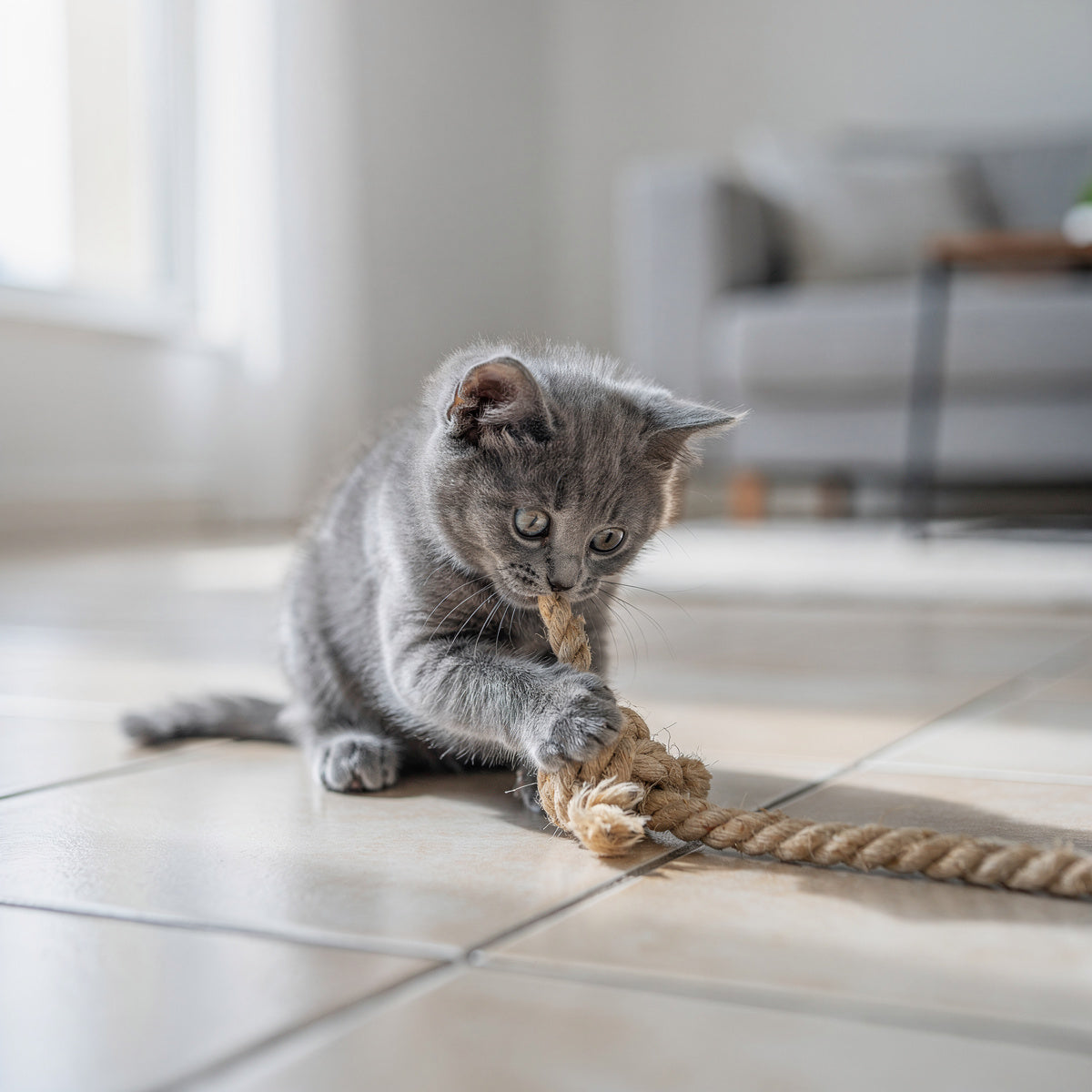
Kittens do not need much to have a good time — but they do need the right kind of stimulation. A bored kitten will find her own entertainment, and trust us, you will not enjoy what she picks. Curtain climbing, wire chewing, knocking your coffee off the table at 2 AM. We have heard every story. The good news is that keeping a kitten mentally and physically engaged is not complicated. You just need to know what actually works.
We see a lot of kittens come through Cuddle Paws Co in Gachibowli — customers bringing in their new furry additions from the neighbourhood, from breeders, sometimes rescued from the IT park parking lots nearby. One of the first things we tell every new kitten parent is this: play is not optional. It is how kittens process their world, burn off energy, and build a bond with you. Think of it less like entertainment and more like daily care.
Why do kittens need so much playtime?
Your kitten is, at her core, a small predator. Every stalk, pounce, and ambush you see is her rehearsing skills that are hardwired into her biology. In the wild, a cat who does not practice hunting does not eat. Your kitten is not hunting for survival, of course, but those instincts are still very much switched on. When she does not get an outlet for them, that energy gets redirected — sometimes destructively.
In Hyderabad's apartments, especially in the compact 2BHK setups common around Gachibowli and Kondapur, kittens have limited space to run. That makes intentional playtime even more important. Two focused play sessions a day — 10 to 15 minutes each — can make a dramatic difference in how settled and well-behaved your kitten is the rest of the time.
What are the best toys to use when playing with a kitten?
Wand Toys and Feather Teasers
If you only ever buy one kitten toy, make it a wand or teaser. These are long sticks with a string attached, usually ending in feathers, a soft toy, or a crinkle material. What makes them so effective is that you control the movement, and movement is everything to a kitten. Drag it slowly across the floor like an injured mouse. Flick it behind the sofa and back out again. Let her almost catch it, then pull it away at the last second. You will see her entire body language shift — low to the ground, pupils wide, that characteristic tail twitch before she launches.
This kind of play also keeps you as the handler safely out of the equation. When kittens play with bare hands, they learn that hands are prey. That is a habit you do not want to build. A wand toy creates clear separation between the toy and you.
Small Balls and Rolling Toys
Kittens are obsessed with anything that moves unpredictably, and a small ball on a hard floor does exactly that. Mylar crinkle balls are a favourite — they make a sound when touched and feel strange under her paws, which kittens find irresistible. Plastic balls with a bell inside work well too. Some cats will actually fetch these and bring them back to you, which is always a delightful surprise.
If your kitten has figured out fetch, lean into it. It is great exercise and one of the nicer ways to interact with a cat without needing constant physical contact, which some kittens are not immediately comfortable with.
Catnip Toys — But Not Yet, If She is Very Young
Catnip gets a lot of attention, and it is genuinely interesting to watch a cat respond to it. The active compound in catnip causes a short, harmless neurological reaction — rolling, rubbing, sudden zoomies, or sometimes just flopping down and looking blissed out. It is perfectly safe and wears off in about 10 to 15 minutes.
Here is what most people do not realise though: kittens younger than four to six months generally do not respond to catnip at all. Their sensitivity to it develops with age. Even among adult cats, only about half are actually reactive. So if you give your three-month-old kitten a catnip toy and she ignores it completely, that is entirely normal. Try again at six months.
Puzzle Feeders and Interactive Toys
These are underused in India, which is a shame because they are brilliant for solo play. A puzzle feeder is a toy where your kitten has to figure out how to get kibble or treats out — by sliding panels, batting at compartments, or fishing through holes. It turns mealtime into a game and keeps her occupied for a surprisingly long time.
We have recommended these to customers who work long hours in the tech offices nearby and feel guilty leaving their kitten alone. A good puzzle feeder gives her something to do and slows down fast eaters, which is a bonus. You can check out our cat products collection to see what enrichment and feeding options we currently carry.
Scratchers — Not a Toy, But Essential Anyway
Scratching is not misbehaviour. It is how cats shed the outer layer of their claws and leave scent marks. The question is never whether your kitten will scratch — she will — but where. A good scratcher gives her an approved surface and saves your furniture in the process.
Flat cardboard scratchers are cheap and most cats love them. Taller sisal posts work better for cats who prefer to scratch while fully stretched out, which is actually more satisfying for them physically. Some scratchers have hanging toys attached, which bridges the gap between scratching and play nicely. If you are setting up a proper space for your kitten, a cat tree with an integrated scratcher is worth the investment.
Can I use a laser pointer with my kitten?
Yes, and most kittens go absolutely wild for them. A laser pointer is fantastic exercise — the movement is unpredictable, fast, and triggers that chase instinct immediately. The one thing to keep in mind is to always end a laser session with a physical toy she can actually catch. A kitten who spends 10 minutes chasing a dot she can never catch can end up frustrated. Finish with a wand toy or a ball she can grab, and she walks away satisfied rather than wound up.
Never point the laser at her eyes, obviously. Keep it low on the floor and walls.
What household items should I keep away from my kitten during play?
This one matters. Kittens are attracted to things that should absolutely not be toys — rubber bands, string, ribbons, foil, plastic bags, small buttons, hair ties. These things are interesting to her for the same reason a wand toy is: they move, they crinkle, they feel strange. But if she swallows any of them, you are looking at a potential blockage, which is a surgical emergency.
Electrical cords are another hazard that is easy to overlook. A kitten who starts chewing on charger cables or power cords is not being naughty — she is just being curious — but the consequences can be severe. Cord protectors are inexpensive and widely available. If your kitten has taken an interest in your cables, sort that out before something goes wrong.
The general rule: if it is small enough to swallow or could shock her, it is not a toy.
How do I know if my kitten is getting enough play?
A well-played kitten is a calm kitten. After a good session, she should be visibly tired — grooming herself, finding a spot to nap, generally settling. If she is tearing around the house at midnight, climbing things she should not, or attacking your ankles constantly, that is her telling you she has energy left over.
Play sessions work best right before feeding time. It mimics the hunt-catch-eat sequence cats naturally follow, and it sets her up to eat and then sleep. Morning and evening sessions tend to work well for most households.
As she grows, you will find the toys she responds to most strongly. Some cats are wand fanatics. Others live for balls. A few will happily entertain themselves with a paper bag for an hour. Pay attention to what makes her light up and build your playtime around that. And if you want to browse what we have in stock — including interactive toys, scratchers, and more — our cat products collection is a good place to start. If you have questions about what is right for your kitten's age and size, come see us in store or get in touch — we are happy to help.
Frequently Asked Questions
At what age can I start playing with my kitten?
From the day you bring her home. Even very young kittens around 6 to 8 weeks old respond to gentle wand play. Keep sessions short — 5 minutes is enough at that age — and always let her set the pace. If she walks away, the session is over.
My kitten only plays at night and disturbs my sleep. What should I do?
This is extremely common and it drives people mad. Kittens are crepuscular — naturally more active at dawn and dusk. The fix is to do a solid play session right before your bedtime, followed by a meal. A kitten who has hunted, eaten, and groomed will usually sleep. If she still wakes you up, consider a puzzle feeder left out overnight so she has something to do when the zoomies hit.
Can Indian cats eat catnip? Is it safe?
Yes, catnip is safe for cats regardless of breed, including Indian desi cats. The reaction is temporary and harmless. As mentioned, not all cats respond to it — roughly half do not — so do not worry if yours shows no interest at all. It is not a sign anything is wrong.
My kitten has started biting my hands during play. How do I stop this?
Stop the play session immediately and walk away. No yelping, no scolding — just total disengagement. Kittens learn fast that biting ends the fun. The bigger fix is to never use your hands as toys in the first place. Always have a wand toy or ball between your hand and her teeth. This is one of those habits that is much easier to prevent than to undo once it is established.