Your Dog's Medicine Never Goes On Sale. Its Food Always Does.
We priced all 5,144 pack sizes in our catalogue against their printed MRP. Food discounts 10%. Veterinary medicine discounts 2%. Here is why.
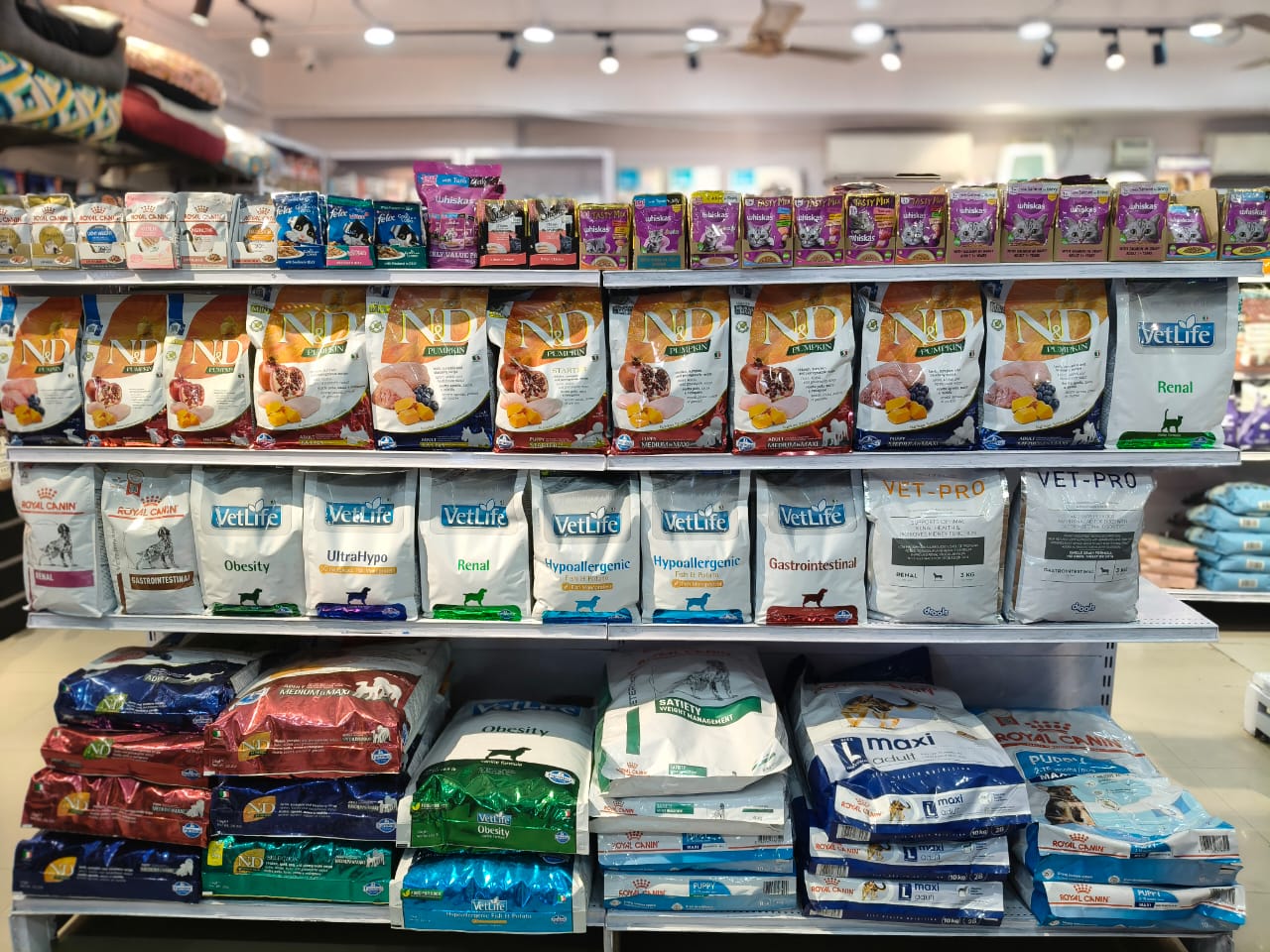
What 5,144 prices from one Indian pet shop show about where the discounting happens.
Every product in an Indian pet shop carries a printed maximum retail price. What it actually sells for is a different number, and the gap between the two is not spread evenly. We pulled every active line in our own catalogue — 3,777 products, of which 3,335 carry a manufacturer's MRP across 5,144 individual pack sizes — to see where it goes.
The answer was not the one we expected.
Medicine holds its price. Everything else does not.
| Category | Lines with an MRP | Median discount |
|---|---|---|
| Dry and wet food | 2,446 | 10.0% |
| Veterinary pharmacy | 1,109 | 2.0% |
| Grooming | 492 | 12.0% |
| Collars, bowls, beds, litter | 476 | 12.0% |
| Toys | 344 | 12.7% |
| Treats | 141 | 12.0% |
Across every non-medical category the discount clusters between 10% and 13%. In the pharmacy it collapses to 2%. In practice that means a ₹122 wound powder sells at ₹120, a ₹1,500 flea tablet at ₹1,470, a ₹188 antiseptic spray at ₹185 — token reductions rather than discounts.
That is worth knowing before you spend an evening comparing prices. Shopping around on your dog's tick tablet will save you about two percent. Shopping around on its food will save you ten. The effort is better spent on the bag. If you want the arithmetic done for you, our pet food cost calculator prices 479 dry foods against each manufacturer’s own feeding chart.
Why the two behave differently
Pet food is where shops compete. It is what brings people through the door, it is bought again every few weeks, and every shop knows what every other shop charges for the common bags. That pushes the price down until the category becomes a volume business.
Veterinary medicine is not bought that way. It is bought because an animal is ill, usually today, usually on a vet's instruction, and usually without a second quote. There is no comparison shopping to respond to. Prices sit close to where the manufacturer put them.
There is a further reason, and it matters more than margin. A pet pharmacy is not a shelf you can simply decide to stock. Much of what sits on it is prescription-only: of our own range, 189 lines across 22 molecules are Schedule H drugs — among them tramadol, an opioid analgesic; cyclosporine and oclacitinib, immunosuppressants; and pimobendan and benazepril for cardiac patients. Those legally require a registered veterinarian's prescription in India. Most pet shops have no veterinarian on site to write one, which limits who can carry the range at all.
What that says about a pet shop
The Indian pet market is usually written about as a premiumisation story about food. Priced line by line, a shop looks less like that and more like a healthcare business with a food aisle attached.
More than a fifth of the priced pack sizes in this catalogue are pharmacy — 1,109 of 5,144. They are the lines that hold their price, they are the ones that need a prescription and a veterinarian, and they are the hardest part of the range for a competitor to copy. Anybody can stack the same bags of kibble.
Method, and what this cannot tell you
Every figure comes from one retailer's live catalogue on 28 September 2026 — all 3,777 active products and every pack size, with no sampling. "Discount" is the gap between the manufacturer's printed MRP and our own selling price, which means half of every number here is our own pricing decision, not the market's. A different shop would produce different figures.
So this is one observation of the spread between printed MRP and street price, not a survey of Indian pet retail. It cannot tell you what any brand's margin is, and nothing here suggests any manufacturer sets its MRP improperly. What it can show, because it is a complete catalogue rather than a sample, is how differently one shop's categories behave — and a five-fold gap between medicine and everything else is too large to be an accident of which products we happen to stock.
The underlying figures are available to any journalist who would like them.
Cuddle Paws Co is an independent pet store and veterinary clinic in Gachibowli, Hyderabad. Data compiled 28 September 2026. Reviewed by Dr Rafi Suhail, resident veterinarian.